
Steel Pipe Price Trends: Separating Mill Prices from Landed Costs
Steel Pipe Price Trends: Separating Mill Prices from Landed Costs
A lower mill quote does not always mean a lower steel pipe purchasing cost. For procurement teams tracking the steel pipe price trend, freight, processing, duties, exchange rates, and delivery terms can change the final landed cost—and reverse an apparent saving. Understanding where mill pricing ends and import expenses begin is essential for comparing suppliers fairly and protecting project budgets.
The practical question is not simply whether steel is getting cheaper. It is whether the same pipe, delivered to the same location, on the same commercial basis, will cost less when you actually need it. Those are different questions, and they require different evidence.
A market price is a reference, not your purchase price
Steel market reports help identify direction, but a headline movement rarely transfers directly into a finished pipe quotation. Welded pipe is exposed to strip or coil costs, while seamless pipe has a different production route involving billet, piercing, and subsequent processing. A general steel index can therefore move before, after, or differently from the product you buy.
Even within one category, grade, outside diameter, wall thickness, heat treatment, testing, and order quantity change the price. A stocked commercial size and a small production run with tight dimensional tolerances do not respond identically to a softer raw-material market. In the second case, setup and processing costs may remain largely unchanged.
A useful trend tracker keeps the specification constant. Record dated quotations for the same grade, dimensions, delivery condition, quantity, currency, and delivery term. If one of those changes, flag it rather than treating the new number as evidence that the market has risen or fallen.
This also explains why a mill may resist a price reduction while a broad index falls. Its available stock, production schedule, or input purchasing position may not reflect that movement yet. Ask what changed in the quotation instead of assuming every difference is negotiable margin.
Define where the quotation stops
“Mill price” is an informal description, not a complete delivery obligation. It may refer to an ex-works offer, a domestic delivered price, or simply the material component before export preparation. Before comparing suppliers, establish the named place or port and the applicable Incoterms® rule and version.
EXW, FCA, FOB, and CIF quotations do not cover the same responsibilities. FOB and CIF are intended for sea and inland waterway transport; FCA may be more appropriate for containerized shipments handed over before vessel loading. The right choice depends on the actual handover arrangement, not the abbreviation most familiar to the purchasing team.
A CIF quotation should not be read as a warehouse-delivered price. Although the seller arranges carriage and insurance to the named destination port, import clearance, duties, and onward delivery generally remain outside that scope. Risk transfer also occurs before arrival. Confirm destination handling charges explicitly rather than assuming “freight included” covers every port invoice.
A practical landed-cost worksheet starts with the quoted goods price, then adds only the costs not already included: origin transport and export handling, freight and insurance, destination charges, customs brokerage, applicable duties, and delivery to the receiving facility. Keep recoverable import taxes separate from permanent costs, while still allowing for their cash-flow impact.
Do not add an estimated freight allowance to a quote that already includes freight. Double-counting is surprisingly easy when purchasing, logistics, and finance maintain separate spreadsheets.
Freight can move against the steel market
A declining steel pipe price trend can coincide with a higher delivered purchase price if shipping becomes more expensive or less efficient. Freight depends on the route, sailing availability, equipment, shipment size, and cargo characteristics—not just steel demand.
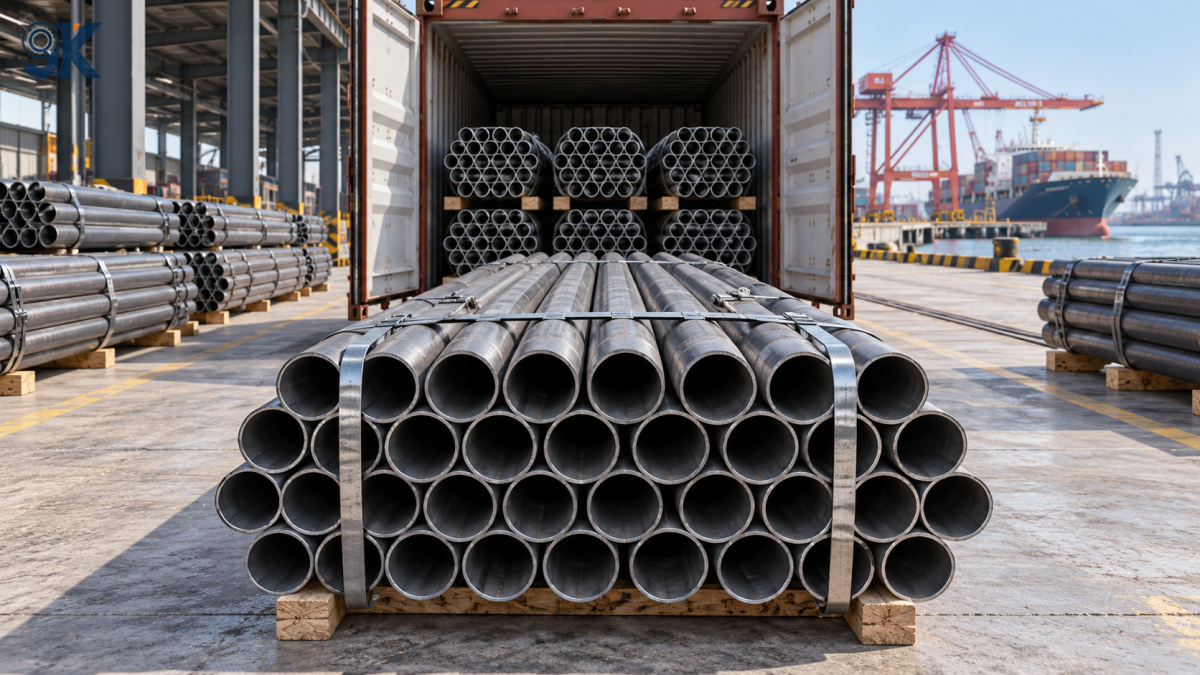
Pipe creates a particular loading problem: it can be heavy, bulky, or both. Small-diameter thick-wall pipe may reach payload limits before using the available space. Large-diameter thin-wall pipe may consume space first. Length, bundle geometry, and handling requirements can further restrict loading. A freight estimate based only on total tonnage misses those differences.
FCL, LCL, and bulk shipping each involve trade-offs. LCL can make a trial order possible without filling a container, but consolidation, handling, and destination charges need close review. FCL offers more control over loading, although a lightly loaded container can carry a high freight cost per tonne. Bulk shipping requires its own assessment of parcel size, handling facilities, and schedule suitability.
For Shandong-origin supply, compare routings through Tianjin, Qingdao, and Rizhao on total cost and workable departure dates. The lowest ocean rate may be offset by inland haulage or an inconvenient sailing. Ask for a proposed loading plan and freight validity before using a logistics estimate to approve a purchase.
Processing and usable yield can outweigh a cheaper tonne
Machinery manufacturers often buy pipe as an input to a finished component. In that setting, purchase price per tonne is only one measure. Cutting, straightening, machining allowance, inspection, and rejected material all affect the cost of usable parts.
Consider a buyer comparing standard mill lengths with cut-to-length supply. Standard lengths may carry the lower material quote, yet require local cutting, create offcuts, and consume handling time. Supplier cutting may reduce those burdens, but it also adds processing charges and makes drawing accuracy more important. Neither option is automatically cheaper.
Compare the delivered cost per accepted component when the application justifies it. Confirm cut-length tolerances, end condition, surface requirements, and inspection scope before making that calculation. Also establish whether invoicing uses actual or theoretical weight; otherwise, two apparently identical per-tonne offers may not produce equivalent invoices.
Mixed-material orders need separate treatment. If a project also includes Galvalume steel sheet , keep its price analysis separate from the pipe basket. Coating requirements, packaging protection, and loading arrangements differ. Shared freight may help, but only if the packing plan protects both products and the allocation method is clear.
Duties and currency can reverse the comparison
An import duty estimate is not reliable without the product description, origin, and destination. Classification can depend on whether pipe is welded or seamless, its material composition, dimensions, and other relevant characteristics. Trade remedies may also apply to particular product scopes and origins.
Have the importer or customs broker verify classification and current treatment before the order is committed. A supplier’s suggested tariff code can support the review, but it should not replace destination-side confirmation. Avoid building a budget around a generic “steel pipe duty” percentage.
Currency introduces another timing issue. A dollar quotation may remain unchanged while its cost in the buyer’s accounting currency rises. Deposits, balance payments, and logistics invoices may fall on different dates, so converting the entire purchase at today’s spot rate can understate exposure. Use the treasury-approved budgeting rate and identify which payments remain exposed.
These items deserve separate lines in the worksheet. If they disappear inside a general contingency allowance, it becomes difficult to explain whether a budget variance came from steel, shipping, taxation, or exchange rates.
Read the trend against your delivery window
Without dated quotations and current route information, a broad claim that pipe prices are “rising” or “falling” is not enough to support an order decision. Track three timelines together: material-price validity, production readiness, and the expected shipping window. They rarely remain aligned for long.
Waiting for a lower mill quote can make sense when specifications are standard, inventory is adequate, and delivery dates are flexible. It is less attractive when the order requires a production slot, special testing, or machining before assembly. A small material saving can be outweighed by expedited freight or a disrupted manufacturing schedule.
For repeat demand, staged purchasing may reduce dependence on a single market entry point. The trade-off is more order administration and potentially less efficient shipments. Check whether call-off quantities preserve workable production batches and freight utilization before treating split orders as a risk-free solution.
Turn the next quotation into a comparable offer
An integrated supplier can help connect drawing requirements with processing and shipment decisions. Shandong Jiukai Metal Materials Co., Ltd., based in Shandong, combines custom production, deep processing, warehousing, logistics, and export customs clearance. For a machinery buyer, that service scope is useful when evaluating whether to ship standard lengths, processed blanks, or a small trial batch before a larger order.
The value still depends on a clear quotation. Before issuing the purchase order, request written confirmation of:
- The specification revision, manufacturing route, tolerances, testing, and weight basis.
- Included processing, packaging, documentation, and any separately charged inspection.
- The delivery rule, named place, quotation validity, and freight assumptions.
- Production lead time, shipment window, payment schedule, and treatment of later changes.
Then compare the offers at the same destination and on the same usable-quantity basis. If the cheaper quote remains cheaper after those adjustments, it is a credible saving. If it does not, the mill price was never the right number to approve.
Latest News
- How do iron ore prices affect steel pipe price trends?
- How do tariffs affect square tube export markets?
- How steel pipe price trends affect inventory valuation
- Steel pipe price forecast for 2026 amid changing raw material costs
- Square Tube Export News: What Buyers Should Watch in Freight and Supply
- What new trade investigations mean for steel pipe exports
Send Us A Message

