
News center
How do iron ore prices affect steel pipe price trends?
For steel pipe distributors, understanding the steel pipe price trend is essential to timing purchases, protecting margins, and managing inventory. Iron ore is a key raw material in steelmaking, so changes in its price can influence steel production costs and, eventually, pipe quotations. Yet the connection is rarely immediate or uniform. A distributor may see iron ore climb while pipe offers remain steady, or watch pipe prices rise even as ore retreats. The difference often lies in production methods, mill inventories, demand, and the costs of getting finished material to the customer.
The question is therefore not simply whether iron ore is up or down. It is whether a change in ore prices is strong and sustained enough to move steelmaking costs—and whether the pipe market can pass those costs along.
How iron ore prices move through the steel pipe supply chain
For many carbon steel products, the journey begins when iron ore is processed and used with coke in a blast furnace to produce hot metal. That metal is converted into steel, cast into forms such as slabs or billets, and then processed into the feedstock used by pipe manufacturers.
Welded pipe is commonly made from steel coil or plate that is formed and welded. Seamless pipe generally starts with a solid billet that is heated and pierced before further rolling and finishing. In both cases, the pipe manufacturer buys or produces an intermediate steel input rather than turning iron ore directly into finished pipe.
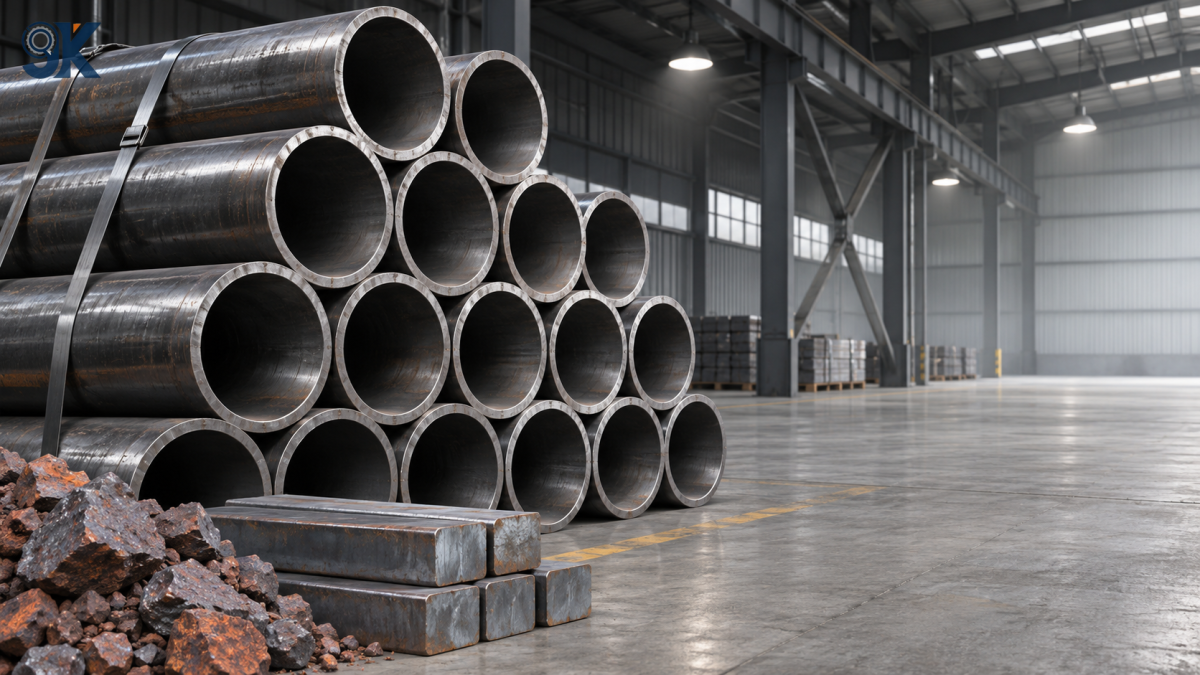
When iron ore becomes more expensive, blast-furnace steelmakers face higher raw material costs. If those costs remain elevated, mills may seek higher prices for coil, plate, or billet. Pipe producers can then face higher feedstock costs and adjust their quotations. The reverse can happen when ore costs fall, but only if lower costs make their way through each stage of the chain.
This transmission is less direct for steel made in electric arc furnaces, which often rely heavily on scrap, although some also use iron-based inputs such as direct reduced iron. In those markets, scrap availability, electricity costs, and the price of alternative metallic inputs may be more immediate influences than iron ore alone.
Why a change in iron ore does not produce an equal change in pipe prices
Iron ore is one input among many, not the entire cost of a pipe. Steelmakers also pay for fuel, energy, labor, maintenance, and transportation. Pipe manufacturers add forming or piercing, welding where applicable, heat treatment, inspection, finishing, packaging, and their own operating costs.
That means a percentage rise in iron ore should not be treated as an equivalent percentage rise in finished pipe. Even a substantial ore movement may have a smaller effect on the final quotation. Conversely, pipe prices may rise by more than the ore movement suggests if several costs increase together or buyers compete for limited production capacity.
Timing complicates the picture. Mills may be using raw materials purchased earlier, while pipe producers may hold coil or billet bought under previous contracts. Existing orders, stock levels, and quotation validity periods can all delay a price adjustment. The lag is not fixed: during a volatile market, suppliers may revise offers quickly; in a quieter market, the effect can take longer to appear.
The role of demand and margins
Cost pressure does not guarantee that a producer can charge more. If demand from machinery manufacturers, construction customers, or other pipe users is weak, mills and distributors may absorb part of the increase to keep orders moving. If demand is strong and available supply is tight, they may have more room to pass costs through.
The same principle applies when iron ore falls. A decline may support lower pipe prices, but strong orders, limited inventory, or high conversion costs can keep offers firm. For distributors, that distinction matters: waiting for the full benefit of a falling raw material price can mean missing a workable purchase window.
What can change the steel pipe price trend besides iron ore?
A useful market view compares iron ore with the specific inputs and conditions relevant to the pipe being purchased. Several signals deserve attention:
- Coil, plate, and billet prices: These are closer to the pipe producer’s purchasing decision than iron ore. For welded pipe, coil or plate movements can be especially relevant; for seamless pipe, billet availability and cost deserve close attention.
- Coking coal, scrap, and energy: Higher fuel or power costs can offset cheaper iron ore. Scrap prices are particularly important where electric arc furnace production has a significant role.
- Mill output and inventory: Maintenance, production restrictions, high stock levels, or tight supply can influence offers even when raw material costs are stable.
- End-user demand: Order patterns in machinery manufacturing and other consuming sectors affect how readily price changes are accepted.
- Freight and exchange rates: An export buyer’s landed cost can change because of ocean freight, local handling, currency movements, duties, or other import charges, even if the mill’s quoted price barely moves.
Specifications matter just as much as market direction. Diameter, wall thickness, grade, length, tolerances, surface condition, testing, and order quantity can all affect the price of a particular pipe. Two offers should not be treated as comparable until those details and their delivery terms are aligned.
Reading different market scenarios
Iron ore rises, but pipe offers stay flat. This may indicate weak demand, ample finished inventory, or mills using lower-cost material already in stock. It can also mean suppliers are reluctant to raise prices before competitors do. A distributor should watch whether coil or billet offers begin to move rather than assuming pipe prices will remain unchanged indefinitely.
Iron ore falls, but pipe offers remain firm. Producers may still be consuming expensive inventory, or other costs may have risen. Tight availability in a particular size or specification can also support prices. Ask suppliers whether the quote reflects current feedstock costs, limited capacity, or a product-specific requirement.
Both raw materials and pipe prices rise quickly. The immediate concern is margin exposure on open customer quotations. Check how long supplier offers remain valid and whether customer contracts leave room for a price adjustment. Buying everything at once can reduce the risk of further increases, but it also creates inventory risk if demand softens.
Prices fall across the chain. This may create an opportunity to replenish, particularly for frequently sold sizes. Still, a lower purchase price is not automatically a good buy if stock turns slowly, financing costs rise, or customers expect further reductions.
These are interpretive scenarios, not forecasts. A price chart can show direction, but it cannot tell a distributor how much stock customers will order next month or whether a particular mill has available capacity.
Carbon steel pipe and stainless products respond differently
Distributors handling multiple metal categories should avoid applying one raw material indicator to every product. Iron ore is relevant to steelmaking broadly, but stainless steel pricing can be strongly influenced by alloying elements, especially nickel and chromium, as well as scrap and production costs. The importance of each input varies by grade and market.
For example, a buyer comparing pipe market movements with the cost of 302 Stainless Steel Coil should also monitor the alloy market and the specifications of the material being quoted. A carbon steel pipe price trend is useful context, but it is not a reliable substitute for a stainless-specific assessment.
A practical buying framework for distributors
Market signals become more useful when they are connected to a purchasing decision. Before placing an order, separate what is known from what is merely expected.
- Track the relevant price chain. Compare iron ore direction with the coil or billet market, then check actual pipe offers for the sizes and grades you sell. A sustained move across several stages is generally more informative than a single daily change.
- Review your exposure. Identify fast-moving stock, customer orders already committed, quotation expiry dates, and material that may sit in the warehouse for a long time.
- Request comparable quotations. Confirm grade, dimensions, processing, inspection requirements, quantity, packaging, delivery point, currency, and validity. Clarify whether freight and other charges are included.
- Consider staged purchasing. Where supplier terms and customer demand allow, splitting an order can reduce reliance on one market entry point. It does not guarantee a lower average cost, and smaller lots may carry a higher unit or shipping cost.
- Recalculate landed margin. Include freight, import charges, local delivery, financing, storage, and an allowance for the time inventory may remain unsold. The cheapest mill quote is not always the lowest landed cost.
A simple internal record can make this process more consistent: note the date of each offer, its validity, relevant feedstock direction, estimated arrival date, and the customer demand it covers. Over time, this helps a purchasing team distinguish a meaningful market shift from a short-lived headline.
Questions to ask before accepting a pipe quotation
When the market is moving, a conversation about price alone can leave important risks unresolved. Ask whether the quoted material is available from stock or requires production, and whether the delivery schedule depends on feedstock availability. Confirm what happens if specifications change after the drawing or order is reviewed. For export orders, establish the agreed delivery terms and which party is responsible for customs documentation and transport arrangements.
Shandong Jiukai Metal Materials Co., Ltd. supports pipe buyers with drawing evaluation, specification selection, custom production, processing, warehousing, and export arrangements. For distributors weighing a larger replenishment order against a smaller trial, discussing the required dimensions, lead time, and shipment plan together can make quotations easier to compare. Depending on the order, shipment options include FCL, LCL, and bulk shipping through ports such as Tianjin, Qingdao, and Rizhao.
Iron ore remains a valuable early signal for the steel pipe market, particularly when higher or lower costs persist. The stronger buying decision, however, comes from following that signal through steel feedstock prices, pipe availability, customer demand, and landed costs. For a distributor, the goal is not to predict every turn; it is to understand which changes could affect the next quotation—and be ready to respond without losing sight of inventory and margin.
Latest News
- How do iron ore prices affect steel pipe price trends?
- How do tariffs affect square tube export markets?
- How steel pipe price trends affect inventory valuation
- Steel pipe price forecast for 2026 amid changing raw material costs
- Square Tube Export News: What Buyers Should Watch in Freight and Supply
- What new trade investigations mean for steel pipe exports
Send Us A Message

