
News center
How steel pipe price trends affect inventory valuation
A steel pipe price trend can affect more than purchasing budgets: it can also influence inventory values, reported margins, and working capital requirements.
For financial approvers in manufacturing, understanding these effects is essential when evaluating stock levels, procurement timing, and potential write-downs.
This article explains how steel pipe price movements relate to inventory valuation and highlights practical considerations for making informed purchasing and financial decisions.
The key distinction is that a market price change does not automatically change the value recorded on the balance sheet. Cost, accounting rules, and expected recoverability determine the outcome.
When does a steel pipe price trend change inventory value?
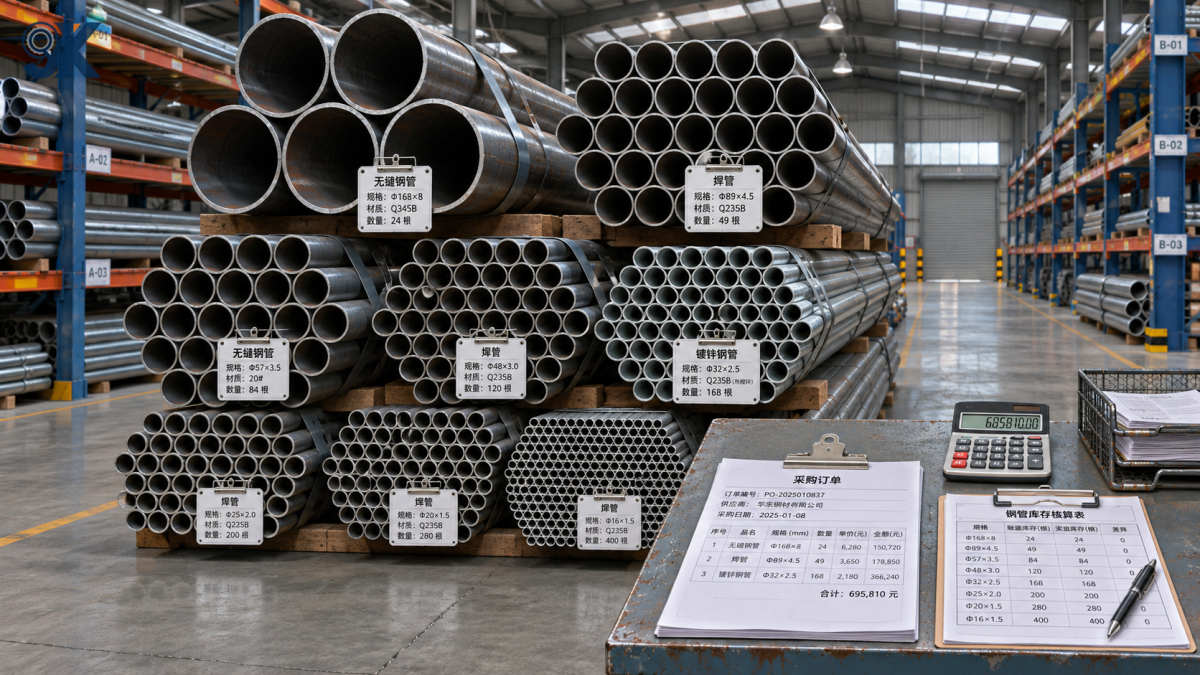
When pipe prices rise, existing inventory generally remains recorded at its historical cost, subject to the applicable inventory accounting rules. A higher replacement price does not create an immediate gain.
When prices fall, the inventory may need to be written down if its recorded amount exceeds the value recoverable under the relevant accounting framework.
For an approver, the immediate questions are therefore different: rising prices affect future purchases and cash requirements, while falling prices may also expose existing stock to impairment.
The timing of the financial impact depends on when purchases are received, which costs are assigned to inventory, and when the material is consumed or sold.
A price chart alone cannot establish the necessary accounting entry. Finance needs inventory records, current sales or production assumptions, and evidence supporting the applicable valuation test.
How do higher pipe prices affect margins and working capital?
Higher prices make replenishment more expensive, even when the pipe already in storage was bought at a lower cost. Purchasing the same quantity can therefore absorb more cash.
Consider a manufacturer that normally holds 500 tonnes of pipe. If its delivered replacement cost rises from $800 to $900 per tonne, equivalent replenishment requires $50,000 more.
That $50,000 is an incremental cash requirement for the same volume, assuming payment terms and other conditions remain unchanged. It is not an immediate inventory profit.
The effect on reported margins depends on the cost flow method and when inventory is used. Older, lower-cost pipe may initially support margins before higher-cost purchases enter production.
If finished product prices remain fixed while replacement costs rise, future margins can narrow. Finance should compare expected material costs with the pricing and duration of customer contracts.
Longer payment terms can ease the immediate cash impact, but they do not eliminate the higher cost. Credit limits, financing charges, and supplier reliability also matter.
Approvers should request a rolling cash forecast that combines planned purchase volumes, delivered prices, supplier payment dates, production schedules, and expected customer collections.
When can falling prices trigger an inventory write-down?
A decline in steel pipe prices is a warning signal, not an automatic write-down. The relevant test depends on accounting standards and how the inventory will be recovered.
Under IFRS, inventory is generally measured at the lower of cost and net realizable value, or NRV. NRV is estimated selling price less completion and selling costs.
Pipe intended for production requires particular care. Under IAS 2, materials are generally not written below cost if the finished products are expected to sell at or above cost.
If a decline in material prices indicates that finished product cost will exceed NRV, a write-down may be needed. Replacement cost can provide the best available measure of material NRV.
Under US GAAP, inventory measured using FIFO or average cost is generally tested at the lower of cost and NRV. LIFO and retail inventory methods use different lower-of-cost-or-market guidance.
For LIFO inventory under US GAAP, market generally starts with current replacement cost, subject to a ceiling of NRV and a floor based on NRV less a normal profit margin.
Consider 100 tonnes of pipe held for resale at $900 per tonne. If supportable NRV is $820 per tonne, the illustrative write-down is $8,000.
The calculation is 100 tonnes multiplied by the $80 difference. The example assumes a lower-of-cost-and-NRV test, comparable units, and no other relevant adjustments.
Specialized grades, unusual dimensions, corrosion, damage, or slow movement may reduce recoverability further. A general market quotation may not represent what those particular items can realize.
Write-down reversals also differ by framework. IFRS permits reversals when circumstances improve, limited to the original write-down; US GAAP generally prohibits subsequent reversals.
Before approving an entry, ask the accounting team to document the governing standard, inventory grouping, valuation evidence, assumptions, and any required management review.
Which inventory cost method changes the reported result?
Cost flow assumptions determine which purchase costs move into expense when pipe is consumed or sold. They do not necessarily describe the physical movement of each pipe.
Under first in, first out, or FIFO, older costs are generally assigned to consumption first. During sustained price increases, remaining inventory will often reflect more recent costs.
Under weighted average cost, purchase costs are averaged according to the company’s calculation method. This generally smooths the effect of individual price changes on inventory and expense.
For example, suppose a company purchases 100 tonnes at $800 and another 100 tonnes at $1,000. The weighted average cost is $900 per tonne, before additional costs.
If it then consumes 100 tonnes, FIFO assigns $80,000 to consumption and leaves $100,000 in inventory. Weighted average assigns $90,000 to each, before any valuation adjustment.
For raw materials, the cost assigned to consumption usually enters work in process or finished goods before affecting cost of sales. Timing depends on production and sales.
LIFO is permitted for eligible inventories under US GAAP but prohibited under IFRS. Tax treatment and eligibility can differ, so accounting choices need appropriate professional review.
Finance should apply the selected method consistently and avoid treating it as a purchasing tactic. A method change may require justification, disclosure, and assessment of applicable rules.
What costs belong in a pipe purchase comparison?
A mill quotation is only the starting point. Finance needs a comparable delivered-cost estimate before deciding whether a price movement improves the economics of an order.
Depending on the transaction, relevant costs can include freight, insurance, import duties, handling, and processing required to bring inventory to its present location and condition.
Abnormal waste, certain storage costs, and financing components may require different accounting treatment. The purchasing cash forecast and the inventory cost calculation should therefore be reconciled.
Delivery terms matter as much as the quoted price. Confirm which party pays for transport, insurance, customs clearance, unloading, and other charges under the agreed terms.
For imported pipe, exchange-rate movements can offset a favorable supplier price. Compare quotes using a consistent currency assumption and identify when payment is actually due.
Specification differences also distort comparisons. Grade, dimensions, tolerances, testing, surface condition, and delivery schedule should match before two quotations are treated as alternatives.
Where material requires cutting, machining, or inspection before use, include those costs and expected yield losses in the business case, subject to applicable accounting treatment.
A low unit price may be less attractive if minimum order quantities, long lead times, or uncertain demand leave the company carrying excess material.
Should finance approve buying ahead when prices are rising?
Buying ahead can protect supply and reduce exposure to later price increases, but it commits cash and increases the quantity exposed if demand or prices fall.
Start with confirmed production requirements and distinguish them from forecasts. Material linked to firm orders usually has a clearer recovery path than stock bought for uncertain demand.
Compare the expected saving with the full carrying cost: financing, warehousing, insurance, handling, and potential deterioration or obsolescence over the additional holding period.
For illustration, buying 200 tonnes early saves $40 per tonne against a credible later quote, or $8,000. The decision is attractive only if relevant incremental costs and risks justify it.
If additional carrying and handling costs total $5,000, the expected benefit falls to $3,000 before considering cancellation, quality, demand, and price risks.
Use scenarios rather than a single price forecast. Show the outcome if prices rise, remain stable, or fall, and state how each case affects cash and recoverability.
Purchase flexibility can reduce exposure. Staged deliveries, smaller releases, or agreed volume ranges may align receipts with production, although suppliers may charge for that flexibility.
Approval should specify the maximum quantity, intended use, delivery window, total financial commitment, and conditions that would trigger a review before additional releases.
How should slow-moving and specialized pipe be reviewed?
Inventory age is a useful screening tool, but age alone does not determine NRV. Some grades move slowly because they support valid long-cycle manufacturing contracts.
Segment stock by specification, location, condition, age, and expected use. Then match significant items against open orders, engineering requirements, and realistic alternative applications.
Flag pipe held beyond its planned consumption date, material linked to canceled projects, and stock that requires reinspection or processing before it can be used.
For surplus material, obtain evidence of potential resale value or reuse. Deduct relevant completion and selling costs when applying an NRV test.
Approvers should challenge assumptions that depend on an unidentified buyer, an unapproved product substitution, or a future order with no reliable supporting evidence.
Review the action plan alongside the accounting estimate: consume suitable stock, seek an approved alternative use, or evaluate sale and disposal options where appropriate.
Adjacent metal products may need separate demand and valuation reviews. For example, 321 Stainless Steel Wire should be assessed against its own specifications and recovery prospects.
What evidence should accompany a purchasing approval?
A concise approval pack should connect market conditions to the actual decision. It should show why the proposed quantity is needed and how its cost will be recovered.
Include current stock, stock already on order, forecast consumption, and the number of months covered. Identify any material that is restricted, obsolete, or unsuitable for the planned production.
Provide comparable supplier quotations with specification, validity period, delivery terms, freight assumptions, currency, payment schedule, and any minimum order requirement.
Show the delivered-cost comparison and the cash effect over time. Separate firm contractual prices from estimates, and identify the assumptions that could materially change the result.
Summarize exposure to existing customer contracts, including whether selling prices can be adjusted and whether customers have committed to the volumes underlying the purchase.
For significant orders, include a downside case showing the effect of lower demand or prices on excess stock, liquidity, and possible valuation adjustments.
Assign responsibility for monitoring the order after approval. Purchasing, operations, and finance should agree on review dates and the information that will trigger corrective action.
How can a supplier help reduce uncertainty?
Supplier information can improve the quality of a financial decision when it clarifies specifications, processing requirements, shipment timing, and the costs included in a quotation.
Shandong Jiukai Metal Materials Co., Ltd. provides steel pipe production, processing, warehousing, and export services for machinery manufacturers, including support with specification selection and documentation.
Its stated shipping options include FCL, LCL, and bulk shipments through ports such as Tianjin, Qingdao, and Rizhao. Availability and final terms should be confirmed for each order.
For an approver, the practical value is a clearer comparison of order sizes, processing needs, and delivery arrangements against the company’s production schedule and cash requirements.
Request a written quotation that identifies the applicable specification, quantity, processing, delivery terms, payment conditions, and quotation validity before incorporating it into a forecast.
How should financial approvers respond to the next price change?
Treat a steel pipe price trend as an input to several linked decisions: replenishment timing, liquidity planning, margin forecasting, and the review of existing inventory.
Rising prices generally increase replacement costs and future cash needs; falling prices can signal a recoverability problem. Neither movement alone determines the balance-sheet value.
The strongest decision combines comparable delivered prices with reliable demand, documented inventory condition, and the correct accounting framework. Reassess those inputs as orders and market evidence change.
Approve purchases when the expected operational benefit and financial return justify the cash commitment and downside exposure. Document the assumptions so the decision can be reviewed later.
Latest News
- How do iron ore prices affect steel pipe price trends?
- How do tariffs affect square tube export markets?
- How steel pipe price trends affect inventory valuation
- Steel pipe price forecast for 2026 amid changing raw material costs
- Square Tube Export News: What Buyers Should Watch in Freight and Supply
- What new trade investigations mean for steel pipe exports
Send Us A Message

