Steel Industry Development: How Decarbonization Affects Mill Selection
Steel Industry Development: How Decarbonization Affects Mill Selection
Steel industry development is increasingly shaped by decarbonization, turning mill selection into a decision that affects procurement costs, supply reliability, and market access. For machinery manufacturers sourcing steel pipes, comparing grades, dimensions, and delivery schedules is no longer enough. Production routes, emissions data, and traceability also deserve scrutiny.
The difficult part is not finding a supplier that talks about lower-carbon steel. It is finding one that can connect its environmental claims to the actual material delivered, without compromising machinability, dimensional consistency, or availability. A procurement decision that looks attractive on an emissions spreadsheet can become expensive if the pipe behaves differently during machining or arrives without usable documentation.
For decision-makers, the practical question is therefore: how much should decarbonization change the approved mill list, and what evidence should justify that change?
The market is moving from mill reputation to product-level evidence
A mill’s delivery record, technical capability, and price remain central to supplier selection. What is changing is the information buyers need alongside those fundamentals. Equipment manufacturers may receive requests for upstream emissions data from customers preparing product footprints, reviewing supply-chain emissions, or responding to tender requirements.
These requests do not all mean the same thing. One customer may accept a supplier-level estimate. Another may require a product-specific footprint with independent verification. Market-access requirements can also differ by destination, product classification, and shipment timing. Before asking suppliers for a generic “carbon certificate,” establish what the receiving customer or applicable rules actually require.
This distinction changes purchasing behavior. A mill with a detailed corporate sustainability report may still be unable to provide data for the pipe grade and production period being purchased. Conversely, a less visible producer may have useful product-level records. Neither branding nor mill size settles the question.
Production route matters, but it is not a purchasing specification
Blast furnace–basic oxygen furnace production typically relies heavily on coal-based ironmaking. Electric arc furnace production can use substantial quantities of scrap, while direct reduced iron can provide another metallic input. These differences influence emissions, but the furnace label alone does not establish the footprint of a finished steel pipe.
Electricity supply, metallic charge, fuel use, rolling, heat treatment, and processing yield all affect the result. An electric arc furnace operating with carbon-intensive electricity is not equivalent to one using a lower-carbon power supply. Likewise, direct reduced iron should not automatically be described as hydrogen-based or near-zero-emission; the actual process and energy inputs must be checked.
For pipe buyers, there is another complication: the steelmaker and the pipe manufacturer may be different businesses. Welded pipe may begin with externally purchased coil. Seamless pipe may begin with billets sourced from another producer. Asking only about the pipe mill’s electricity consumption can overlook a substantial upstream contribution.
A useful supplier discussion follows the material through steelmaking, billet or coil production, pipe conversion, heat treatment, and finishing. It should identify which facilities are covered by the reported footprint and which stages remain outside it.
Do not trade technical suitability for a furnace label
Scrap-based steelmaking can require careful control of residual elements, depending on the application. This is not a reason to reject electric arc furnace material; it is a reason to review chemistry and process control rather than assume every route produces interchangeable material.
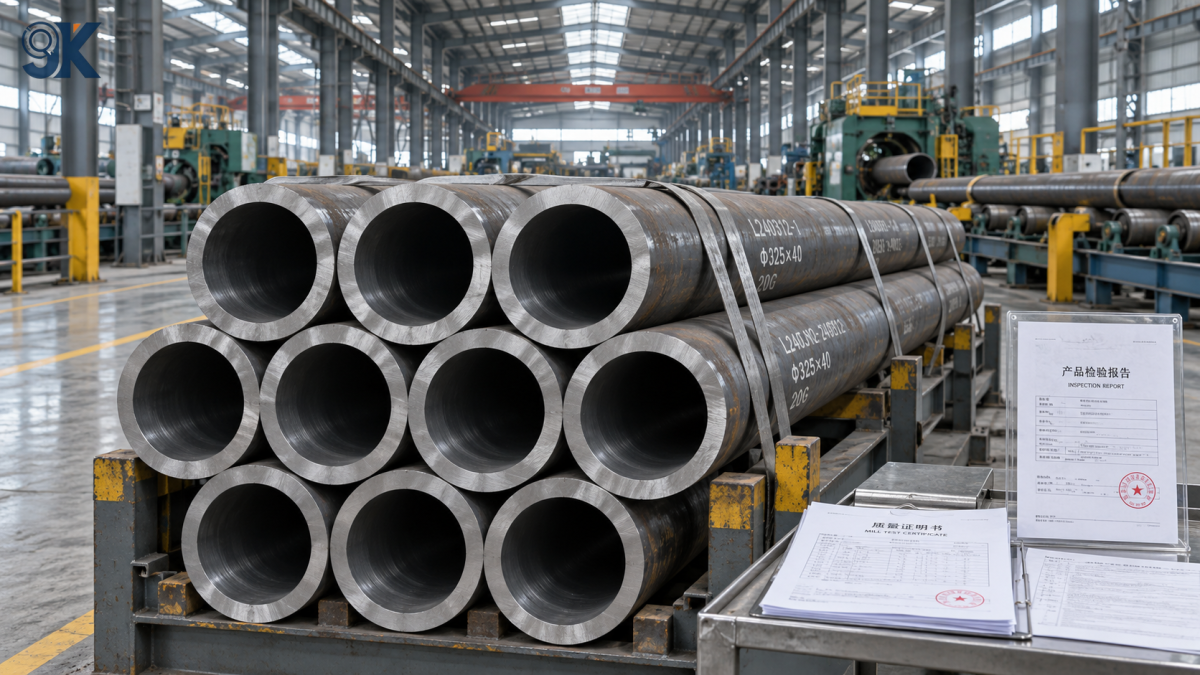
Consider a machined sleeve made from thick-wall seamless pipe. The engineering team may care about hardness variation, straightness, internal soundness, and behavior after machining. A lower reported carbon footprint cannot compensate for material that misses those requirements. Keep the technical acceptance criteria fixed while assessing a new source, and qualify changes through inspection and trials appropriate to the component’s risk.
Make emissions figures comparable before comparing prices
Two quotations can both report emissions per tonne and still describe different things. One may cover crude steel at the steelworks gate; another may cover finished pipe after heat treatment. Comparing them directly rewards the narrower calculation, not necessarily the cleaner product.
Before treating a carbon figure as a commercial differentiator, ask for:
- The declared product and unit: crude steel, billet, coil, or finished pipe, expressed on a consistent basis.
- The system boundary: whether upstream materials, purchased electricity, pipe conversion, finishing, and transport are included.
- The reporting period and method: when the data was collected and how emissions were calculated and allocated.
- The evidence status: whether the result is estimated, independently verified, or supported by an applicable environmental product declaration.
- The connection to the order: how the declaration relates to the production site, product family, and supplied material.
An environmental product declaration can help structure disclosure, but its existence alone does not prove that one product has lower emissions than another. Comparability depends on the underlying rules, boundaries, and declared units. Nor does a conventional mill test certificate establish a carbon footprint: it serves a different purpose, documenting specified material characteristics and test results.
Also distinguish physical supply from certificate-based allocation. If a supplier offers an attributed emissions reduction rather than material from a dedicated production route, ask how that claim is allocated and what the buyer may legitimately report. The commercial offer should make that distinction visible.
The cheapest lower-carbon quote may not be the lowest-cost option
Decarbonization changes the cost discussion, but it does not replace landed-cost analysis. Buyers still need to account for freight, duties where applicable, inspection, processing yield, inventory, and the consequences of late delivery. Any carbon-related compliance cost should be assessed against the actual destination and product scope, not a general headline about steel imports.
For a machinery manufacturer buying recurring pipe sizes, a practical comparison is cost per accepted, usable component. A supplier offering a lower price per tonne may require more machining allowance or generate more rejected pieces. Where technically feasible, better dimensional control or an agreed cut-length program may reduce material consumption without changing the steelmaking route.
Those savings should be measured, not presumed. Review actual nesting, cutting losses, rejection records, and machining requirements before claiming an environmental benefit. Reducing purchased tonnage while increasing failures downstream would be a poor trade.
The same discipline applies when purchasing adjacent products such as Galvalume Steel Coil for suitable enclosure or cladding applications. Substrate production, coating, and service requirements need separate consideration. A footprint for uncoated steel cannot simply be assigned to the coated product, and coating suitability remains an application-specific engineering decision.
Keep supply resilience in the decarbonization plan
A lower-carbon source is only useful if it can supply the required grade, size, condition, and volume. Capacity announcements do not establish present availability. Buyers should distinguish between equipment under construction, commissioned facilities, and production already qualified for their application.
For critical pipe items, maintaining more than one qualified source can be sensible. One may offer stronger emissions documentation; another may provide established dimensional performance and shorter replenishment times. The objective is to improve the sourcing mix without creating a single point of failure.
Start with a specification that has stable demand and manageable qualification risk. A small-batch trial can check material performance, document flow, and receiving procedures before a larger commitment. For safety-critical or pressure-related components, however, a trial order does not replace required approvals or applicable testing.
Contracts should also address substitutions. Changing the billet source, coil source, or manufacturing site may affect both quality approval and the validity of emissions documentation. Require notification when changes affect an agreed specification or environmental claim.
An integrated service provider should close information gaps
For international buyers, coordinating mills, processors, warehouses, and freight providers can be as demanding as selecting the steel itself. An integrated supplier is useful when it keeps these handoffs visible—not when it replaces the original producer’s evidence with a broad assurance.
Based in Shandong, Shandong Jiukai Metal Materials Co., Ltd. combines custom production coordination, deep processing, warehousing, logistics, and export customs clearance for machinery-sector steel pipe buyers. Its role can include drawing evaluation, specification matching, and documentation coordination. Where emissions information is requested, the practical task is to establish what the upstream producer can substantiate and identify any gaps before shipment.
Shipment planning also deserves attention. Jiukai Metal supports FCL, LCL, and bulk shipping through options including Tianjin, Qingdao, and Rizhao. Port and shipping choices should reflect cargo dimensions, handling risks, schedules, and total logistics requirements. A shorter inland journey does not automatically mean a lower-emission shipment; a reliable comparison requires consistent transport assumptions.
Whether the order is a small trial or a long-term supply program, retain the connection between physical bundles, heat identification, processing records, and shipping documents. That connection supports quality investigations and makes environmental disclosures more defensible.
Change the approval process before changing the entire mill list
The practical response to steel industry development is not an immediate switch to whichever supplier advertises the lowest footprint. Add a separate emissions-evidence review to the existing technical and commercial approval process. Keep those assessments distinct so that a strong result in one area does not conceal a weakness in another.
For the next sourcing round, select one recurring pipe specification and request comparable quotations from qualified mills. Ask each supplier for the same technical documentation, emissions boundary, evidence status, and substitution terms. Where comparable data is unavailable, record the gap rather than inventing a ranking. That gives procurement a defensible basis for deciding where to trial a new source, where to negotiate better disclosure, and where changing mills would introduce more risk than benefit.
Latest News
- How do iron ore prices affect steel pipe price trends?
- How do tariffs affect square tube export markets?
- How steel pipe price trends affect inventory valuation
- Steel pipe price forecast for 2026 amid changing raw material costs
- Square Tube Export News: What Buyers Should Watch in Freight and Supply
- What new trade investigations mean for steel pipe exports
Send Us A Message

