
Steel Pipe Export News: Which Trade Measures Could Affect Your Orders?
Steel Pipe Export News: Which Trade Measures Could Affect Your Orders?
Could a tariff change turn your next steel pipe shipment into a margin squeeze? For distributors, dealers, and agents, following Steel Pipe Export News means understanding how anti-dumping duties, import quotas, rules of origin, and customs requirements could affect landed costs and delivery schedules. The useful question is not simply whether a market has announced restrictions, but whether those restrictions cover your exact product, producer, origin, and import date.
That distinction matters when quotations remain open for weeks and shipments spend additional time in production and transit. A price that works when an order is signed may no longer work when goods enter customs. Buyers need a repeatable way to connect policy announcements with purchasing decisions—not another stream of headlines.
Read the product scope before reacting to the headline
“Steel pipe” is a commercial description, not a complete customs identity. Seamless and welded products, circular and rectangular sections, alloy and non-alloy steels, and different applications can fall under different tariff headings or trade-remedy scopes. A measure affecting one category does not automatically cover every tube shipped from the same country.
Start with a technical description that includes manufacturing method, material grade, outside diameter or section dimensions, wall thickness, applicable standard, surface condition, and intended use where relevant. The destination country’s tariff schedule may require detail beyond the internationally harmonized six-digit HS level.
Classification and trade-remedy coverage are related but separate questions. In some jurisdictions, tariff codes are provided for reference while the written product description determines coverage. An exclusion may depend on dimensions or technical characteristics that an invoice saying “carbon steel tube” never records. Where the distinction materially affects cost, seek a formal classification or scope determination through the applicable local procedure.
The measures that can change your landed-cost calculation
Anti-dumping and countervailing duties
Anti-dumping duties address imports found to be dumped under the importing jurisdiction’s rules; countervailing duties address qualifying subsidies. Neither should be treated as just another standard tariff line. Applicable rates can depend on the producer, exporter, or their specified combination, and different measures may apply together.
Ask which legal entities will appear on the commercial invoice and supporting records. A rate associated with one manufacturer should not be assumed to apply to goods sourced through another arrangement. Also distinguish a cash deposit from final liability: in certain systems, later reviews can change the amount ultimately owed. The importer should understand that exposure before fixing resale prices.
Safeguards, quotas, and additional tariffs
A safeguard or tariff-rate quota can make availability as important as the headline duty rate. Depending on the scheme, treatment may vary by product category, origin, quota period, and remaining balance. An attractive quotation does not reserve quota access unless the relevant system explicitly provides for reservation.
Check which event controls eligibility: shipment, arrival, declaration acceptance, or another legally defined date. A vessel delay can move an entry into a different quota period. Additional country-specific tariffs may also apply alongside ordinary customs duties, subject to local rules on exemptions and interaction with other measures.
Origin rules and circumvention investigations
The loading port is not necessarily the country of origin. Routing Chinese-made pipe through another country does not, by itself, change its origin. Cutting, coating, machining, or other processing must be assessed under the destination’s applicable origin rules; buyers should not assume that any additional operation creates a new origin.
Preferential origin under a trade agreement is also distinct from non-preferential origin used for other customs purposes. Circumvention rules can create further exposure in certain supply chains. If a sourcing proposal depends on a claimed origin change, obtain a documented legal assessment rather than relying on a trading company’s assurance.
Follow the policy timeline, not just the announced rate
A new investigation, a provisional measure, a final determination, and a review are different stages. Each may create a different commercial risk. Some proceedings can involve registration requirements or legally specified retroactive exposure, so “not currently collected” does not always mean “no potential liability.” Equally, an investigation announcement is not proof that a final duty will follow.
For market monitoring, separate official legal notices from commentary. Useful starting points include the destination customs authority, the responsible trade-remedy authority, and official gazettes. For European Union measures, consult European Commission notices and TARIC; for United States orders, check Department of Commerce materials and relevant Customs and Border Protection instructions. WTO notifications provide context but do not replace destination-country entry requirements.
Keep a short order-level record: source notice, publication date, effective date, covered goods, affected entities, and the next review point. Recheck it before booking and before customs entry. That is more useful than forwarding an alarming headline without identifying which purchase orders it affects.
Carbon requirements add a different kind of exposure
For EU-bound business, the Carbon Border Adjustment Mechanism deserves a separate check. Certain iron and steel goods fall within its scope, but applicability must be established against the relevant product codes and current rules. Do not assume that every steel item is covered—or that a conventional mill test certificate provides all required emissions information.
Confirm the importer’s obligations, applicable exemptions, required emissions methodology, and what production data the supplier can provide. These requirements are distinct from anti-dumping duties and product conformity documentation. When comparing suppliers, the ability to obtain usable installation and production-route information can therefore matter alongside the quoted price.
Make the paperwork match the physical shipment
Customs problems often begin with inconsistent descriptions rather than missing documents. The purchase order may specify seamless mechanical tubing, while the invoice uses a generic pipe description and the packing list omits heat references. Those inconsistencies can prompt questions when classification, origin, or duty treatment depends on precise product identity.
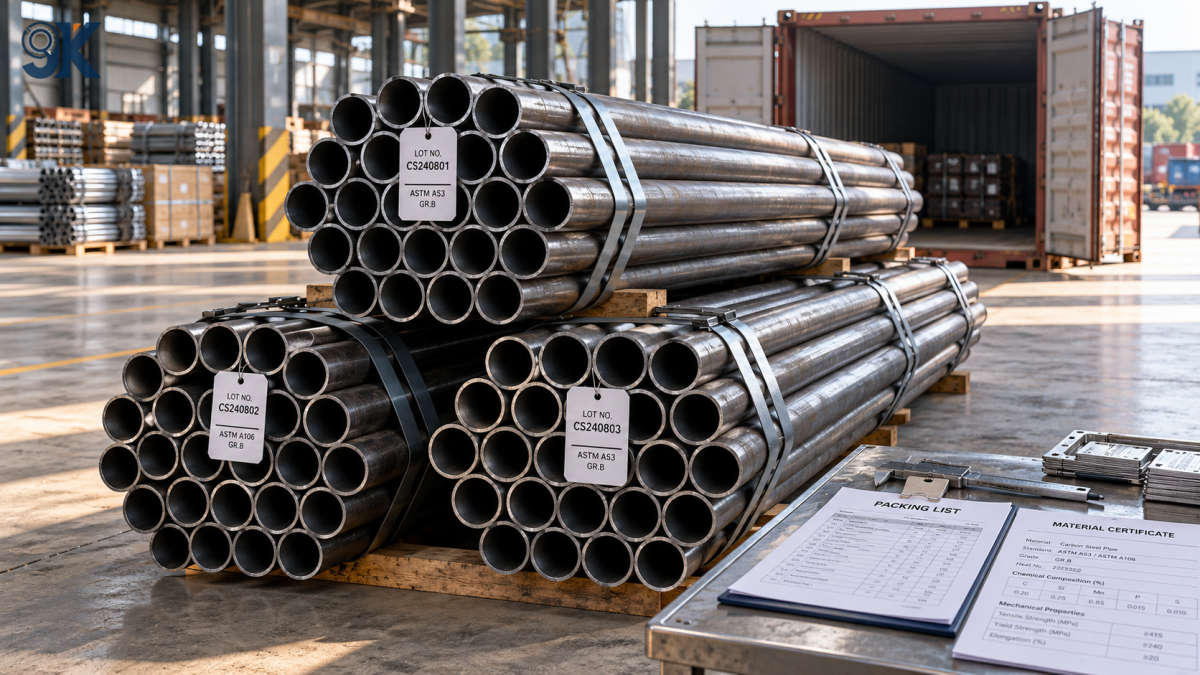
Build a traceable chain from the approved specification to production records, inspection documents, bundle markings, invoice, and packing list. Where required, origin evidence should support the actual manufacturing history. A mill test certificate helps establish material characteristics and traceability; it does not independently settle every customs question.
Product form also deserves attention when sourcing upstream material. For example, S235JR Carbon Steel Strip should not be evaluated under assumptions made for finished pipe merely because both are carbon steel products. Confirm its own classification, specifications, origin requirements, and trade-measure coverage. If strip will subsequently become welded tubing, assess the finished product separately rather than carrying the strip’s customs treatment forward.
Use shipping flexibility without confusing it with compliance
Port selection can improve scheduling options, but it does not remove a destination tariff or alter origin. The practical choice is between routes with different sailing frequency, inland handling, transshipment exposure, and arrival reliability. Where quota timing matters, a cheaper route with a less predictable arrival may carry a larger commercial risk.
Based in Shandong, Shandong Jiukai Metal Materials Co., Ltd. combines custom steel pipe production, deep processing, warehousing, logistics, and export customs clearance. Access to Tianjin, Qingdao, and Rizhao provides options for coordinating production readiness with shipping schedules. Its FCL, LCL, and bulk-shipping capabilities accommodate different order sizes, although route and handling suitability still depend on dimensions, weight, packaging, and destination facilities.
For a small trial order, LCL may avoid committing to a full container, but consolidation and deconsolidation add handling stages. For long or heavy pipe, packaging and terminal capability may outweigh freight-price differences. These are delivery decisions; none substitutes for checking import admissibility before dispatch.
Turn trade news into an order-release decision
Before releasing production, bring purchasing, the supplier, the customs broker, and the importer of record around the same specification. Resolve five questions:
- Which destination tariff classification and written trade-remedy scope apply?
- Are the declared manufacturer, exporter, and origin supported by records?
- Which date determines the duty or quota treatment, and could the shipping schedule cross it?
- Does the landed-cost estimate include applicable duties, brokerage, handling, and contingency for unresolved exposure?
- Who bears additional costs or delays if rules change between quotation and entry?
Put the answers into the quotation assumptions and contract where appropriate. Incoterms allocate specified responsibilities and costs, but they do not by themselves resolve every issue of tariff-change allocation, importer eligibility, or retrospective duty liability. Those points need explicit treatment consistent with local law.
Jiukai Metal’s drawing evaluation, specification selection, documentation processing, and logistics tracking can support the supplier side of this review. Destination-country classification and legal obligations should still be confirmed with the importer’s qualified advisers. Before committing the next order, align the exact product, responsible entities, required records, and expected entry window. That is when Steel Pipe Export News becomes a purchasing tool rather than background noise.
Latest News
- How do iron ore prices affect steel pipe price trends?
- How do tariffs affect square tube export markets?
- How steel pipe price trends affect inventory valuation
- Steel pipe price forecast for 2026 amid changing raw material costs
- Square Tube Export News: What Buyers Should Watch in Freight and Supply
- What new trade investigations mean for steel pipe exports
Send Us A Message

