
News center
How energy costs shape steel pipe price trends
Energy costs can change steel pipe prices at several points before an order reaches its destination: during steelmaking, pipe production and transportation. Yet a rise in electricity or fuel prices does not translate into an equal increase in the final pipe quotation. The effect depends on the production route, the supplier’s energy contracts, demand, freight terms and the time at which each cost enters the supply chain.
For budget approval, the distinction matters. A higher energy bill can put pressure on a mill’s costs without immediately changing the price of an existing pipe order. Conversely, a stable factory quotation can conceal a rising delivered cost if freight or fuel surcharges are billed separately. Reading the steel pipe price trend therefore requires more than tracking a single energy benchmark.
Where energy enters the pipe price
Most of a steel pipe’s energy exposure begins before the pipe mill forms the product. Steel must first be produced and converted into an input such as hot-rolled coil, plate, billet or round bar. Pipe producers then use electricity and fuels for forming, welding or piercing, heat treatment, finishing and material handling. The finished pipe must also be transported, sometimes across several borders.
These stages do not have the same cost structure. An integrated steelmaker using a blast furnace and basic oxygen furnace relies heavily on coal-derived coke and other fuels, although it also consumes substantial electricity. An electric arc furnace producer uses electricity to melt its metallic charge, commonly including scrap, and may use natural gas or other fuels for heating. Both routes are exposed to raw-material costs as well as energy, and the proportions differ by plant and operating conditions.
That distinction limits the usefulness of broad claims such as “higher electricity prices mean higher pipe prices.” Electricity can be a decisive pressure for one producer while coking coal, gas or purchased steel feedstock matters more for another. Even within the same route, long-term power contracts, self-generation and hedging can create different effective costs.
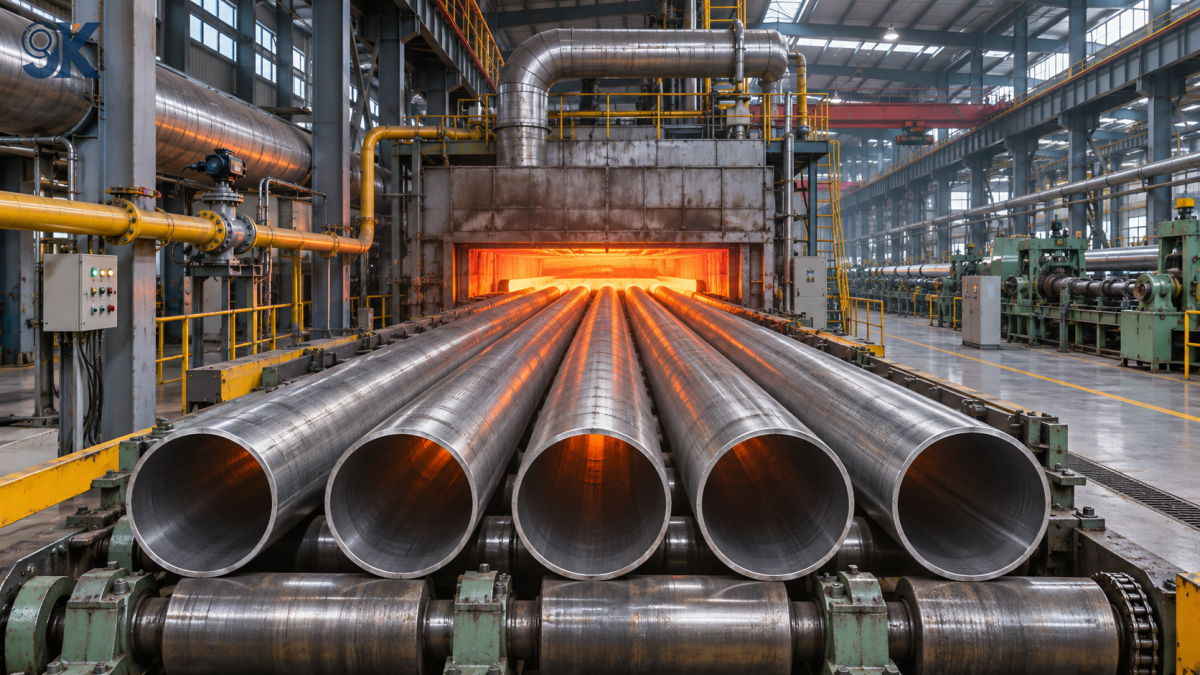
Pipe manufacturing adds another layer. Welded pipe is generally made by forming and welding strip or plate; seamless pipe is produced from a solid billet or round that is heated and pierced. The energy intensity of the finished product depends on the process and specification, not simply on the label “welded” or “seamless.” Heat treatment, tight dimensional requirements, inspection, coating and low production yields can all increase the processing cost per saleable tonne.
A quotation for heat-treated seamless pipe, for example, can respond differently to a gas-price increase than a quotation for a standard welded product made from recently purchased coil. Comparing the two without separating feedstock and conversion costs can lead to an incorrect conclusion about the cause of a price change.
Why price changes move through the chain unevenly
An energy shock reaches the pipe market through a sequence of purchasing and production decisions. A steelmaker may face a higher power tariff immediately, while a pipe producer continues using coil purchased under an earlier contract. The producer may not seek a higher pipe price until it replaces that inventory—or until customers accept a revised quotation.
The reverse can happen when energy prices fall. Existing inventory, contracted input prices and order backlogs can keep costs elevated for a time. A lower spot gas or electricity price is therefore not proof that a supplier’s current pipe cost has already fallen by the same amount.
Market conditions also determine how much of a cost change becomes a selling-price change. When order books are weak, producers may absorb part of an increase through lower margins or reduce output rather than pass through the full amount. When supply is tight, price increases can exceed the immediate energy-cost change because buyers are competing for limited production capacity. In either case, the observed pipe price reflects both costs and market conditions.
Quotation timing adds another complication. One offer may be based on a spot feedstock purchase, while another reflects a contract covering several months. A short quotation validity period can signal uncertainty about replacement costs, but it does not by itself establish that a price increase is justified. The relevant question is which cost has changed, when it applies and how much of the quoted price it affects.
Electricity and fuel: different exposures, different signals
Electricity costs matter most where power makes up a material share of conversion costs or where a plant buys power at rates closely linked to wholesale markets. A headline wholesale power price is not necessarily the price paid by the mill: network charges, contract terms, time-of-use rates and onsite generation can all change the effective rate.
Natural gas and other heating fuels affect furnaces used for reheating, heat treatment and other thermal processes. Their impact can be particularly relevant when the specification requires additional thermal cycles. However, a supplier’s ability to switch fuels, its furnace efficiency and the utilization of its equipment all affect the cost passed into each tonne.
Utilization is important because energy consumption is not entirely proportional to output. Furnaces require heat to start and maintain operating temperatures, and equipment uses power even when production is below capacity. If orders fall and production runs become shorter, the energy cost allocated to each saleable tonne can rise even without an increase in the energy tariff. At the same time, weak demand may make it harder for the supplier to recover that cost in its selling price.
Energy costs can also influence supply indirectly. If producers cut output because operating costs exceed achievable selling prices, less material may be available. Whether that supports pipe prices depends on demand, inventories and alternative supply. A production cut alone is not enough to establish the direction of the market.
Freight can change the delivered-price trend
Fuel affects inland trucking and shipping, but transport charges are not a simple proxy for diesel or marine fuel prices. Vessel availability, route demand, port congestion, handling costs and the balance of cargo flows can all affect freight rates. A fall in fuel prices can coincide with higher freight charges if transport capacity tightens.
The contract’s delivery terms determine where that exposure appears. An ex-works price excludes most transport arrangements, while a delivered quotation incorporates more of them. Under a term such as FOB or CIF, the allocation of costs and responsibilities differs; the agreed named place and the rest of the contract remain essential to interpreting the quotation. Insurance and destination charges should not be assumed to be included merely because ocean freight is covered.
For a meaningful comparison, bring offers to the same delivery point and currency, then identify which charges are fixed and which remain variable. A lower mill price may not produce a lower landed cost if inland haulage, ocean freight or separately invoiced fuel adjustments have increased. Conversely, a higher factory price can be offset by a lower freight component.
Currency movements further complicate the picture. Energy or steel inputs may be priced in one currency, the pipe in another and freight in a third. A change in the approved budget currency can therefore alter the apparent energy-related increase even when the supplier’s local-currency cost is unchanged.
Testing an energy-related price increase
A useful review starts with the portion of the quotation that is actually exposed. Consider an illustrative order priced at $1,000 per tonne, with $600 attributed to steel feedstock, $200 to conversion and other supplier costs, and $200 to freight. These figures are examples, not market benchmarks. If the supplier demonstrates that an energy-related component within conversion rises by $20 per tonne and all other quoted components remain unchanged, the direct arithmetic effect is 2% of the original total—not the percentage increase in the underlying energy price.
The calculation becomes less straightforward if higher energy costs are already embedded in the replacement price of the steel feedstock. Adding a separate full energy surcharge on top of an increased feedstock price could count some of the same cost twice. It is reasonable to ask which part of the adjustment relates to purchased steel, which relates to pipe conversion and which relates to freight. A supplier may not disclose its complete cost structure, but it should be able to explain the basis and period of an adjustment.
A review can focus on a few points that directly affect the approval decision:
- Reference period: Does the proposed adjustment reflect current replacement costs, an earlier contract period or a forecast?
- Scope: Does it apply to the full invoice, only the mill price or a defined surcharge component?
- Direction: If the charge follows an index, does the formula also allow a reduction when the index falls?
- Timing: Does the revised price apply at order placement, production, shipment or delivery?
- Interaction with freight: Is a fuel adjustment already included in the quoted freight rate or invoiced separately?
These questions are especially relevant to long lead-time orders. A fixed price transfers more short-term cost risk to the supplier, which may be reflected in the initial offer. An indexed price can reduce the need for a large upfront risk allowance, but it makes the final expenditure less certain. The better arrangement depends on the size of the order, available budget headroom and the period between approval and delivery.
Planning around uncertainty rather than a single forecast
A practical budget can distinguish the committed pipe price from unresolved energy and logistics exposure. Where the price is fixed through shipment, the main remaining variables may lie outside the mill quotation, such as destination charges or currency conversion. Where the contract permits adjustment, the approval should identify the formula, its reference date and any cap or floor before the order is placed.
Scenario analysis is more informative than applying a blanket percentage to the entire purchase. Model a change in the exposed component, then add the effect of freight and currency separately. For a contract with a defined energy surcharge, the model can use the contract formula. For a fixed-price offer, a scenario is more useful for assessing the cost of the next renewal than for revising an already committed amount.
Order timing also involves a trade-off. Buying ahead can secure a known price and production slot, but it ties up cash and creates inventory carrying costs. Splitting purchases can reduce exposure to a single pricing date, while leaving later volumes open to increases or supply constraints. Neither approach is inherently cheaper; the decision depends on consumption certainty, storage costs and the financial impact of a delayed delivery.
The strongest signal is not an isolated move in oil, gas or electricity, but a consistent change across the relevant cost chain: the supplier’s energy exposure, its steel feedstock replacement price, pipe conversion terms and the freight route used for the order. When those signals diverge, the quoted price should be assessed on its own contractual basis rather than treated as a direct reflection of an energy headline.
Latest News
- How do iron ore prices affect steel pipe price trends?
- How do tariffs affect square tube export markets?
- How steel pipe price trends affect inventory valuation
- Steel pipe price forecast for 2026 amid changing raw material costs
- Square Tube Export News: What Buyers Should Watch in Freight and Supply
- What new trade investigations mean for steel pipe exports
Send Us A Message

