
News center
How could construction demand affect steel pipe prices in 2026?
Construction demand could put upward pressure on steel pipe prices in 2026, but the effect will depend less on headline construction spending than on which projects proceed to procurement, what pipe they require, and whether mills have capacity to supply it. Strong infrastructure orders can tighten selected large-diameter or coated pipe markets even while a weak residential sector leaves other pipe products in ample supply.
A single global price direction would therefore be misleading. A useful steel pipe price forecast for 2026 must distinguish between project pipelines and firm orders, local and imported supply, and changes in pipe demand versus changes in the cost of steel inputs. The greatest price risk arises when several of these forces move in the same direction at the point when buyers need delivery.
How construction activity reaches the pipe market
Construction affects pipe prices through an uneven chain. A project must secure financing, complete design and approvals, appoint contractors, and reach the relevant installation phase before a substantial pipe order is placed. An announced investment program or an increase in building permits can signal future demand, but neither guarantees an immediate increase in mill orders.
The timing also differs by application. Underground water, drainage and piling work can generate demand relatively early in a project. Mechanical systems in a building may require pipe later, after the structure is underway. A delay in one part of the construction schedule can shift an order into a different quarter without eliminating it altogether.
That distinction matters for 2026 pricing. If several large projects move from planning into procurement at the same time, order books can tighten quickly for particular diameters, wall thicknesses or processing capabilities. Conversely, a large value of announced projects may have little near-term effect if financing, permitting or design decisions prevent orders from being released.
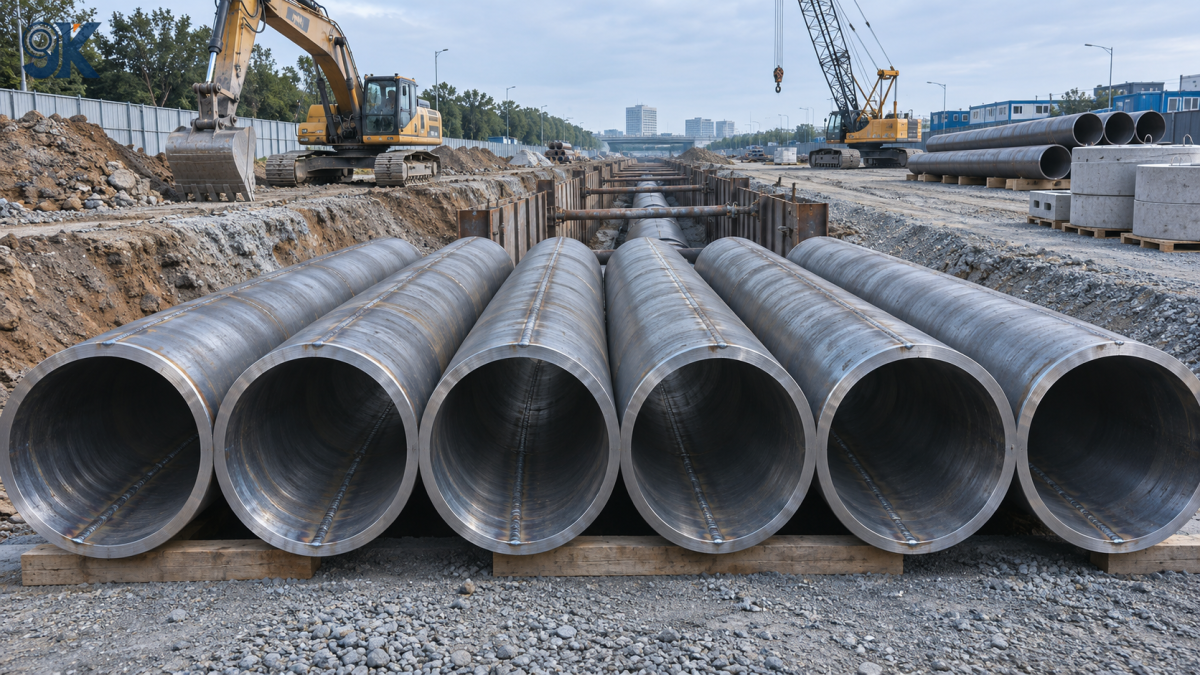
Construction spending is also an imperfect proxy for pipe tonnage. Spending can rise because labor, land or equipment costs are higher, while the physical volume of pipe installed changes little. Project design matters as well: the amount of steel pipe required depends on the network layout, structural system, pressure requirements and the materials specified. A meaningful demand assessment should therefore connect spending forecasts to project schedules and the actual bill of materials wherever possible.
Infrastructure can create concentrated pressure
Water transmission, drainage, transport and other infrastructure projects can require substantial quantities of steel pipe for pipelines, piles, casings and structural applications. Their effect on prices is not necessarily spread evenly across the market. A major project may need a particular diameter range, wall thickness, coating system or inspection package that only part of the available supplier base can provide.
When several tenders with similar requirements overlap, competition for rolling slots, fabrication capacity, coating lines or testing services can raise delivered costs and extend lead times. The quoted price of standard pipe may show little movement while the premium for a project-specific configuration increases. The reverse is also possible: a delayed tender can release capacity and reduce competition for the same products.
Infrastructure budgets need to be interpreted carefully. A budget allocation is not the same as a funded contract, and a contract award is not necessarily the same as a pipe purchase order. Changes in routing, design approval or environmental review can affect both the volume and the procurement date. The most useful signals are therefore tender releases, contract awards, approved specifications and delivery schedules, considered together rather than in isolation.
Project size can also complicate price negotiation. A large order may attract competitive bids, but it can still command a premium if it requires production outside normal mill schedules or ties up specialized processing capacity. Unit price should be assessed alongside the cost of phased deliveries, storage and the risk of a missed construction window.
Residential and commercial demand affects a different mix
Residential construction influences demand for pipe used in building services, foundations and related works, although the steel content varies substantially by building design and local material preferences. A change in housing starts does not translate directly into an equivalent change in steel pipe consumption. Plastic, copper, concrete and other materials may compete with steel in some applications, subject to design requirements and local rules.
A weaker flow of new housing projects can reduce demand for common pipe products, particularly where orders are fragmented across distributors and contractors. That does not automatically lower prices if input costs rise, mills reduce production, or the same products are absorbed by other applications. It can, however, leave buyers with more options when inventories are available and delivery requirements are flexible.
Commercial construction has its own timing and product mix. Offices, logistics facilities, industrial buildings and other developments may use steel pipe in structural elements, fire protection and mechanical systems. Their purchasing schedules depend on project financing, tenant commitments and construction sequencing. A project that remains in the planning pipeline but is not released for construction should not be counted as immediate pipe demand.
For companies budgeting across multiple sites, the important distinction is between an aggregate construction outlook and the products actually specified. A positive outlook for one segment cannot be assumed to support every pipe category. Demand for structural hollow sections, for example, should not be treated as interchangeable with demand for pressure-rated pipe: manufacturing routes, specifications and available suppliers can differ.
Why stronger demand may not produce higher prices
Construction demand is only one side of the pricing equation. Steel pipe producers also respond to the cost of feedstock, energy, labor, financing and transport. Depending on the product and manufacturing route, hot-rolled coil, plate, billets or other steel inputs may be more relevant than the price of finished pipe in another category.
If construction orders strengthen while input prices fall, producers may be able to hold or reduce pipe prices despite better demand. If construction activity softens while feedstock costs rise, pipe prices may remain firm. The outcome depends on whether suppliers can pass higher costs through and whether competing supply is available at the required specification.
Capacity utilization matters as much as nominal capacity. A mill may have room to produce pipe in general but not have an available slot for a specific size or grade. Similarly, finishing capacity can become the constraint after pipe production: coating, threading, cutting, inspection or documentation may determine the achievable delivery date. A market can therefore look adequately supplied in aggregate while certain orders face higher premiums.
Inventories add another layer. Distributors holding stock purchased at earlier prices may quote differently from mills offering new production. Available inventory can cushion a short-term demand increase, but only if the stock matches the required dimensions, standard and delivery location. Buyers should avoid treating an indicative spot price as the equivalent of a confirmed offer for project-specific material.
Regional trade can amplify or offset local demand
Steel pipe prices are negotiated in regional markets, even when material can be traded internationally. Local construction demand competes with imports, while export availability depends on production economics, freight, exchange rates and trade measures. A construction slowdown in one market may make material available elsewhere, but landed cost and delivery timing determine whether it is a practical alternative.
Trade remedies and customs requirements can change the economics of sourcing. Their applicability depends on the importing jurisdiction, product classification, origin and the measures in force when goods are entered. They should be checked for the precise transaction rather than inferred from a general statement about a country or steel products as a whole.
Comparing an imported quote with a domestic quote also requires a consistent cost basis. Freight, insurance where applicable, duties, port charges, inland transport, financing and inspection can materially change the comparison. A lower mill price may not remain lower after these costs are included, particularly for small orders or urgent shipments.
Delivery reliability is part of that calculation. Imported material can be competitive for planned volumes, but longer transit and customs procedures expose a project to schedule changes. Domestic or regional stock may cost more per tonne while offering a shorter replenishment cycle. The economically preferable choice depends on the cost of holding inventory and the consequences of a delayed installation.
Three demand scenarios for 2026
Without a reliable basis for a single numerical forecast, scenarios provide a more useful way to test a budget. They are conditional outcomes, not claims about what has already happened or what will happen in every region.
The distinction between a temporary order surge and a sustained increase in consumption is important. A cluster of purchases can lift quotes for a delivery window and then subside once those requirements are covered. Conversely, a sequence of funded projects can keep capacity occupied even if no individual order appears unusually large.
Turning the outlook into purchasing decisions
The most useful monitoring starts with the products and delivery dates that matter to the business, rather than a broad steel index alone. Track firm project awards and tender schedules in the relevant market, then compare them with supplier lead times, available inventory and the price of the appropriate steel input. A widening difference between standard stock prices and made-to-order quotes can indicate pressure on specific production or finishing capacity.
Budget assumptions should separate the base pipe price from freight, processing, coatings, inspection and currency exposure. This makes it easier to identify whether a higher delivered quote reflects construction demand, input costs or a change in scope. It also prevents apparent savings from being overstated when one offer excludes services included in another.
Purchasing schedules should reflect the certainty of the underlying project. Committing the full volume before design approval can create excess inventory or leave the buyer holding an unsuitable specification. Waiting until installation is imminent creates exposure to production-slot shortages and expedited freight. Where contract terms and supplier capacity allow, staged orders can balance these risks, provided the parties agree on pricing, quantities, delivery windows and any change conditions.
Supplier diversification is valuable only when alternatives can meet the same technical and documentation requirements. An additional source that cannot supply the required grade, dimensions, inspection records or delivery schedule may not reduce meaningful risk. Qualification before a project reaches an urgent procurement phase gives a company more options if capacity tightens.
For 2026, the decisive question is not simply whether construction activity rises or falls. It is whether funded projects convert into orders for the pipe products a company needs, at the same time and in the same locations as available supply becomes constrained. Following that chain provides a stronger basis for pricing decisions than relying on a single construction headline or a generalized steel market forecast.
Latest News
- How do iron ore prices affect steel pipe price trends?
- How do tariffs affect square tube export markets?
- How steel pipe price trends affect inventory valuation
- Steel pipe price forecast for 2026 amid changing raw material costs
- Square Tube Export News: What Buyers Should Watch in Freight and Supply
- What new trade investigations mean for steel pipe exports
Send Us A Message

