
News center
The role of scrap supply in steel industry development
Scrap supply is becoming a defining constraint on steel industry development as producers seek greater flexibility in raw materials and lower-emission production. Availability alone does not determine the outcome: usable scrap must arrive at the right location, in a suitable grade and at a cost that makes sense against other metallic inputs. A market with abundant obsolete machinery or discarded vehicles can still face shortages of clean, low-residual scrap suitable for demanding steel grades.
These distinctions affect the economics of new melting capacity, the stability of steel prices and the availability of consistent material for downstream processing. They also explain why a rise in total scrap collection does not automatically translate into an equivalent increase in high-quality steel output.
Scrap availability is local, while competition is increasingly connected
Steel scrap comes from several streams with different supply characteristics. Home scrap is generated within steelmaking and processing operations and returned to production. Prompt scrap arises from manufacturing activities such as stamping and fabrication. Obsolete scrap comes from products and structures at the end of their useful lives, including vehicles, equipment and buildings.
Prompt scrap tends to be relatively identifiable because its source material is known and it has spent less time in mixed waste streams. Its availability, however, moves with manufacturing activity. A slowdown in fabrication can reduce prompt scrap generation just as steel producers seek lower-cost inputs. Obsolete scrap is often more plentiful across a mature economy, but recovery requires collection, dismantling, separation and transport. Its composition can be less predictable.
The amount of steel accumulated in buildings, infrastructure and manufactured goods influences future scrap generation, but that stock does not return to the market on a fixed schedule. Products have different service lives, and collection depends on dismantling economics, local infrastructure and access to end-of-life material. Regions with growing steel consumption do not necessarily generate enough domestic scrap to satisfy expanding melting capacity.
Trade connects regions with different supply and demand balances, although transport costs, port capacity and trade measures affect which flows are viable. Export restrictions or changes in import requirements can redirect material quickly. A producer that appears well supplied at a national level can still face tight local conditions if competing mills are closer to the same collection network or if inland freight makes imported scrap uneconomic.
Quality determines which capacity can actually use the scrap
Scrap is purchased by grade, but a grade name alone does not fully describe melting performance. Piece size, density, moisture, coatings, attached nonmetallic material and chemical composition all influence yield and processing. A dense, well-prepared charge can reduce handling and melting difficulties, while material containing excessive dirt or nonmetallic attachments produces less saleable steel from the same purchased weight.
Chemistry is especially important when scrap is repeatedly recycled. Elements such as copper and tin can enter the stream through mixed components and are difficult to remove during conventional steelmaking. Their accumulation can restrict the use of some scrap in grades with tight surface or processing requirements. Better sorting helps prevent contamination, but it cannot always restore the composition of material that has already been mixed or alloyed.
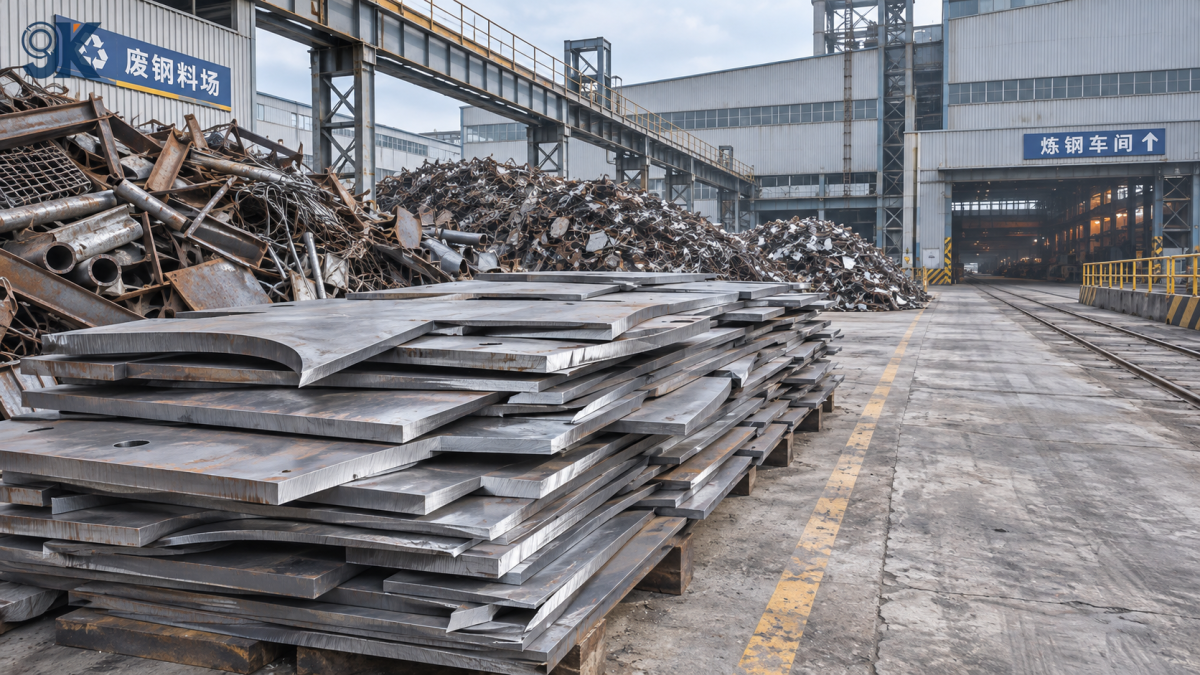
Two lots with similar purchase prices can therefore have very different effective costs. A lower-priced lot that produces more slag, requires additional preparation or forces a larger share of clean metallics into the charge may be more expensive per tonne of acceptable steel. The relevant comparison includes delivered cost, expected yield, treatment requirements and the effect on the final grade, rather than the quoted scrap price alone.
Quality requirements also vary by product route. A mill producing grades with broader chemistry tolerances may use a wider range of scrap than one serving applications with demanding forming or surface requirements. The market price of clean scrap reflects this competition: as more producers pursue higher-quality output from recycled inputs, limited supply of suitable grades can command a premium even when mixed scrap is widely available.
Electric arc furnace expansion changes the demand mix
Electric arc furnaces commonly use scrap as a major metallic input, while blast furnace and basic oxygen furnace operations also consume scrap as part of their charge. The appropriate share varies with equipment, process conditions, product specifications and the availability of other metallics. Consequently, an announcement of additional electric arc furnace capacity is a signal of potential scrap demand, not a direct forecast of an equal increase in purchased scrap.
Actual demand depends on operating rates and charge design. A furnace supplied with cleaner scrap can produce grades that would be difficult to achieve with heavily mixed feed. Where residual elements are too high, virgin iron inputs such as direct reduced iron, hot briquetted iron or pig iron can dilute the charge. These alternatives have their own cost, energy and supply constraints, so access to them changes the value of a given scrap stream.
Capacity plans are also sensitive to the timing of collection infrastructure. Building melting capacity can move faster than developing reliable sorting, dismantling and logistics networks. If several facilities draw from the same regional pool, their combined demand can lift premiums for prepared material and increase dependence on longer-distance shipments. Nameplate capacity on its own says little about whether sufficient feed will be available at sustainable operating costs.
Electricity supply matters alongside scrap. The environmental and commercial performance of an electric arc furnace depends partly on the electricity used, operating efficiency and the mix of metallic inputs. A high scrap share is relevant to emissions assessment, but it should not be treated as a complete measure of a particular steel product's footprint.
Prices transmit pressure unevenly through the chain
Scrap prices respond to steel production, collection rates, inventory levels and competition from alternative metallics. Yet different grades do not necessarily move together. Strong demand for low-residual material can widen the premium over mixed obsolete scrap; conversely, weaker manufacturing activity can reduce both steel demand and the generation of clean prompt scrap. Those simultaneous movements complicate attempts to infer supply conditions from a single price index.
Freight adds another layer. A coastal mill with access to imports and an inland mill relying on regional collection can experience different delivered costs despite operating in the same country. When fuel, handling or port congestion raises transport costs, nearby scrap can become more valuable without a corresponding change in the benchmark price at a major export hub.
Steel selling prices do not always adjust at the same speed as scrap costs. A mill with fixed-price sales commitments may absorb part of a sudden increase until contracts reset; a formula-linked arrangement may transmit changes more quickly. Inventory purchased before a market move also affects reported costs. For this reason, a short-term improvement in a mill's margin does not necessarily establish a durable raw material advantage.
Comparisons between suppliers are more useful when they distinguish purchased scrap price from delivered metallic cost and identify the period covered. They should also account for the proportion of higher-grade scrap or alternative metallics needed to meet the product specification. Without that context, a low average input cost can reflect a different product mix rather than superior sourcing.
Implications for steel pipe supply
Scrap affects pipe supply through the steelmaking route and the quality of the incoming feedstock, not through a simple assumption that recycled material is unsuitable. Steel made with scrap can meet demanding requirements when the melt is controlled and the finished material conforms to its specification. The relevant question is whether chemistry, cleanliness and consistency are maintained across production lots.
Residual elements deserve attention where steel must withstand demanding forming, welding or surface-quality requirements. Their effect depends on concentration, overall composition and processing conditions; scrap origin alone does not establish a defect. Mill test documentation and agreement on applicable chemical and mechanical requirements provide a firmer basis for evaluation than a general claim about recycled content.
Availability can also change with the upstream route. A pipe producer relying on purchased coil, plate or billet is exposed to the feedstock decisions and order schedules of its steel supplier. If clean scrap becomes scarce, the steelmaker may adjust its charge, use more alternative metallics or prioritize particular grades. The resulting effect can appear downstream as a longer lead time or a revised quotation, even when the pipe producer's own capacity has not changed.
Consistent traceability helps distinguish a market shortage from a production-specific issue. Records linking finished lots to steelmaking and feedstock controls do not guarantee identical scrap inputs, but they make it easier to investigate chemistry variation, processing deviations or changes in yield. Where orders involve tight tolerances or repeat processing, agreement on documentation and change notification is more useful than assuming every lot follows an unchanged route.
Reading the direction of the market
Several signals are more informative when considered together: announced melting capacity, actual utilization, regional scrap collection, the premium for clean grades and the cost of substitute metallics. Rising capacity alongside stable collection suggests stronger competition for feedstock, but the effect on a particular grade depends on its charge mix and access to other inputs.
Likewise, a temporary increase in scrap exports does not prove that a region has a lasting surplus. The flow can reflect a price difference, weak local steel output or inventories released after a period of accumulation. A sustained change in collection infrastructure or domestic melting demand has different implications from a short-lived trading opportunity.
The most useful view of scrap supply therefore follows material from collection through sorting, delivery and melt use. It reveals whether additional steelmaking capacity has access to suitable feedstock and whether the cost of that feedstock is likely to remain consistent with the products being made.
Latest News
- How do iron ore prices affect steel pipe price trends?
- How do tariffs affect square tube export markets?
- How steel pipe price trends affect inventory valuation
- Steel pipe price forecast for 2026 amid changing raw material costs
- Square Tube Export News: What Buyers Should Watch in Freight and Supply
- What new trade investigations mean for steel pipe exports
Send Us A Message

