
Steel Pipe Price Trends: Reading Coil, Billet, and Mill Inventory Signals
Steel Pipe Price Trends: Reading Coil, Billet, and Mill Inventory Signals
A steel pipe price trend is easier to interpret when coil costs, billet prices, and mill inventories are read together—not in isolation. For commercial evaluators sourcing steel pipes, these signals help distinguish cost-driven increases from temporary supply pressure and assess whether supplier quotations reflect broader market conditions. The challenge is knowing which indicator matters for the pipe being purchased, how quickly it reaches the quotation, and what else sits inside the final delivered price.
A rising steel market does not mean every pipe quotation should rise immediately. Equally, falling feedstock prices do not guarantee cheaper material for an urgent shipment. Production routes, stock ownership, processing requirements, and delivery commitments can pull quotations in different directions. A useful market assessment explains those differences rather than reducing them to a single headline.
Start with the feedstock that actually becomes your pipe
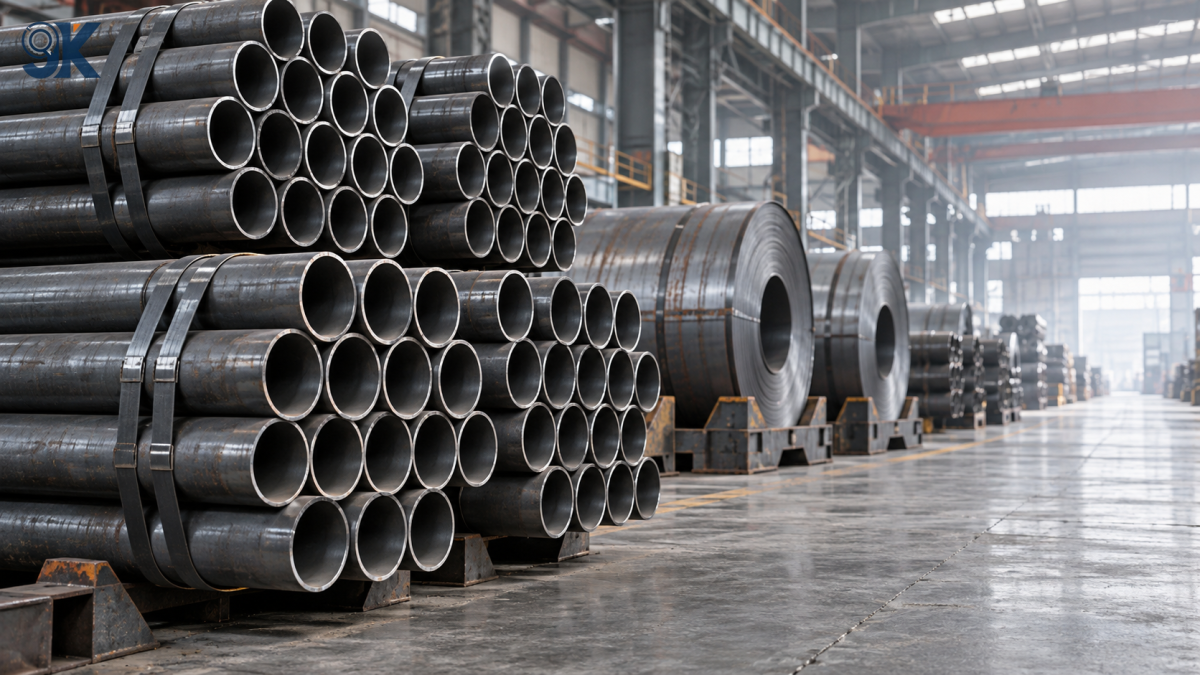
For many electric resistance welded pipes, hot-rolled coil or strip is the closest raw-material reference. The producer purchases flat steel, forms it, welds the seam, and completes the required finishing and inspection. Coil prices therefore provide a more direct cost signal than a general steel index. However, the reference must match the relevant grade, thickness, width, and supply region closely enough to be meaningful.
Plate-based welded pipe needs a different comparison. A hot-rolled coil benchmark may indicate broad market direction, but it does not fully describe plate availability or the cost of a particular plate specification. Treating all welded pipe as coil-derived can create a misleading assessment before the commercial comparison even begins.
For seamless pipe, suitable round billets or other specified solid feedstock are more relevant. A widely quoted construction-billet price can help show market sentiment, but it is not automatically the purchase price for tube-making material. Chemistry, cleanliness, dimensions, and processing suitability can create premiums that move independently of the headline billet market.
That distinction matters when a supplier explains a seamless-pipe increase by saying “billet is up.” Ask which billet reference changed and whether the movement applies to the grade being offered. The explanation may be valid, but it needs a traceable connection to the production route.
Read price changes through the mill’s purchasing cycle
Pipe prices rarely move in perfect step with daily feedstock quotations. Mills may be consuming previously purchased coil, drawing down billet stocks, or negotiating material for a future production campaign. A stockholder can have finished pipe purchased under an entirely different cost environment. These positions help explain why apparently similar suppliers respond differently to the same market movement.
In a rising market, a seller may price available stock against replacement cost rather than historical purchase cost. In a falling market, another seller may discount inventory to release working capital, while a mill maintains its offer because the next production slot still carries higher input costs. Neither quotation alone proves the direction of the wider market.
Separate three dates in the comparison: the feedstock reference date, the pipe quotation date, and the expected production or dispatch date. There is no universal pricing lag. Its length depends on purchasing arrangements, stock turnover, order coverage, and whether the quotation concerns existing stock or new production.
Also distinguish an announced mill increase from an accepted transaction price. Published offers show seller intentions; concluded business shows what buyers will accept. Where transaction evidence is unavailable, label the assessment as offer-based rather than presenting it as a confirmed market clearing level.
Inventory explains whether cost pressure can stick
Inventory gives a price movement context, but the word needs unpacking. Raw-material inventory, work in progress, finished pipe at the mill, and distributor stock describe different supply conditions. A mill can have ample coil yet little finished pipe in the diameter required for an immediate shipment.
Total tonnage can also conceal a specification shortage. Stock concentrated in common sizes offers little protection to a buyer requiring an uncommon wall thickness, heat-treatment condition, or inspection scope. Conversely, a high overall inventory figure may create discounting opportunities only in slow-moving sizes that cannot be substituted into the project.
Read inventory direction alongside deliveries and production. Falling finished stock with stable output and sustained dispatches is more consistent with active demand than falling stock caused by a shutdown. Rising inventory may indicate weaker sales, but it can also reflect planned preparation for a holiday or a scheduled shipping window.
The strongest interpretation usually comes from several signals agreeing:
- Feedstock rising, saleable pipe inventory falling, lead times extending: upward quotations have stronger support, especially when new orders are being accepted at higher levels.
- Feedstock rising, finished stock accumulating, delivery slots readily available: mills face cost pressure, but buyers may resist full pass-through. Negotiated increases may be smaller than announced increases.
- Feedstock falling, required sizes scarce: prompt-delivery prices can remain firm even as forward-production offers soften.
- Feedstock falling, inventory rising, lead times shortening: conditions favor negotiation, although processing and logistics costs may limit the delivered-price reduction.
These are interpretive patterns, not automatic trading rules. A shutdown, concentrated order release, or transport interruption can temporarily break the relationship.
Keep the market signal separate from the specification premium
A pipe quotation includes more than steel. Depending on the order, it may cover forming, welding or piercing, cold drawing, heat treatment, straightening, machining, testing, surface treatment, packaging, and yield losses. Some components respond to feedstock movements; others depend more on production scheduling and order complexity.
This is particularly relevant for machinery manufacturing. A standard stock pipe and a cut-to-length, machined tube with tighter dimensional requirements are not interchangeable commercial references. Small batches can also carry higher unit processing costs because setup and inspection effort are spread across fewer tonnes.
Keep related flat-steel purchases separate as well. If an equipment package includes 1023 Cold Rolled Steel Plate, assess that item against its own specification and processing requirements. Its quotation should not be used as a direct proxy for hot-rolled coil or seamless-pipe feedstock simply because all three belong to the same steel procurement package.
For repeat comparisons, hold the specification constant: grade, manufacturing route, outside diameter, wall thickness, length, delivery condition, testing, and documentation. Confirm whether weight is theoretical or actual. Otherwise, an apparent market discount may simply reflect a different quantity basis or reduced scope.
An export quotation can move against the domestic market
Domestic steel prices and overseas landed costs do not always move together. Currency changes, inland transport, port handling, ocean freight, insurance, and destination charges can offset a mill-price reduction. Import duties and any applicable trade measures require separate verification for the product classification, origin, destination, and shipment date.
Compare quotations under the same Incoterms rule, named place or port, and edition. An FOB offer cannot be judged directly against a CIF offer without adjusting the included costs. Neither necessarily represents the buyer’s complete landed cost. Payment timing, financing exposure, and quotation validity also affect the commercial result.
Shipping mode deserves attention before price approval. Full-container, less-than-container, and bulk shipments have different handling and scheduling considerations. Long pipe lengths, packaging dimensions, and shipment volume can restrict the practical options. A cheaper pipe price may lose its advantage if it requires a less suitable freight arrangement.
For Shandong Jiukai Metal Materials Co., Ltd., a Shandong-based pipe service provider with independent import and export rights, this is where sourcing and logistics need to be evaluated together. Its scope spans custom production, deep processing, warehousing, export clearance, and logistics, with shipping options through Tianjin, Qingdao, and Rizhao. The useful comparison is not which port sounds closest, but which workable route meets the order’s dimensions, volume, and delivery window.
Build a buying decision around evidence, not a single forecast
A practical market review can be compact. Record the relevant coil or tube-billet reference, its date and specification, available finished stock, quoted lead time, and comparable supplier offers. Keep the source consistent over time. Industry price services, mill notices, and inventory surveys can contribute, but check whether each reports offers or transactions and whether its coverage matches the sourcing region.
Then connect the evidence to the purchase constraint. If production cannot tolerate a delay, securing confirmed, compliant stock may matter more than capturing a possible price decline. If demand is flexible and inventory is building across comparable suppliers, staged purchasing may reduce exposure to an uncertain turning point. Staging still needs a cost check: extra freight, repeated setups, and minimum-order requirements can erase the benefit.
A service provider supporting both long-term orders and small trial batches can help distinguish these options. Jiukai Metal’s drawing evaluation, specification selection, documentation support, and logistics tracking are relevant when the buying decision depends on more than headline tonnage pricing. Those services should be translated into a clear quotation scope and delivery commitment, not treated as a substitute for them.
Before approving an order, ask what supports the price, which stock or production slot supports delivery, and which costs remain outside the offer. A steel pipe price trend becomes commercially useful when it helps answer those questions—not when it merely predicts whether steel will be higher or lower next week.
Latest News
- How do iron ore prices affect steel pipe price trends?
- How do tariffs affect square tube export markets?
- How steel pipe price trends affect inventory valuation
- Steel pipe price forecast for 2026 amid changing raw material costs
- Square Tube Export News: What Buyers Should Watch in Freight and Supply
- What new trade investigations mean for steel pipe exports
Send Us A Message

