
When are seamless rectangular and square pipes used for pressure service?
Seamless rectangular and square pipes are considered for pressure service when a flat-sided passage or a compact assembly offers a clear design advantage and the complete pressure boundary can be qualified for the specified conditions. Typical candidates include restricted-space manifolds, equipment passages and heat-transfer components. A seamless section does not automatically have a pressure rating: its flat walls, corners, closures and connections all require assessment under the applicable design rules.
For many pressure lines, a round pipe remains the simpler choice. Internal pressure loads its wall mainly in tension, while the flat faces of a rectangular section also bend outward. A rectangular or square section becomes a credible option when its packaging or connection benefits justify that additional design work and the selected material, dimensions and fabrication route are acceptable for the service.
Where a rectangular pressure passage has a practical purpose
A confined equipment envelope can favor a flat-sided passage. For example, a machine assembly may have limited clearance between a frame and a cover, while requiring a fluid passage with enough flow area. A rectangular section can fit that envelope and present flat surfaces for brackets or adjacent components. The space gained must be weighed against the wall thickness, reinforcement and end closures needed to contain pressure.
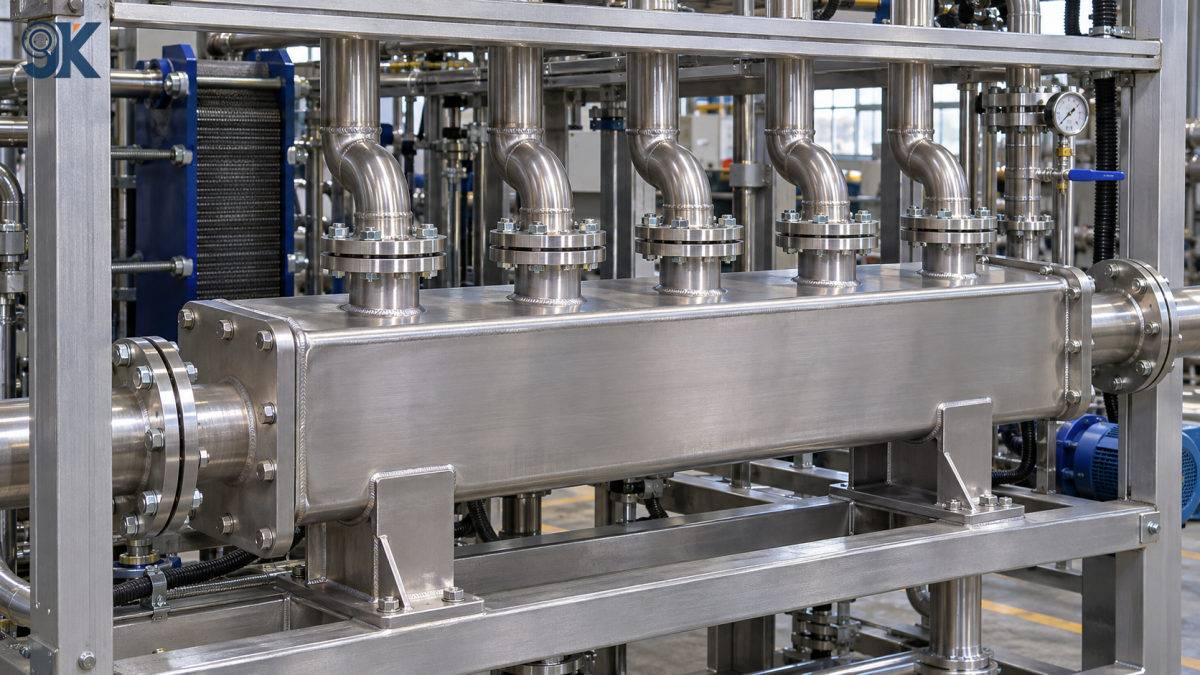
Compact manifolds are another possible application. Several branch connections can be arranged along a flat face, which may simplify the physical layout of valves or distribution lines. Each opening also removes material from a pressure-loaded wall. Closely spaced branches, attachment welds and local loads from connected piping can make the manifold more demanding than an unperforated length of tube. A layout that looks convenient on a drawing is therefore only a starting point for pressure design.
Rectangular passages also appear in custom heat-transfer or cooling assemblies, where a flat contact surface or shallow flow path serves the equipment layout. The pressure boundary may include plates, headers, welds and seals as well as the hollow section itself. Fluid pressure, temperature difference, thermal expansion and cleaning requirements all influence whether that assembly is suitable.
These applications are strongest when the shape performs a defined function. If a rectangular section is chosen solely because it is already used in the surrounding frame, the justification is weaker. A structural member carrying a coolant or hydraulic fluid has acquired a pressure-containment duty, even if its original purpose was mechanical support.
Flat walls change the pressure calculation
Internal pressure pushes each face outward. The middle of a broad flat face can deflect, while the corners restrain that movement and create local bending and stress concentrations. Increasing wall thickness reduces deflection, but the resulting behavior cannot be assessed reliably by applying a round-pipe wall-thickness formula to the rectangular section.
Width matters alongside thickness. Two sections with the same wall thickness and internal pressure can behave very differently when one has a much wider unsupported face. The aspect ratio also matters: a long, shallow rectangle has different face spans and corner behavior from a square of similar cross-sectional area. Rounded corner geometry, actual wall profile and the length between restraints influence the result.
External pressure presents a different problem. A section exposed to vacuum or pressure outside the pipe can fail through instability or inward deformation, potentially before a simple material-strength calculation suggests a problem. Reinforcement that addresses outward bulging under internal pressure does not automatically establish an adequate external-pressure capacity.
The assessment needs to cover the complete range of operating and test conditions. Steady pressure is only one load. Pressure fluctuations, startup temperature changes, vibration, bending from connected pipework and loads at supports can combine with pressure stresses. Repeated pressure cycles deserve particular attention at branch openings, corners and welded transitions, where local stress ranges affect fatigue life.
Nominal wall thickness is not the whole geometry
A nominal size is useful for identifying a section, but a pressure assessment needs the dimensional basis actually permitted by the purchase specification. Wall thickness can vary around the section and along its length within manufacturing tolerances. Corner radii, straightness and the shape of the flat faces affect both calculations and fit-up. The minimum permitted wall, after any corrosion allowance and forming or machining losses, is more relevant to containment than a nominal figure alone.
Where a design relies on a particular corner radius or tightly controlled wall profile, those requirements need to appear on the drawing or purchase specification. Otherwise, a delivered section that meets a general dimensional description may still be unsuitable for the analyzed geometry.
Code acceptance comes before a pressure rating
Pressure design begins by identifying the governing construction code and the service conditions it covers. The chosen rules may provide a method for noncircular pressure components, permit a qualified analysis route, or impose restrictions that make a proposed geometry or material unsuitable. A structural hollow-section designation on its own does not establish compliance for a pressure boundary.
Where the applicable rules permit analysis, a calculation or finite element model should represent the actual load path: flat faces, corners, closures, openings, supports and relevant weld details. The model needs appropriate boundary conditions and a basis for assessing both general stresses and local concentrations. An idealized section with perfectly fixed ends can understate deformation if the real ends are more flexible.
Testing has a different role. A specified pressure test can reveal leakage or gross defects in the tested assembly, but a successful test alone does not establish allowable operating pressure, fatigue life or compliance with the governing design requirements. Test pressure, test medium, acceptance criteria and any limits on deformation need to be defined as part of the approved design and inspection plan.
Closures and connections often govern the design
The ends of a pressurized rectangular section need closures capable of carrying the pressure load into the walls. A flat end plate can bend significantly if it is too thin or insufficiently supported. Its welds, corner transitions and any added stiffeners need to be evaluated together. The end load also creates forces along the assembly and at anchors; those forces do not disappear because the passage is short.
Round-to-rectangular transitions deserve similar attention. A round inlet may be straightforward to connect to conventional piping, but the change in shape introduces a complex load path. Abrupt geometry, restricted access for welding and nearby supports can increase local stresses or make inspection difficult. The transition should be included in the pressure design rather than treated as a simple dimensional adapter.
For a manifold, branch spacing and orientation affect more than installation. Openings close to a corner or closure interact with regions already carrying bending stresses. Valves and connected lines can add weight, thermal movement and vibration. A flange or threaded connection that is adequate on a round pipe cannot be assumed adequate when attached to a flexible flat wall.
Seamless manufacture removes a longitudinal seam from the supplied tube, but the finished assembly can still contain pressure-retaining welds at ends, branches and transitions. Weld procedure qualification, inspection access and acceptance criteria should be established for those joints under the applicable requirements. A joint hidden behind a bracket or inside a tight corner can create a fabrication delay even when the base section is available.
Material selection follows the fluid and the design temperature
Material choice starts with the fluid, concentration, contaminants and temperature across the expected operating range. Carbon steel may be appropriate where corrosion is controlled and its properties meet the design conditions. Stainless steels may be considered where the environment or cleanliness requirements justify them, but corrosion resistance varies by alloy and service. Chlorides, deposits, stagnant zones and temperature can change the outcome.
Duplex stainless steel is one possible material family for demanding corrosion and strength requirements. For example, 2205 Duplex Stainless Steel Pipe illustrates a material option that still requires confirmation of product form, applicable specification, temperature limits and compatibility with the fluid. A pipe listing alone does not establish that a seamless rectangular or square section is available, or that it is qualified for a particular pressure assembly.
Fabrication affects the material decision. Welding and subsequent processing must preserve the properties required by the governing specification. For corrosion-sensitive service, surface condition, cleaning and the treatment of weld areas can also influence performance. If the design includes crevices behind attachments or low points where liquid can collect, those details should be considered alongside the alloy selection.
Turn the concept into an orderable specification
Before ordering, the design basis needs to connect the intended duty to a specific product and fabrication route. The required outside dimensions, minimum wall, corner geometry, length and dimensional tolerances should match the analysis. The material specification and delivery condition need to be suitable for the pressure application, with traceability and inspection documentation defined in the purchase requirements.
Confirm whether the requested section is seamless in its supplied form and how its rectangular geometry is produced. The manufacturing route can affect dimensional variation, material condition and the evidence available for acceptance. If a proposed substitute is a welded hollow section, or a round seamless pipe subsequently formed into another shape, that change requires review against the design basis and governing rules rather than a simple size-for-size substitution.
Coordinate the section drawing with the fabricator before fixing the delivery length. Allowances for end preparation, distortion, machining and fit-up can affect the usable length. The same review should establish whether pressure tests and weld examinations occur before or after attachments are installed, when access and the ability to isolate the component may be different.
Where the rectangular shape has no defined function, a round pressure pipe routed through the available space may avoid a difficult custom closure or manifold design. Where the flat-sided geometry is essential, the decision rests on an approved pressure design and an orderable section whose material, dimensions and documentation match that design.
Latest News
- How do iron ore prices affect steel pipe price trends?
- How do tariffs affect square tube export markets?
- How steel pipe price trends affect inventory valuation
- Steel pipe price forecast for 2026 amid changing raw material costs
- Square Tube Export News: What Buyers Should Watch in Freight and Supply
- What new trade investigations mean for steel pipe exports
Send Us A Message

