
How can pipe handling damage be reduced between warehouse and port?
Pipe handling damage between the warehouse and port is best reduced by treating storage, lifting, truck loading, transport, and terminal handover as one continuous operation. Protective wrapping alone is not enough: a well-packed bundle can still arrive with bent ends, damaged coatings, or distorted pipe if it is lifted incorrectly or allowed to move on the vehicle.
Effective Steel Pipe Warehousing and Logistics depends on knowing which surfaces and dimensions need protection, designing the load around those requirements, and recording its condition at each transfer. The most useful control is a handling plan agreed before dispatch—not a damage claim raised after the pipes reach the port.
Identify what can be damaged before choosing protection
The handling risks are not identical for every pipe shipment. Heavy-wall carbon steel pipe may tolerate contact that would mark a polished stainless steel surface, while a long, thin-wall pipe may be more vulnerable to local deformation under a tight sling or strap. The consequences also depend on the intended use: a shallow surface mark may be acceptable on one order but require review on another.
Start with the purchase specification and identify the features that must arrive within agreed limits:
- Pipe ends: Bevels, threads, machined faces, and plain ends can be damaged by impact or by pipes sliding against one another.
- Shape and straightness: Inadequate support, excessive stacking, or concentrated lifting loads can cause bending, flattening, or ovality.
- External and internal surfaces: Coatings, polished finishes, and cleanliness-sensitive bores require protection from abrasion, contamination, and trapped moisture.
- Identification: Heat numbers, size markings, and bundle labels must remain legible and traceable after packing and transport.
These requirements should be translated into instructions that a warehouse operator and carrier can use. “Handle with care” does not say where to place a sling, whether a forklift may contact the pipe directly, or what condition requires the load to be held for inspection.
Make the warehouse layout part of the transport plan
Damage prevention begins before a truck is booked. Pipes resting directly on uneven ground can collect water, dirt, and debris, and can be difficult to lift without dragging. Use stable, level supports suitable for the pipe diameter, weight, and length. Place supports so that the load is carried without excessive overhang or concentrated pressure, and use restraints or chocks where necessary to prevent rolling.
Separate incompatible materials and finishes. Carbon steel contact can contaminate stainless steel surfaces, so dedicated or suitably protected storage supports, lifting equipment, and vehicle contact points are important where surface cleanliness matters. For an order of 2205 Duplex Stainless Steel Pipe, for example, the handling plan should address both mechanical damage and the risk of iron contamination; wrapping the outside does not help if dirty chains or forklift tines contact exposed pipe ends.
Storage arrangements also affect dispatch speed. If a required bundle is buried beneath several other loads, it may need to be lifted and repositioned repeatedly. Keep dispatch-ready material accessible, maintain clear identification, and avoid unnecessary transfers between racks. Where mixed sizes are stored, segregate them so that a smaller or thinner-wall pipe is not inadvertently subjected to a load intended for heavier material.
Before release, inspect the exposed pipe and packaging for existing damage, loose straps, missing end protection, moisture, and inconsistent markings. Record exceptions before the load leaves the warehouse; otherwise, it becomes difficult to distinguish pre-existing defects from transport damage.
Choose packing for the actual handling route
Packaging should protect the pipe through the expected sequence of lifts and transfers, not merely keep the pieces together on a stationary truck. The appropriate arrangement depends on pipe length, diameter, wall thickness, surface finish, bundle weight, and whether the cargo will be delivered as a container load or handled as individual bundles at the terminal.
Bundle pipes of compatible dimensions and protection requirements. Use suitable strapping and dunnage to keep the bundle stable without crushing the pipe or damaging its finish. Contact areas beneath straps may need padding or load-spreading protection. A bundle that looks tight at the warehouse can loosen if the pipes settle during travel, so the arrangement must resist movement without relying on excessive tightening.
Fit end caps, plugs, or purpose-designed guards where the specification and handling risks justify them. Threaded or beveled ends need protection against direct contact, but a cap should not be treated as a substitute for preventing longitudinal movement. If a bundle shifts into a headboard or another load, the force can damage both the guard and the pipe beneath it.
For coated or finished pipe, place compatible separators at contact points and avoid materials that can abrade the surface. Wrapping can limit dirt and splash exposure, but it can also trap moisture if applied over wet material or if water enters a poorly sealed package. Packing decisions should reflect the expected weather, storage duration, and destination requirements; inspect and dry material as appropriate before enclosing it.
Leave identification visible or reproduce it on durable external tags linked to the original records. An intact bundle that cannot be matched to its inspection documents can still interrupt port acceptance or later project use.
Control each lift and vehicle contact point
Every lift introduces a risk of impact, bending, slipping, or surface damage. The lifting method should be selected for the actual load weight, dimensions, balance, and packaging—not simply for the equipment available at the warehouse. A single-point lift of a long bundle can create excessive bending or cause the load to tilt; a suitably designed multi-point arrangement or lifting beam may be needed to distribute the load.
Use rated lifting equipment and accessories appropriate to the load and their configuration. Where surface protection is required, use compatible slings or protective sleeves rather than allowing bare chains or wire rope to bear directly on the pipe. Protect sling contact areas from sharp edges, and do not assume that soft slings eliminate the risk of crushing thin-wall material.
Forklift handling needs similar attention. Fork length, spacing, truck capacity, and the load’s center of gravity must suit the bundle. Protect the contact surfaces where required, and avoid lifting with the tips of the forks or allowing long pipes to project without adequate support. Individual pipes and unstable bundles can roll, so they should not be moved unless the arrangement prevents unintended movement.
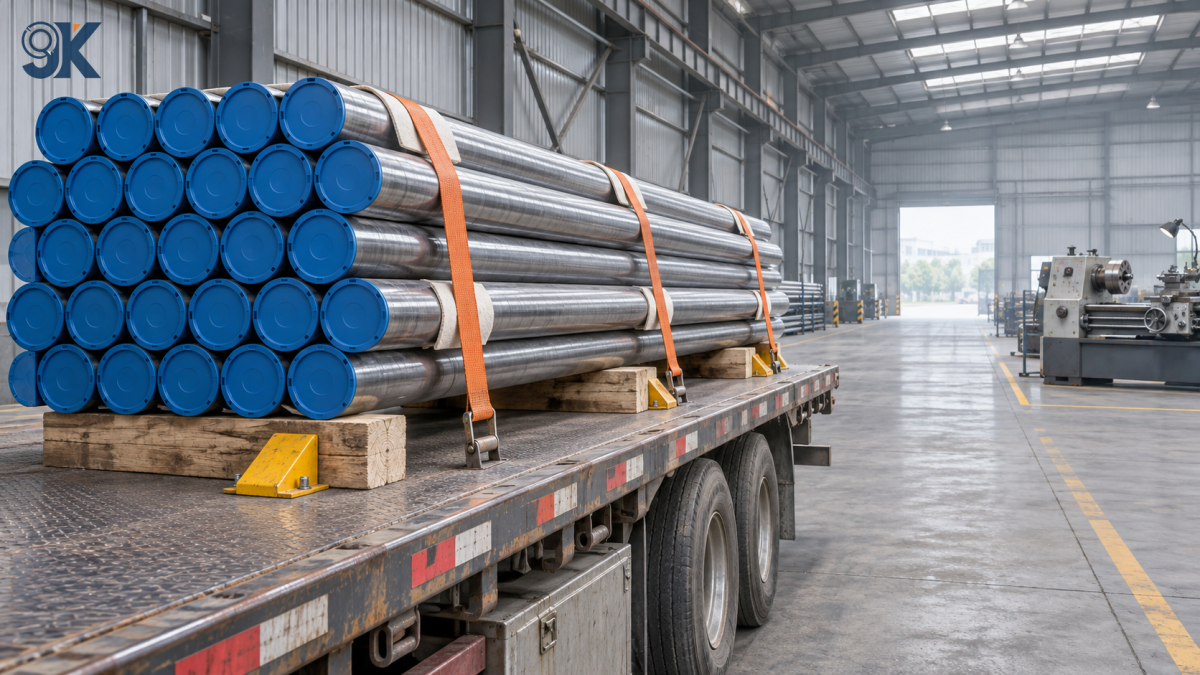
Keep personnel clear of suspended loads, control the lifting path, and set the load down onto prepared supports rather than dropping it into position. A small collision during loading can damage a pipe end even when the bundle and its wrapping appear intact afterward.
Secure the load against movement, not just against falling off
Road movement creates forces in several directions. Braking pushes the load forward; acceleration and vibration can cause settling; turning and uneven roads can produce lateral movement. A securing arrangement must address those forces while keeping pressure on the pipe within acceptable limits.
Inspect the vehicle bed before loading. Remove debris, protruding fasteners, and contaminants, and provide suitable dunnage between the steel and the bed. Arrange supports to carry the load along its length and maintain a stable profile. Where round bundles could roll, use appropriate chocks or other positive restraints compatible with the vehicle and load.
Restraints should be selected and positioned according to the cargo weight, configuration, vehicle design, route, and applicable transport requirements. Edge protection and load spreaders can reduce concentrated pressure, but their use must not compromise the effectiveness of the restraint. Do not use pipe end caps, light wrapping, or unsecured timber as the primary means of preventing movement.
For long pipes, check overhang, axle loading, turning clearance, and any route or permit restrictions before dispatch. If the vehicle must stop for a securing inspection, the driver should follow a safe procedure and the carrier’s instructions. Retightening must not introduce damaging pressure; any shifted or unstable load should be made safe using a controlled unloading or re-securing plan.
When pipes are packed into a container before road transport, the same principles apply inside it: stable support, separation where needed, and restraint against longitudinal and lateral movement. The container floor, walls, and securing points must be suitable for the proposed load. Closing the doors does not prevent cargo movement, and door-adjacent pipes must not be positioned so that they can fall out when the container is opened.
Plan the port handover before the truck leaves
The final transfer can undo earlier precautions if the terminal uses different equipment or has different receiving conditions. Confirm the delivery window, cargo description, bundle weights and dimensions, unloading method, and any terminal restrictions with the relevant parties before dispatch. The carrier should know where to report and whom to contact if the receiving area cannot handle the load as planned.
For loose or bundled pipe delivered for conventional vessel loading, agree who will provide lifting points and protective gear at the terminal. If the cargo is already in a container, clarify whether the container will remain sealed until the next agreed inspection point. A sealed container can limit visibility of the internal cargo condition, making photographs and packing records at dispatch particularly valuable.
Responsibility should be clear at each handover. Record the time, vehicle and shipment identifiers, bundle count, visible condition, and any exceptions on the delivery or terminal receipt. Photographs should show the overall load, restraint arrangement, identifying marks, pipe ends, and any existing damage. They support an investigation, but they do not replace an inspection or prove the condition of surfaces hidden inside a bundle.
Decide in advance what happens when damage is found
A damaged cap does not automatically mean the pipe is defective, and an undamaged cap does not prove that the end beneath it is acceptable. If there is evidence of impact, shifting, broken restraints, wet packaging, or contamination, isolate the affected material where practicable and preserve the relevant packaging and records. Do not conceal the issue by replacing the protection before the condition has been documented.
The next action depends on the damage and the project specification. A qualified party may need to inspect the end preparation, measure straightness or ovality, assess a coating defect, or determine whether cleaning and repair are permitted. Surface grinding or reworking should not be assumed acceptable: it can affect wall thickness, finish, traceability, or compliance with the purchase requirements.
Agree who has authority to release, repair, reject, or replace affected material, and communicate the decision before the shipment proceeds. Where port deadlines are tight, the practical choice may be to separate unaffected, traceable bundles from material requiring assessment—provided the terminal and shipment documentation can accommodate the change.
The strongest damage-control plan is therefore specific to the pipe and visible to everyone who handles it. Define acceptable condition, prepare the load for the actual route, document its state at transfer points, and give each party a clear way to stop and resolve an exception before it becomes a shipment or project delay.
Latest News
- Which export market trends affect demand for square tubes?
- How do iron ore prices affect steel pipe price trends?
- How do tariffs affect square tube export markets?
- How steel pipe price trends affect inventory valuation
- Steel pipe price forecast for 2026 amid changing raw material costs
- Square Tube Export News: What Buyers Should Watch in Freight and Supply
Send Us A Message

