When should steel pipes be beveled before welding?
Steel pipes should be beveled before welding when wall thickness, joint design, or the applicable welding procedure requires greater access to the root of the joint. Proper beveling helps welders achieve the required penetration and fusion, while reducing the risk of costly defects and rework. For operators, knowing when to prepare the pipe ends—and which bevel geometry to use—is an essential part of Steel Pipe Processing. This guide explains the practical factors to check before welding, including pipe thickness, welding method, and project specifications.
The decision starts with the joint, not a universal thickness limit
A bevel removes material from the edge of a pipe end to create a groove when two components are fitted together. That groove gives the welding arc and filler metal access to areas that may otherwise be difficult to fuse. It can be necessary for a complete-joint-penetration butt weld, but not every pipe weld requires one.
Thin-wall tube can often be joined with a square-edge preparation when the approved procedure provides adequate access and penetration. As wall thickness increases, a square butt joint becomes more difficult to weld through from one side. A groove may then be needed to reach the root and fill the joint in controlled passes. The exact point at which preparation changes depends on the process, access, material and governing requirements; there is no single thickness that applies to every job.
Joint type matters just as much. A butt weld between two pipe ends may require a bevel, while a socket or fillet-welded connection has a different joint design. A partial-penetration weld may also have a different preparation from a full-penetration weld. Do not specify a bevel simply because the material is called pipe: check what the drawing actually asks the weld to do.
When beveling is usually necessary
The clearest reason to bevel is that the specified weld requires root access that a square end cannot reliably provide. This often arises on heavier-wall butt joints welded from the outside, particularly where the inside of the pipe is inaccessible. Without a suitable groove, an apparently sound surface bead can conceal lack of fusion deeper in the joint.
Beveling is also needed when it is shown on the joint detail or required by the welding procedure specification, commonly called the WPS. An operator should not substitute a square edge because it looks faster, or select a different angle because the pipe happens to fit. The procedure may have been qualified for a specific range of joint variables, and a change may require engineering review or requalification.
Another common reason is a transition between components with different wall thicknesses or inside diameters. A bevel alone does not automatically correct the mismatch. The drawing may require a taper, internal machining or another transition detail to provide an acceptable fit and weld profile. Removing material without checking the minimum permitted thickness can create a new problem while trying to solve the old one.
Conversely, a square butt joint may be appropriate where the specified process can achieve the required result on the material and thickness involved. Thin-wall applications, some mechanized processes and joints with access from both sides may allow different preparations. The WPS and acceptance requirements—not habit—settle the question.
Bevel angle, root face and gap work together
The bevel angle is only one part of the geometry. The root face, sometimes called the land, is the flat portion left at the pipe edge. The root opening is the separation between the fitted edges. Together, these dimensions affect arc access, heat concentration and the amount of filler needed.
A narrow opening or oversized root face can restrict penetration. An excessive gap or an overly thin land can make the root difficult to control and increase the chance of burn-through. A wider groove may improve access, but it also requires more weld metal and can increase welding time and distortion. The best geometry is therefore not simply the largest angle that fits.
A single-V preparation is familiar on pipe butt welds, but it is not the only option. J and U preparations can reduce the volume of weld metal on suitable heavier sections, although they generally demand more involved machining. A double-sided preparation can distribute weld metal across both sides of a joint when internal access and the design permit it. Choose from the joint detail and production constraints, rather than assuming one profile is universally better.
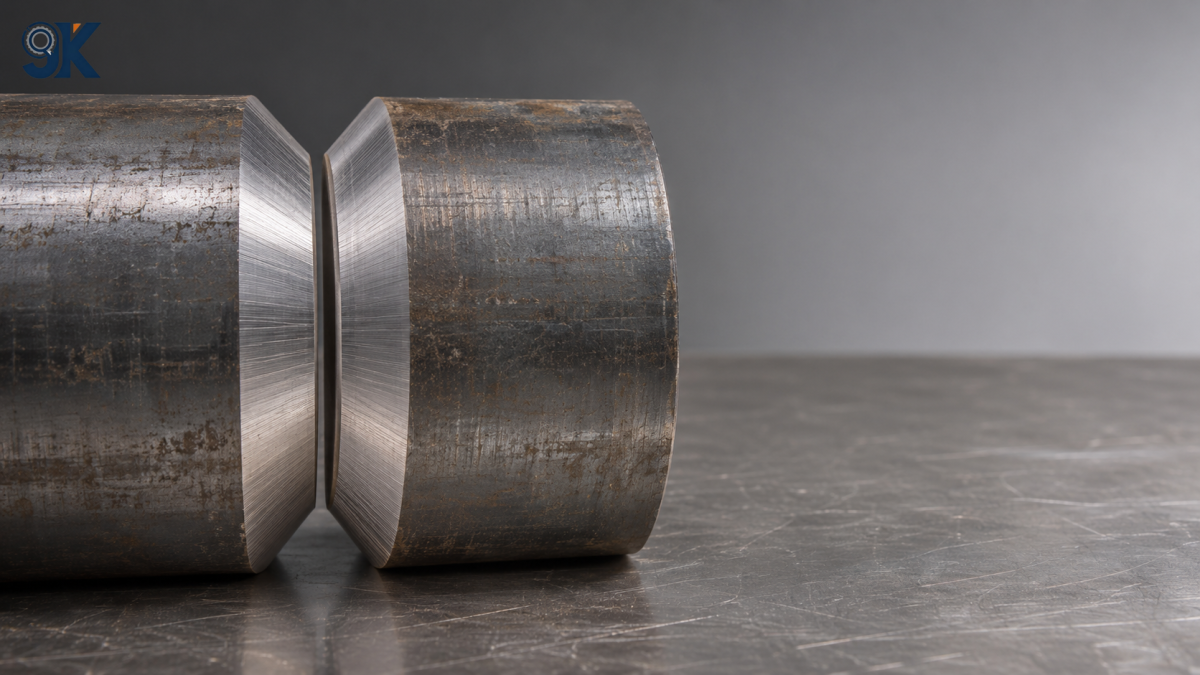
When reading a drawing, check whether an angle refers to one prepared edge or to the included angle of the assembled groove. Confusing those two measurements can produce a joint that looks plausible at fit-up but falls outside the specified detail. Measure the prepared ends and verify the assembled gap separately; one does not guarantee the other.
What the welding process changes
Different processes deliver and control heat differently. Gas tungsten arc welding is often selected for controlled root passes, while shielded metal arc welding and gas metal arc welding may be used for root, fill or cap passes depending on the procedure. These choices influence the practical groove shape, root opening and number of passes.
Position also changes the operator’s challenge. A preparation that is manageable on a rotating pipe may be harder to weld on a fixed line, especially at the overhead portion. Restricted access around an installed pipe can limit the torch or electrode angle even when the groove dimensions are technically correct. Before preparing a batch, confirm that the welder can physically reach the joint in the intended position.
Backing and back welding are equally important. A backing ring, backing gas or weld made from the opposite side may be part of the approved procedure, but these are not interchangeable. Some services restrict permanent backing or require particular internal conditions. If the root will be inaccessible after fit-up, resolve those requirements before the ends are cut.
Which standards and documents should operators check?
Start with the project drawing, joint detail and applicable WPS. Then confirm the construction code and project specification identified for the work. Depending on the application, the governing framework may include ASME B31.3 for process piping, ASME B31.1 for power piping, or API 1104 for certain pipeline welding activities. The applicable edition and any project-specific amendments matter; these documents do not all apply to every pipe installation.
ASME Section IX addresses qualification of welding procedures and personnel where invoked; it should not be treated as a universal drawing for every pipe-end bevel. ASME B16.25 covers butt-welding ends for components within its scope and can be relevant to end preparation. ISO-based projects may refer to ISO 9692-1 for recommended joint preparation in specified steel welding applications. In each case, confirm scope and contract requirements rather than borrowing a dimension from an unrelated standard.
The material specification, pipe schedule or nominal wall thickness alone does not provide a complete welding instruction. Actual dimensions and tolerances, filler selection, preheat where required, inspection method and acceptance criteria may all affect the job. If the drawing and WPS appear inconsistent, stop and request clarification through the responsible welding or engineering team.
Preparation method matters as much as the drawing
Machining generally provides good dimensional control and is useful when the root face and angle must be held consistently. Portable beveling equipment can prepare installed or long pipe without moving the entire length. Grinding may be suitable for local correction, provided the operator can maintain the required profile and does not remove excessive material.
Thermal cutting can be practical, but the cut surface must be assessed against the applicable procedure and material requirements. Slag, oxides and irregularities may need to be removed, and some materials or specifications may require additional controls because heat can affect the cut edge. Do not assume that a visually clean flame-cut surface is automatically ready for welding.
Before fit-up, remove contaminants from the weld area as required by the procedure. Oil, paint, rust, moisture and cutting residue can interfere with welding or inspection. For galvanized pipe, zinc coating introduces additional fume and weld-quality concerns. Follow the approved preparation method and site controls, including suitable ventilation and respiratory protection where required; coating removal and repair should be specified rather than improvised.
The same distinction applies when other coated steel products are present in a workshop. For example, DX52D+Z Galvanized Steel Wire should not be assumed to be a welding filler merely because it is steel wire. Filler material must match the qualified procedure and be identified for its intended welding use.
A practical fit-up check before the root pass
A good bevel can still produce a poor joint if the pipe ends are misaligned. Check the bevel profile, root face and opening against the approved documents around the circumference, not just at the easiest point to reach. Pipe ovality, uneven cutting and inconsistent wall thickness can cause the gap to vary as the joint is rotated.
Pay particular attention to internal alignment, often called hi-lo. Excessive mismatch can make root fusion difficult and leave an internal step that may not be acceptable for the service. Clamps and tack welds can hold alignment, but they should not force a joint into position in a way that damages the pipe or contradicts the fit-up procedure. Inspect tacks before welding over them, and repair or remove defective tacks as required.
If the gap falls outside the permitted range, do not fill it by guesswork. The remedy may be repositioning, controlled re-preparation or an approved repair method. Repeated grinding can shorten a pipe or reduce the root face beyond tolerance, so check both the joint and the finished length before making corrections.
Ordering prepared pipe ends without creating downstream rework
When beveling is performed before delivery, send the supplier the joint drawing and identify which ends require preparation. Include pipe material, outside diameter, wall thickness, finished length, bevel geometry, dimensional tolerances and any requirements for cleanliness, identification and end protection. State whether dimensions are measured before or after preparation, particularly when cut length is critical.
It is also worth agreeing on how prepared ends will be checked and protected during handling. A dented land or damaged edge can turn an otherwise accurate preparation into a fit-up problem. For mixed orders, marking each item against its drawing or line reference makes it easier to keep different joint details separate on site.
Shandong Jiukai Metal Materials Co., Ltd. combines custom pipe production and processing with warehousing, logistics and export documentation. For machinery manufacturers considering preprocessed pipe, an early drawing review can help clarify specification selection and delivery arrangements, whether the requirement is a trial batch or a longer-term order. The key is to settle the welding detail before processing begins: a supplier can prepare the end, but the project’s approved welding documents define what that end must be.
Latest News
- How do iron ore prices affect steel pipe price trends?
- How do tariffs affect square tube export markets?
- How steel pipe price trends affect inventory valuation
- Steel pipe price forecast for 2026 amid changing raw material costs
- Square Tube Export News: What Buyers Should Watch in Freight and Supply
- What new trade investigations mean for steel pipe exports
Send Us A Message

