
News center
Why does carbon steel pipe corrode under insulation?
Carbon steel pipe corrodes under insulation when moisture reaches the steel and remains there long enough to support corrosion. The insulation holds water against the surface, while damaged coating, oxygen and dissolved contaminants allow metal loss to develop out of sight. A dry-looking jacket does not prove that the pipe underneath is dry.
The immediate response to suspected corrosion under insulation (CUI) is to locate likely water entry points, assess whether the line is safe to inspect, and determine the remaining wall thickness where damage is found. Replacing wet insulation without examining the steel and coating can conceal an active problem.
How water gets past the outer covering
Insulation jacketing sheds water, but its seams, joints and penetrations are rarely a perfect barrier throughout the life of a piping system. Rain can enter through damaged cladding, poorly sealed longitudinal seams, open end caps or gaps around valve stems and supports. Water running along the outside of a vertical line can also pass behind a jacket where an upper section is incorrectly overlapped or has separated.
Condensation creates a different route. On cold pipework, warm, humid air that reaches a surface below the air’s dew point can deposit water. A break in the vapor barrier at a fitting, hanger or repaired section gives humid air a path into the insulation. Sealing the outside after the insulation has become wet will not necessarily dry it; trapped moisture can continue to contact the pipe.
Washdown water, leaks from equipment above and temporary exposure during maintenance are additional sources. The visible entry point may be some distance from the worst corrosion because water travels along the pipe, through insulation joints or around supports before collecting at a low point.
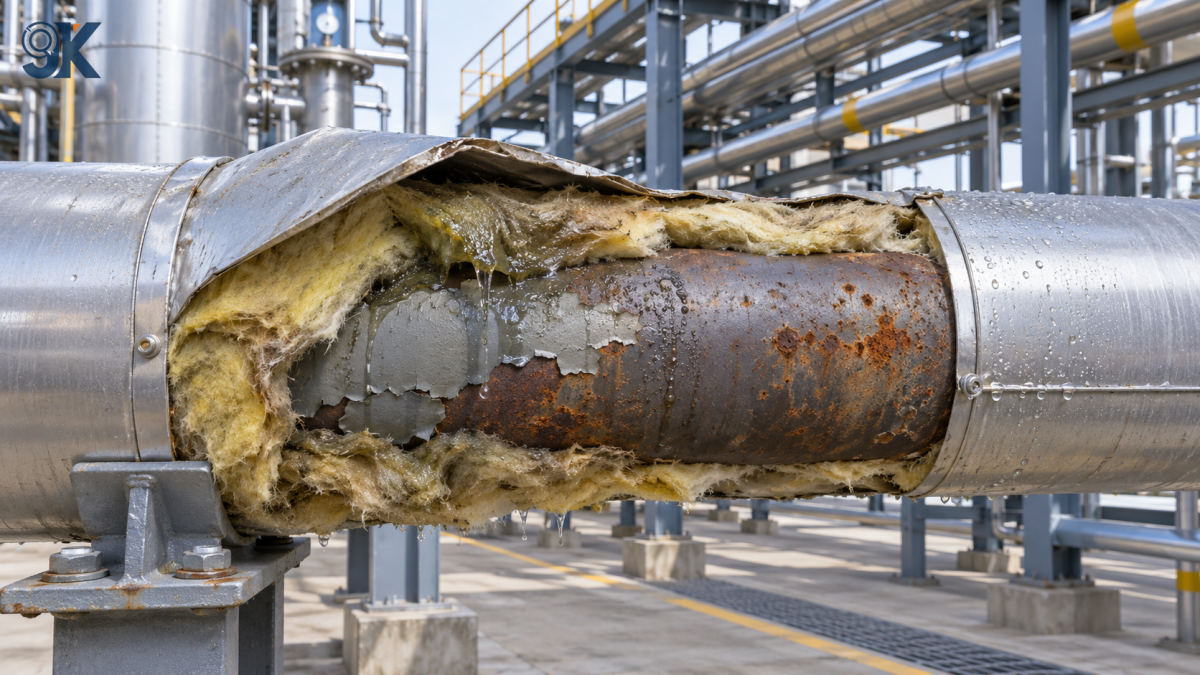
Pay particular attention to terminations, elbows, flanges, valve stations, supports and transitions between horizontal and vertical runs. These details interrupt the jacket and insulation, making them harder to seal and inspect than a straight, uninterrupted length. A rust stain below a seam is a useful reason to investigate, although the absence of staining does not establish that the steel is sound.
Why trapped moisture attacks carbon steel
Water on the steel surface acts as an electrolyte. In the presence of oxygen, electrochemical reactions convert iron into corrosion products and reduce the pipe wall. Wet insulation extends the time that moisture stays in contact with the pipe, and a compromised coating exposes local areas of steel to that moisture.
Repeated wetting and drying can concentrate dissolved salts at the surface. Chlorides from a coastal atmosphere, contaminated wash water or other sources can make the moisture more aggressive. The presence of a salt alone does not establish the rate of attack: oxygen supply, temperature, surface condition and the duration of wetness also affect the outcome.
Insulation condition matters, but insulation should not be judged by appearance alone. Some materials retain more water than others; joints, damaged facings and installation details can still admit moisture regardless of the insulation type. Water-resistant insulation also cannot compensate for a damaged protective coating or an unsealed penetration.
Temperature changes the exposure
Pipe surface temperature influences how long water remains liquid, how quickly corrosion reactions proceed and whether moisture evaporates. A line that cycles between operating and ambient conditions can experience repeated condensation or wetting. Shutdowns are particularly relevant when a normally hot surface cools and remains damp beneath insulation.
A hot operating temperature should not be treated as proof that CUI is impossible. Temperature can vary along a line, at supports and around fittings, and it changes during startup and shutdown. Conversely, a cold line may collect condensate when the vapor barrier is damaged. Evaluate the actual surface temperatures and operating history rather than relying only on the fluid’s normal operating temperature.
Finding the damage without mistaking the symptom
Begin with the condition of the jacket and the surrounding installation. Crushed cladding, missing fasteners, loose bands, damaged sealant and gaps around attachments identify places where moisture can enter. Note whether the defect is exposed to rain, washdown or a source of leakage above it. Record the location so that it can be compared with later inspections.
External clues are incomplete. Rust-colored staining can come from adjacent steelwork, and a clean jacket can cover saturated insulation. A wet patch at one end of a run does not establish where water entered. Use these observations to select inspection locations, then confirm conditions beneath the insulation.
Inspection openings should expose enough of the suspect area to assess the insulation, coating and pipe surface. At a support, corrosion can be concentrated where water collects or where contact damages the coating; a small opening beside the support may miss the affected area. Openings also need to be reinstated with compatible insulation, vapor barrier where required, and weatherproof jacketing after the examination.
Non-destructive examination can help assess wall thickness, but the method and access matter. Ultrasonic thickness measurement on an exposed, prepared surface provides local readings. A few readings on sound-looking steel do not rule out a nearby pit, so measurement locations and coverage should reflect the observed damage pattern. Where insulation remains in place, a suitable screening method may help identify areas for further examination, subject to its limits for the pipe geometry, insulation and defect size.
Compare measured thickness with the required minimum for the actual piping service and applicable design basis. Nominal wall thickness is not a rejection limit, and an isolated reading cannot describe the full extent of local thinning. Record the measurement location, technique and surface condition so future readings can be compared meaningfully.
When corrosion is found
If the pipe is leaking, visibly distorted or severely thinned, treat the condition as a potential loss of containment. Control access and follow the site’s isolation and pressure-release procedures before disturbing the insulation or pipe. Surface cleaning, coating work and repair can expose weakened metal; their suitability must be assessed against the condition and service of the line.
Remove wet insulation from the affected area and extend the examination far enough to establish the limits of moisture and corrosion. Clean the steel sufficiently to reveal pitting and coating defects, then measure the remaining wall. If the damage approaches or falls below the applicable minimum thickness, have the line assessed for an engineered repair or replacement under the site’s piping integrity procedure.
Do not assume that shallow-looking rust is harmless. Scale can conceal pits, especially at the underside of a horizontal pipe or beneath a support. Equally, heavy staining on insulation does not by itself prove that the pressure boundary has lost unacceptable wall thickness. The decision follows from the exposed surface, measured wall and service requirements.
When pipe replacement is necessary, verify the specified grade, dimensions and pressure-boundary requirements before installation. Materials used for adjacent components do not establish the material for the pipe itself. For example, Duplex Alloy Bar belongs to a different material category; its presence in an assembly does not make it an interchangeable replacement for a carbon steel pipe section.
Restoring protection after inspection or repair
Find and correct the moisture path before closing the insulation. If water entered through an open valve penetration, simply replacing the insulation around the valve leaves the original route available. If a support traps water, review its detail and the coating damage at the contact area as part of the repair.
Prepare the steel and apply a coating system selected for the pipe surface temperature, service cycle and exposure. Coating performance depends on surface preparation, application conditions and adequate curing as well as product selection. At welds, edges and supports, inspect coverage carefully: these areas are difficult to coat uniformly and can be damaged during reassembly.
Reinstall insulation only when the substrate and coating are ready under the coating system’s requirements. Replace insulation that cannot be dried or restored to its specified condition. On cold lines, continuity of the vapor barrier at joints, fittings and supports is essential to control condensation; on outdoor lines, jacket overlaps and sealed penetrations must shed rain without directing it behind the cladding.
Keep inspection openings, measurements and repairs in the line’s maintenance record. Repeated wetting at the same location calls for investigation of the installation detail or water source, even if the steel has not yet reached its minimum permitted thickness. That history helps select the next inspection location and prevents a repaired section from being closed over the same unresolved cause.
Latest News
- How do iron ore prices affect steel pipe price trends?
- How do tariffs affect square tube export markets?
- How steel pipe price trends affect inventory valuation
- Steel pipe price forecast for 2026 amid changing raw material costs
- Square Tube Export News: What Buyers Should Watch in Freight and Supply
- What new trade investigations mean for steel pipe exports
Send Us A Message

