
Why Steel Pipes Rust in Storage: Condensation and Drainage Problems
A bundle of steel pipes can arrive dry, remain under a roof, and still develop rust before the next inspection. For the quality team, that raises an uncomfortable question: did the problem begin during transport, or did the warehouse create it? The answer often lies in moisture that nobody saw forming—and water that had no reliable way to escape.
When pipe surfaces fall below the surrounding air’s dew point, condensation can form on both external and internal surfaces. Tight bundles, blocked pipe ends, uneven supports, and poorly drained floors then keep that moisture against the steel. Effective Steel Pipe Warehousing therefore depends on controlling two linked conditions: how water reaches the material and how long it stays there.
The roof is dry. Why are the pipes wet?
Carbon steel corrodes when moisture and oxygen support electrochemical reactions at its surface. Rain is an obvious source of water, but condensation is easier to overlook because it can appear without a leak, splash, or visible weather exposure.
Steel pipes have considerable thermal mass. After a cold night or a journey through cooler conditions, they may remain cold even when the warehouse air warms quickly. If warm, humid air enters through loading doors, water vapor can condense on the colder steel.
For example, air at approximately 25°C and 80% relative humidity has a dew point near 21°C. Pipes below that temperature can become wet even though the building feels warm. This is why opening every door to “air out” a warehouse can sometimes make the problem worse.
Conditions that deserve particular attention include:
- Seasonal temperature changes: cold inventory encounters warmer, moisture-laden air.
- Frequent loading-door operation: changing outdoor conditions repeatedly reach stored bundles.
- Cold incoming material: pipes enter a warmer warehouse before their temperature has equalized.
- Unconditioned containers or covered storage: temperature cycling produces condensation on steel or surrounding enclosure surfaces.
Warehouse humidity alone does not establish whether condensation will occur. Inspectors need the relationship between air temperature, relative humidity, and actual pipe surface temperature.
Find the places where water cannot leave
A small amount of moisture can become a persistent corrosion problem when it collects in sheltered locations. The exposed top of a bundle may dry while the lower layers remain wet. A clean-looking outer pipe is therefore not proof that the entire bundle is dry.
Drainage is not simply a matter of raising pipes off the floor. A supported bundle can still trap water internally if its orientation creates low points or if packaging blocks the outlets. Similarly, placing a waterproof sheet over wet material may protect it from further rainfall while extending the time that existing moisture remains in contact with steel.
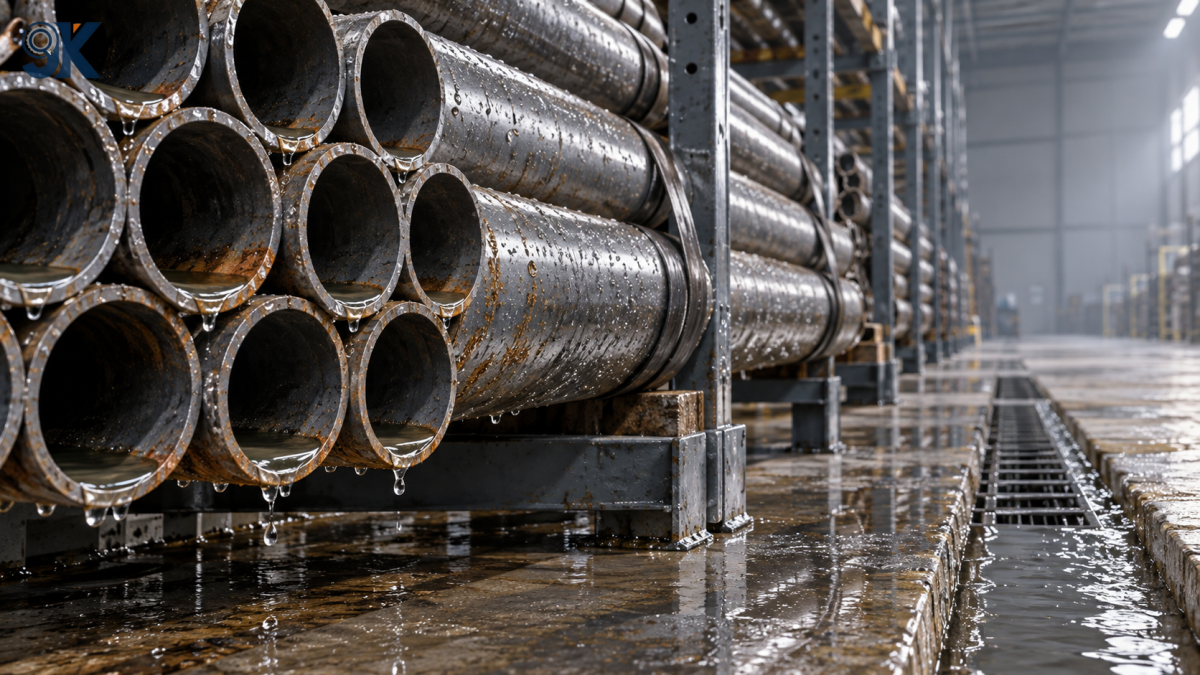
Water marks can reveal the route moisture has taken. Repeated rust bands near supports suggest retained moisture at those interfaces; corrosion concentrated around pipe ends may point toward entry, drainage, or packaging problems. These patterns are clues rather than proof, so compare them with temperature records and the material’s handling history.
A practical investigation before moving the whole bundle
When rust appears, the immediate temptation is to unwrap, separate, and clean everything. That may eventually be necessary, but uncontrolled handling can lose useful evidence and create rolling or lifting hazards. Begin with a documented inspection of the affected storage position.
Check the environment and the steel together
Record air temperature and relative humidity near the affected material, then measure representative pipe surface temperatures. Include lower layers and positions close to doors or external walls where accessible. Compare the surface readings with the calculated dew point.
Infrared thermometers require care on shiny or reflective steel because emissivity can distort readings. A suitable contact probe, or a validated measurement method, can provide a more dependable basis for decisions. One reading after the warehouse has warmed may miss an overnight event, so use logged measurements where recurring condensation is suspected.
Trace moisture to its likely source
Look for roof drips, container condensation, washdown water, wet forklift routes, damp timber, or rain entry around loading bays. Ask when the bundle arrived, whether it was wet on receipt, and whether its wrapping or end protection changed. An incoming inspection photograph can be more useful than recollection several weeks later.
Inspect accessible pipe bores using suitable lighting or a borescope when internal condition matters. Do not assume that a dry pipe mouth means the full length is dry. Equally, do not remove straps or climb unstable stacks merely to obtain a better view; use an approved handling plan to expose hidden surfaces.
Map the affected stock
Record bundle identification, heat or batch references where applicable, storage position, affected surfaces, and visible severity. Distinguish isolated staining from widespread corrosion. This allows the quality team to hold the correct material without unnecessarily stopping unrelated inventory.
Improve drainage without creating a storage hazard
The objective is to remove standing water while keeping bundles stable, identifiable, and accessible. Improvised drainage arrangements can introduce risks more immediate than the corrosion itself.
Start with the floor. Keep drainage channels clear and investigate recurring puddles rather than repeatedly sweeping them away. Stock should not sit where roof runoff, cleaning water, or vehicle traffic directs moisture toward it. Use supports appropriate to the bundle load, storage duration, and site conditions.
Review the support layout. Supports should prevent ground contact and avoid unnecessary water traps. Wet, contaminated, or deteriorating dunnage should be replaced. Support spacing must also suit the pipe dimensions and load so that correcting a moisture problem does not introduce bending or instability.
Provide a verified drainage path. Where the storage system permits it, a controlled longitudinal fall can help water leave pipe bores. Any slope must be compatible with the rack design, restraints, and lifting arrangements. Never improvise a tilt with loose wedges or rely on friction to prevent round pipes from rolling.
Check end protection. Caps and plugs serve different purposes, including cleanliness and transit protection. Depending on their design, they may also retain water. Follow the specified protection method, check that pipes are dry before closure, and use approved drainage or ventilation provisions where appropriate. Removing all caps indiscriminately can exchange a moisture problem for contamination or end damage.
Make ventilation and packaging work with the weather
More airflow is not always better. Ventilation helps when incoming air can remove moisture without causing condensation on colder steel. When outdoor air is warm and humid, uncontrolled ventilation may add moisture faster than it removes it.
In enclosed storage, consider controlled ventilation or dehumidification based on measured conditions. Place sensors near vulnerable stock rather than relying solely on a wall-mounted display elsewhere in the building. For critical material, establish an operating margin above dew point that accounts for sensor accuracy and local temperature variation.
Packaging also needs a purpose. Covers should shed external water without forming pockets that collect it. Where wrapping is required, select a system compatible with the expected storage period, climate, surface treatment, and customer requirements. Desiccants or vapor corrosion inhibitors may be useful in appropriately designed packaging, but they cannot compensate for sealing visibly wet pipes or allowing continuing water ingress.
Mixed-material warehouses need an additional check. If steel pipes share storage areas with products such as 6003 Aluminium Bar, use suitable segregation and clean supports to limit cross-contamination and wet dissimilar-metal contact. Aluminum does not develop the same red rust as carbon steel, but shared damp storage conditions still require material-specific corrosion controls.
Deciding whether rusty pipes can be released
Rust color alone is not an acceptance criterion. A light surface film may be removable, while localized pitting can matter significantly for pressure service, precision machining, coating, or fatigue-sensitive components. The correct decision depends on the purchase specification, applicable product standard, intended use, and customer requirements.
For quality control personnel, a defensible disposition follows this sequence:
- Identify and hold affected material while preserving traceability.
- Inspect representative areas, including hidden interfaces and bores where relevant.
- Clean selected areas using an approved method to distinguish removable deposits from underlying damage.
- Assess dimensions and surface condition, using suitable thickness or pit-depth measurements when required.
- Authorize release, rework, or rejection against documented acceptance criteria.
Do not assume that oiling over rust restores the original condition. Likewise, aggressive cleaning can alter dimensions, surface finish, or identification markings. If a protective oil or coating is applied after drying, confirm compatibility with later welding, machining, painting, and customer handling requirements.
Safety personnel should also consider standing water around stacks, slippery oily surfaces, and the risks of releasing bundle restraints. Any cleaning or drying activity must fit the site’s lifting, chemical-handling, and access procedures.
Build the controls into warehouse and export handovers
The most useful Steel Pipe Warehousing checks occur at transitions: receipt, relocation, repacking, and dispatch. These are the moments when moisture conditions change and responsibility can become unclear.
At receipt, document wet packaging and visible internal or external moisture. During storage, increase inspections after humid weather, major temperature changes, or drainage failures. Before shipment, confirm that pipes, supports, and packaging are suitably dry, and that the selected protection matches the expected journey.
For a provider such as Shandong Jiukai Metal Materials Co., Ltd., whose services span production, processing, warehousing, and export logistics, these checks belong across the handling chain—not only at final inspection. Dispatch through ports such as Qingdao, Tianjin, or Rizhao can involve further temperature changes and moisture exposure. FCL, LCL, and bulk shipments each require protection suited to their handling and exposure conditions.
The key question is not simply whether pipes were dry when someone last looked. It is whether the storage and shipping arrangement prevents new condensation where practicable, lets incidental water escape, and makes hidden moisture discoverable. When those conditions are controlled, quality teams face fewer uncertain release decisions—and warehouse teams spend less time reopening bundles that should have remained ready for use.
Latest News
- How do iron ore prices affect steel pipe price trends?
- How do tariffs affect square tube export markets?
- How steel pipe price trends affect inventory valuation
- Steel pipe price forecast for 2026 amid changing raw material costs
- Square Tube Export News: What Buyers Should Watch in Freight and Supply
- What new trade investigations mean for steel pipe exports
Send Us A Message

