
News center
Which steel coil types are used in automotive body panels?
Automotive body panels commonly start with cold-rolled steel coil, galvanized or galvannealed steel coil, and, for selected components, advanced high-strength steel coil. The right choice depends on the part: an exposed door skin needs excellent surface quality and formability, while an inner panel or reinforcement may place greater demands on strength, stiffness, or crash performance.
These descriptions overlap. Cold rolling describes how the sheet is produced; galvanizing describes a zinc-based coating; and advanced high-strength steel describes a family of grades with particular mechanical properties. A single coil can therefore be cold-rolled, zinc-coated, and made from a high-strength grade. Understanding those distinctions makes the Uses of steel coils in vehicle bodies much easier to compare.
Which coils go into which body parts?
A vehicle body combines exposed panels, inner panels, and structural parts. They do not all face the same forming operations or performance requirements, so the material used for a visible hood skin may differ substantially from the material behind it.
These are application patterns, not fixed rules. A manufacturer may choose a different grade for the same nominal part depending on its geometry, joining method, corrosion strategy, and vehicle design. “Body panel” can also mean different things in conversation: a door outer skin is a visible sheet-metal panel, while a door reinforcement is a structural component within the door assembly.
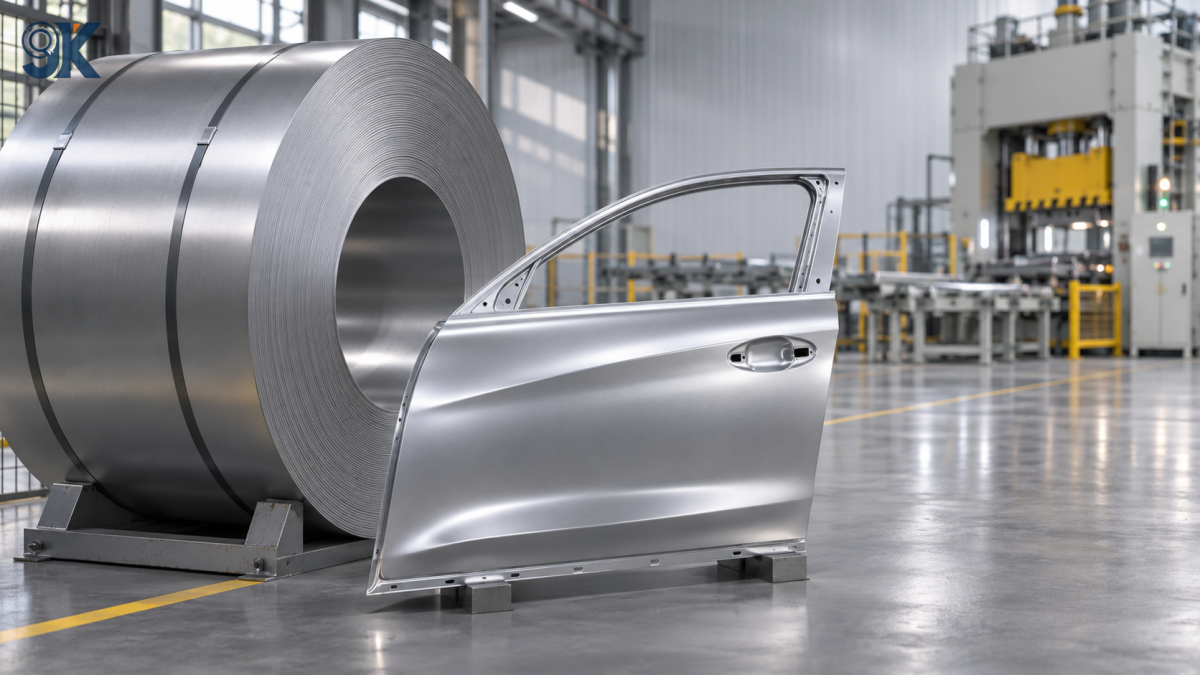
Cold-rolled steel: the starting point for many stamped panels
Cold-rolled low-carbon steel is used where a sheet must be formed into a complex shape with a consistent surface. Compared with strength-driven structural grades, these steels can offer greater forming latitude, which matters when a blank must stretch or draw into a door, fender, hood, or inner panel without splitting.
Interstitial-free, or IF, steels are an important option for demanding forming operations. Their composition and processing are designed to provide high formability, making them suitable for parts with deep draws or complex contours. A grade chosen for a difficult inner panel, however, may not be the same grade chosen for a highly visible exterior surface: the latter also requires close attention to surface defects and appearance after painting.
Cold-rolled sheet may be supplied uncoated or with a metallic coating. Uncoated sheet can be appropriate where the part design and subsequent finishing process provide the required protection. In areas with significant corrosion exposure, a coated sheet may offer a more suitable starting point. The choice depends on the complete body and coating system, including pretreatment, paint, sealants, drainage, and exposure.
Zinc-coated coils: protection with production trade-offs
Galvanized automotive sheet carries a zinc-based coating intended to improve corrosion resistance. Zinc-coated coils are used for many outer and inner body parts, including areas where moisture and road contaminants can collect. The coating does not eliminate the need for good joint design or paint protection, but it adds a protective layer to the steel substrate.
Two coating routes are relevant when comparing automotive coils. Hot-dip galvanizing applies a zinc coating by passing the strip through a molten zinc bath. Electrogalvanizing deposits zinc electrolytically. Both can be used for automotive sheet, but coating characteristics, available specifications, and processing behavior differ. The coating designation alone does not establish that a coil is suitable for a particular visible panel.
Galvannealed sheet is produced by heat-treating a hot-dip zinc-coated sheet to form a zinc-iron alloy layer. It can be selected for its compatibility with certain welding and painting operations. At the same time, its coating behavior during severe forming needs attention: powdering or flaking can become a concern if the coating and forming conditions are poorly matched.
For exposed panels, buyers need to consider both sides of the sheet. The visible surface must support the required finish, while the reverse side may face moisture or contact other parts. Coating type, coating mass, surface condition, lubrication, and the stamping process all affect whether the finished part meets its requirements.
When body panels need more strength
Not every panel can be made from a highly formable mild steel. A hood outer, for example, needs to retain its shape and resist minor dents as well as form successfully. Inner panels and body structures can also contribute to stiffness and crash performance. Higher-strength grades address some of these needs, but their benefits come with forming and process considerations.
Bake-hardening steel for selected outer panels
Bake-hardening steel is designed to gain strength during the heat cycle used to cure paint. It can be formed in a relatively workable condition and then develop additional strength in the finished body. This makes it useful for selected outer panels where dent resistance matters.
The amount of strengthening depends on the material and the manufacturing cycle. Stamping strain, paint-bake conditions, and coil aging behavior can all affect the result. A bake-hardening grade therefore needs to be evaluated against the actual production route rather than treated as an automatic upgrade for every exterior panel.
High-strength low-alloy and advanced high-strength steels
High-strength low-alloy, or HSLA, steels use controlled chemistry and processing to provide more strength than many conventional low-carbon sheet grades. They may be selected for inner panels, structural members, and reinforcements where designers need strength without moving to a more demanding material family.
Advanced high-strength steels, often abbreviated to AHSS, cover several families with different combinations of strength and forming behavior. Dual-phase steel is one example used in automotive components. Other families offer different trade-offs depending on how the steel deforms and how the part is manufactured.
AHSS can help designers meet structural and crash requirements while controlling component weight. Higher strength can also make forming more difficult. Springback—the tendency of a stamped part to change shape when released from the die—may complicate dimensional control. Edge cracking, tool wear, and joining behavior can also influence whether a grade works in production.
These steels are more commonly associated with structural members and reinforcements than with a large, deeply drawn visible outer skin. That distinction is useful when reading a vehicle material list: the presence of AHSS in a body does not mean that every exterior panel is made from it.
Hot-stamped steel belongs in the body, but serves a different role
Some high-strength body components begin as coil or sheet intended for hot stamping. In a typical press-hardening process, a blank is heated, formed in a press, and cooled rapidly in the tooling to develop its final properties. Aluminum-silicon-coated press-hardening steel is one material used for this route.
Hot-stamped parts can be used in areas such as pillars and reinforcements where high strength is important. They should not be confused with ordinary cold-stamped outer panels. Their manufacturing route, tooling, and final properties differ, and the process must be considered alongside the part’s crash and joining requirements.
Other steel products may appear relevant because they are supplied as strip or coil, but their application category still matters. For example, S275J0 Carbon Steel Strip is identified by a structural steel designation; that designation alone does not establish the surface quality, forming behavior, coating, or automotive approval needed for a body panel. The required product specification should be checked against the intended part and process.
How to narrow the choice for a particular panel
Start with the part’s function and its location in the body. An exposed panel, a hidden inner panel, and a reinforcement may all be stamped from coil, but their acceptance criteria differ. The following questions separate the material decisions that matter most:
- Is the surface visible after painting? Exposed skins need a surface suitable for the intended finish, as well as control of marks introduced during handling and stamping.
- How difficult is the shape to form? Draw depth, local stretching, edge condition, and the forming route influence the grade and lubrication needed.
- What load must the part carry? Dent resistance, stiffness, and crash performance are different requirements; a strength value alone does not describe all three.
- Where can moisture collect? Coating selection should account for the part’s exposure, joints, drainage, and the rest of the corrosion protection system.
- How will the part be joined and finished? Welding, adhesives, pretreatment, and paint baking can affect the suitability of both the steel grade and its coating.
Once those conditions are clear, the coil specification can be narrowed to a steel grade, thickness, coating, surface quality, and dimensional tolerances. The applicable vehicle manufacturer’s material specification remains central: two coils described as galvanized cold-rolled steel may differ in ways that matter to stamping yield or final appearance.
For an initial assessment, the most useful conclusion is therefore tied to the part. Formable cold-rolled and coated sheet are common starting points for skins and complex panels; higher-strength grades become more relevant where structural performance is required. The final selection rests on whether the specified coil can be formed, joined, protected, and finished consistently as that particular component.
Latest News
- How do iron ore prices affect steel pipe price trends?
- How do tariffs affect square tube export markets?
- How steel pipe price trends affect inventory valuation
- Steel pipe price forecast for 2026 amid changing raw material costs
- Square Tube Export News: What Buyers Should Watch in Freight and Supply
- What new trade investigations mean for steel pipe exports
Send Us A Message

