
News center
Which documents support export customs clearance for steel pipe?
Accurate documentation is essential for smooth Export Customs Clearance of steel pipe. Missing or inconsistent paperwork can cause shipment delays, unexpected costs, and difficulties at the destination port.
Common supporting documents include the commercial invoice, packing list, sales contract, and transport documents. Certificates of origin, inspection records, or mill test certificates may also be required.
For distributors and agents, the practical priority is to confirm which documents apply before production and ensure that shipment details match across the entire document package.
Which steel pipe export documents should buyers request first?
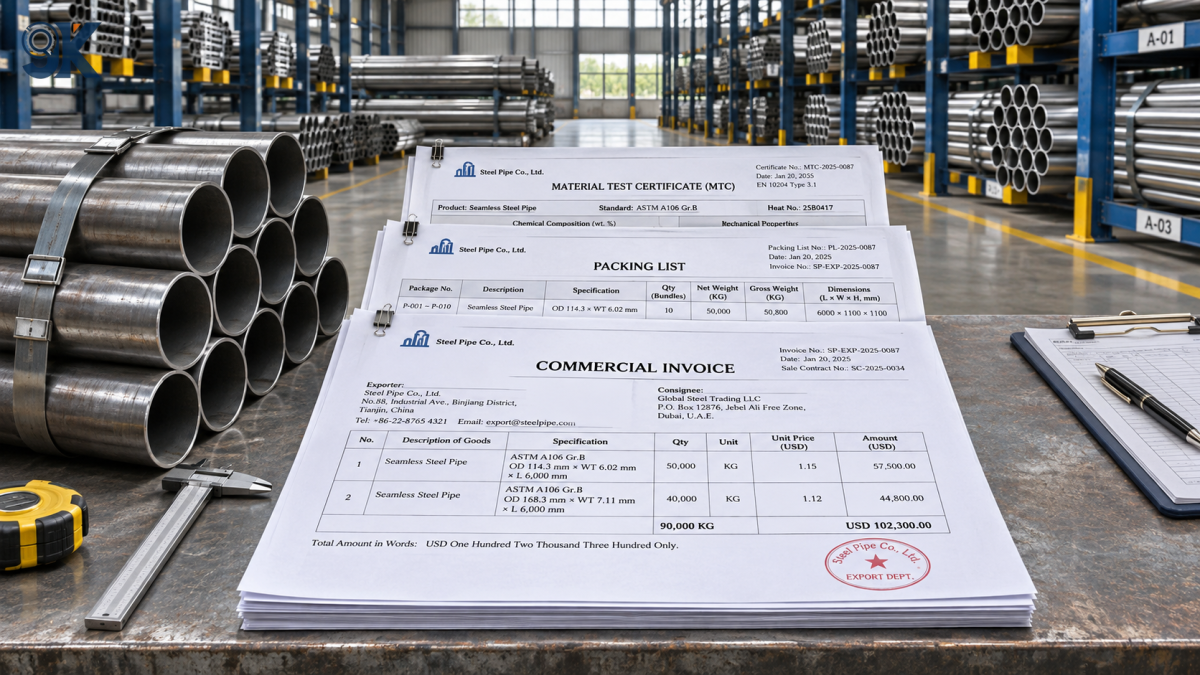
Start with the commercial invoice, packing list, sales contract or purchase order, and transport document. These establish what was sold, how it was packed, and where it is going.
For steel pipe, also request a mill test certificate and confirm whether the destination requires a certificate of origin, inspection certificate, import permit, or other product-specific evidence.
The exact requirements depend on the pipe specification, customs classification, exporting and importing countries, transaction structure, and any applicable trade measures. No single list covers every shipment.
Ask the supplier and customs broker to confirm the requirements for the actual goods and route. Provide the destination, proposed classification, material grade, dimensions, and intended use.
Keep China export formalities separate from destination import requirements. A document requested by the buyer or destination authority may support the transaction without being mandatory for Chinese export clearance.
What information must appear on the commercial invoice?
The commercial invoice records the transaction value and identifies the seller, buyer, and goods. Customs authorities use it alongside other evidence when assessing the shipment.
It should normally show invoice number and date, party details, currency, quantities, unit prices, total value, and the agreed Incoterms rule and named place.
Describe the pipe precisely enough to distinguish the goods. Include material, manufacturing type, grade, outside diameter, wall thickness, length, and applicable standard when relevant.
For example, “seamless carbon steel pipe, ASTM A106 Grade B, 60.3 mm outside diameter, 3.91 mm wall thickness” is more useful than “steel products.”
The invoice should reflect the actual transaction. If freight, insurance, discounts, or other charges are listed separately, ensure their treatment is consistent with the contract.
Do not assume the invoice value alone determines destination customs value. The importer or broker should assess applicable valuation rules and any required adjustments.
If the buyer, consignee, and notify party are different companies, identify their roles clearly. This is especially useful when an agent arranges shipment for a distributor’s customer.
How does the packing list prevent delays and extra handling?
The packing list explains how the goods are physically presented. It helps customs officers, warehouse teams, forwarders, and receivers locate and verify the shipment.
For each bundle or package, record the package number, pipe description, quantity, gross weight, net weight, dimensions, and identifying marks where applicable.
Check that the total number of bundles, pieces, and weight reconciles with the invoice and transport booking. Explain legitimate measurement or rounding differences before documents are issued.
For mixed specifications, separate the quantities and weights by item or bundle. A receiver can then identify the correct pipe without opening every package.
Containerized shipments may also require verified gross mass information under applicable shipping rules. The shipper and carrier should confirm responsibilities and submission deadlines for the route.
For bulk or breakbulk cargo, agree on the weight evidence, bundle identification, and loading records with the carrier. These details can matter when reconciling delivered quantities.
When are the sales contract and transport documents needed?
The sales contract or purchase order supports the transaction by recording the agreed products, prices, quantities, payment terms, delivery terms, and documentary obligations.
It can help resolve questions when an invoice omits context or a bank, broker, or customer asks for evidence of the commercial arrangement.
Specify who provides each certificate, who pays for inspections, and when documents must be available. Include tolerances for quantity, weight, and dimensions where commercially appropriate.
The transport document depends on the shipping method. Ocean shipments commonly use a bill of lading or sea waybill, while air shipments use an air waybill.
Check the shipper, consignee, notify party, port or place of loading, destination, package count, and cargo description against the booking and other documents.
A bill of lading may be issued after loading, so it is not necessarily available at the initial export declaration. Confirm the carrier’s timeline with the forwarder.
Document control also matters after departure. If original bills are required for release, agree on their delivery method and timing before the vessel sails.
Is a certificate of origin required for steel pipe exports?
A certificate of origin identifies the goods’ origin under the rules applicable to that certificate. Buyers may need it for customs, contractual, or trade agreement purposes.
A preferential certificate or approved origin declaration may support a reduced duty rate when an applicable agreement covers the goods and its origin requirements are met.
Preferential treatment is not automatic. The importer should confirm the agreement, tariff classification, origin criteria, documentary format, and filing deadline with its customs broker.
A non-preferential certificate may be requested for other destination requirements or commercial reasons. Its availability does not by itself establish eligibility for preferential duty.
Manufacture, processing, and sourcing can affect origin. Ask the supplier for supporting production and material records early, especially when pipe is processed from purchased steel.
Make sure the exporter, product description, quantities, and invoice reference agree with the underlying transaction. Corrections after issuance can delay the importer’s entry or duty claim.
Do mill test certificates and inspection records support customs clearance?
A mill test certificate documents production and test information for the supplied material. It is primarily a quality and traceability document, although customers or authorities may request it.
Depending on the standard and order, it may show the steel grade, heat number, chemical composition, mechanical properties, dimensions, and results of specified tests.
For traceability, compare heat numbers on the certificate with pipe markings, bundle labels, or other records. Agree on the required level of identification before production.
Do not treat every certificate as equivalent. Confirm the required inspection document type, issuing party, standard, and test scope in the contract or purchase order.
A third-party inspection certificate may be necessary when required by the buyer, financing arrangement, or destination rules. Arrange inspection early enough to avoid missing the shipping schedule.
Where destination authorities require conformity assessment, product registration, or technical documentation, verify whether the pipe falls within the relevant scope and obtain the required evidence.
Mill certificates demonstrate reported material properties; they do not replace permits, certificates of origin, or customs declarations. Each document addresses a different requirement.
Which classification and trade measures should distributors check?
Steel pipe classification can change with material, manufacturing process, cross section, dimensions, and intended characteristics. Accurate classification affects declarations, duties, and documentary requirements.
Give the broker a complete specification, including whether the pipe is seamless or welded, its alloy composition, dimensions, and any further processing or coating.
The exporting and importing countries may use different national extensions beyond the internationally harmonized six-digit level. Confirm the appropriate code separately in each jurisdiction.
Some steel pipe products face additional duties, quotas, licensing, or trade remedies in certain markets. Applicability depends on the product scope, origin, and rules in force.
Ask the destination broker to check current measures before committing to a selling price. A small specification difference can change the applicable classification or remedy scope.
Do not change descriptions or origin information to obtain a preferred tariff outcome. Resolve uncertain classifications with the relevant authority or qualified broker before shipment.
What changes for agents, resellers, and mixed shipments?
In a multi-party sale, the manufacturer, exporter, seller, buyer, and consignee may differ. Map these roles before documents are prepared to avoid conflicting company details.
Agree which invoice supports each customs transaction and which invoice the destination importer needs. The chosen structure must reflect the actual parties and sale.
If a letter of credit applies, compare its documentary conditions with the contract and shipping schedule. Banks review the documents presented against applicable credit terms.
For trial orders shipped by LCL, confirm package markings and cut-off dates with the forwarder. Consolidation can add handling steps even when the shipment is small.
FCL orders benefit from a clear container-level packing breakdown. Record seal and container numbers when available, and reconcile them with the carrier’s final transport document.
When a shipment combines pipe with other steel products, list each item separately and confirm its own classification and requirements. One description rarely covers every product.
For example, an order that also includes Wear-resistant Plate-(1) should identify the plate separately from the pipe on commercial and packing documents.
Who prepares the documents, and when should they be checked?
The seller or exporter generally prepares commercial documents and provides product information. A forwarder or customs broker may prepare or submit declarations using the supplied data.
The importer or its broker should confirm destination requirements, import entry details, and any applicable permits. The carrier or its agent issues the relevant transport document.
Responsibility can vary with the contract and Incoterms rule. Name the responsible company for each document instead of assuming the delivery term covers every task.
Before placing the order, request a destination-specific document list and confirm the product specification, origin evidence, inspection needs, and any special wording required by the buyer.
Before dispatch, compare draft documents against the contract and physical goods. Focus on company names, item descriptions, quantities, weights, currency, delivery terms, and marks.
Before final issuance, ask the importer and bank, where applicable, to review drafts. Correcting a draft is generally easier than amending documents after shipment.
After departure, track document release and send copies through the agreed channel. Escalate discrepancies immediately so the broker can assess whether amendments or explanations are needed.
How can distributors judge a supplier’s documentation support?
Ask prospective suppliers for sample invoices, packing lists, and mill certificates for comparable products. Remove confidential information when sharing examples with a broker or customer.
Look for consistent descriptions and traceability between the order, bundle marks, and certificates. Ask who manages corrections and how quickly draft documents are provided.
Also confirm whether the supplier can coordinate inspections, origin documentation, and forwarding for the selected route. Third-party issuance and destination approval remain subject to applicable requirements.
Shandong Jiukai Metal Materials Co., Ltd. provides steel pipe production coordination, processing, warehousing, logistics, and export documentation support for distributors and machinery manufacturers.
Its shipping options include routes through Tianjin, Qingdao, and Rizhao, with FCL, LCL, and bulk arrangements available according to the shipment and carrier availability.
For a useful quotation, provide the pipe standard, grade, dimensions, quantity, destination, delivery term, and required certificates. Include your broker’s preliminary requirements where available.
Final checklist for a smoother shipment
A reliable document package begins with accurate product information and a clear division of responsibilities. Confirm requirements for both China export and destination import before production.
Match the invoice, packing list, contract, and transport details, then add origin, quality, inspection, and permit documents when the shipment or destination requires them.
For distributors and agents, early review protects the delivery schedule and helps expose duty, compliance, and document-release issues before they become costly destination-port problems.
Latest News
- How do iron ore prices affect steel pipe price trends?
- How do tariffs affect square tube export markets?
- How steel pipe price trends affect inventory valuation
- Steel pipe price forecast for 2026 amid changing raw material costs
- Square Tube Export News: What Buyers Should Watch in Freight and Supply
- What new trade investigations mean for steel pipe exports
Send Us A Message

