
News center
Which documents are needed for steel pipe export clearance?
Steel pipe export clearance normally requires a commercial invoice, packing list, export customs declaration and transport booking details. A sales contract, certificate of origin, mill test certificate and inspection or licensing documents may also be needed, depending on the pipe specification, transaction, export controls and destination requirements. The bill of lading or other transport document is usually issued after the shipment has been accepted or loaded, so it may not be available when the export declaration is lodged.
Problems often arise when the invoice describes “steel pipe” but the packing list, test certificate or customs entry identifies a different grade, size or quantity. Before the goods leave the warehouse, establish which documents are needed for both export and import, then reconcile their descriptions against the physical shipment. A document that clears the export side is not automatically sufficient for release at the destination.
Start with the shipment facts, not a generic document list
The exact paperwork depends on the product and the route. Identify whether the goods are seamless or welded, their material and grade, outside diameter, wall thickness, surface condition and intended use. These details help determine the correct tariff classification and whether a specific inspection, trade remedy or destination restriction needs review. Do not select a customs code solely because it appeared on an earlier pipe shipment: a change in alloy content or manufacturing method can affect classification.
Confirm the exporter, importer, consignee and notify party, as well as the agreed Incoterms rule and named place. Incoterms allocate certain transport costs and responsibilities, but they do not replace local customs rules or identify every document the authorities may request. The contract should also specify who obtains the certificate of origin, inspection records and any destination-specific documents.
For shipments leaving China, establish whether the exporter is the seller or another authorized entity, and confirm the declaration and supporting-document requirements with the customs broker before booking. The broker may request an authorization or declaration mandate in addition to commercial paperwork. Requirements can change with the declared goods and customs procedures.
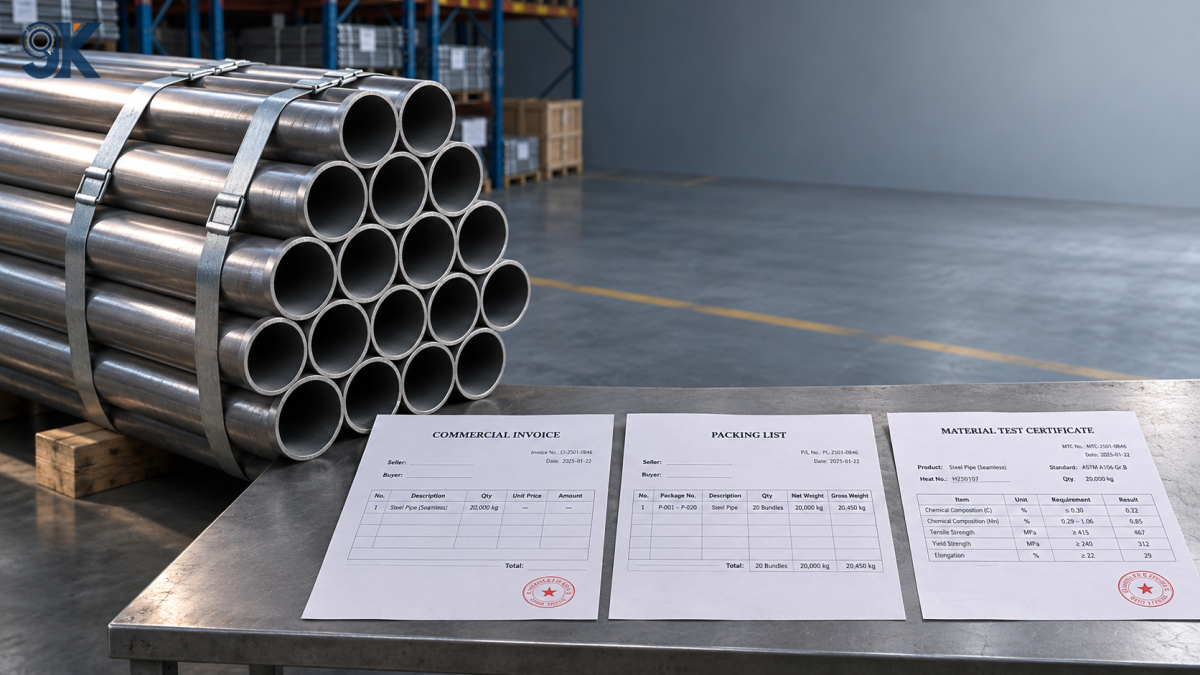
The commercial documents that form the core file
Commercial invoice
The commercial invoice records the parties, goods and transaction value. It should normally show the seller and buyer, invoice number and date, a sufficiently precise product description, quantity, unit price, total value, currency, delivery terms and country of origin. Include the consignee or other details where required by the transaction or destination.
For steel pipe, a useful description identifies the manufacturing type, grade or standard, dimensions and relevant finish. Avoid using a product code alone when the recipient must assess classification or admissibility. The invoice value should reflect the transaction; any adjustments required for customs valuation must be handled under the applicable rules rather than hidden in a vague description.
Packing list
The packing list explains how the shipment is physically organized. It typically identifies the number and type of packages or bundles, package marks, pipe sizes, quantities, net and gross weights, and package dimensions where relevant. Link bundle or package identifiers to the invoice line items so that the contents can be located during an inspection.
Check the basis of each weight. Net weight generally refers to the goods without packing, while gross weight includes packing; the precise figures must reflect the shipment. A difference between theoretical pipe weight and actual weighed quantity should be understood and documented before declaration rather than corrected by changing figures without evidence.
Sales contract or purchase order
The contract or purchase order supports the commercial terms behind the declaration. It can help resolve questions about product specifications, quantities, price, payment and delivery obligations. Keep amendments with the original agreement, particularly when a change in pipe size or shipment quantity occurred after the initial order.
Documents that prove origin, specification or condition
Not every shipment needs the same certificates. Separate documents required by customs or a trade agreement from those required by the customer, a bank or a technical specification. A document can be commercially essential even when it is not a universal export clearance requirement.
A certificate of origin is not the same as a mill test certificate. The former states origin under the applicable rules; the latter records material and test information. A preferential certificate or origin statement is useful only when the goods meet the relevant rules of origin and the prescribed procedure is followed. Shipping from a country does not, by itself, establish preferential origin. Check the destination’s current requirements before promising a reduced duty rate.
Mill test certificates commonly include a heat or cast number, chemical composition, mechanical properties and the applicable specification, depending on the order. Match the heat numbers and product identification to pipe markings or a traceability record. A certificate for a similar grade is not a substitute for evidence covering the supplied material. Where several heats are combined in one shipment, the file should make clear which certificates apply to which bundles.
Third-party inspection records should state what was actually inspected. A visual inspection of packing, for example, should not be presented as proof that every pipe passed dimensional or mechanical testing. Review the contract for the required inspection stage, sampling scope and document format before production or dispatch.
Transport papers and the customs declaration
The export declaration is prepared from the shipment data and submitted through the applicable customs process, often by an authorized broker. It generally includes the exporter, consignee, commodity classification, product description, quantities, value, trade terms and transport information. The supporting invoice and packing list should substantiate the entry. The declaration is not merely another copy of the invoice: it must satisfy customs data requirements, including the appropriate units and classification.
Transport documentation depends on the mode. For ocean freight, a shipping instruction supplies details used to prepare the bill of lading or sea waybill. Review the draft for shipper, consignee, notify party, port information, package count, marks and description. The final transport document follows the carrier’s procedures and shipment events; its issue date and availability should be coordinated with payment and destination clearance needs.
Container shipments may also involve a verified gross mass declaration under applicable maritime rules. This is separate from the commercial invoice and should be arranged with the carrier or freight forwarder. For LCL cargo, confirm whether package marks and weights will appear on a house transport document, a carrier document or both. For bulk or breakbulk cargo, agree on how bundles, weight and loading details will be recorded.
Original document requirements matter operationally. A negotiable bill of lading, a sea waybill and an electronic release arrangement do not all work the same way. Confirm the selected release method and any bank requirements before issuing shipping instructions; an incorrect consignee or unavailable original can delay cargo release even after export clearance is complete.
Reconcile the file before the declaration is submitted
Use the final packing information as the physical reference, then compare it with the commercial and technical records. The review should be performed after the shipment has been assembled but early enough to correct discrepancies before declaration and document issuance.
- Match the goods: compare product descriptions, grade, manufacturing type, dimensions and finish across the order, invoice, packing list and test records. Explain legitimate differences in wording rather than allowing descriptions to contradict one another.
- Match quantities: reconcile pieces, bundles, length and weight using the units required for each document. Ensure split shipments and partial order balances are identified clearly.
- Match the parties and terms: check legal names, addresses, consignee details, currency, Incoterms rule and named place. The seller, exporter and shipper can differ, but their roles must be supportable.
- Trace the material: connect package marks and heat numbers to the relevant certificates. Keep a mapping record if a certificate covers material packed in more than one bundle.
- Confirm destination requirements: obtain the importer’s broker’s instructions for classification, origin evidence, permits and any applicable steel trade measures. Check bank wording separately if payment depends on document presentation.
Where a load contains different materials, keep the descriptions and supporting records distinct. For example, an order that also includes 1070 Aluminum Coil should not be described entirely as steel pipe. Each product needs its own accurate invoice description, classification assessment and supporting documents as applicable.
When a discrepancy is discovered
First establish whether the error is clerical or reflects a different physical shipment. A missing digit in a bundle mark may require a corrected packing list; an incorrect grade, weight or quantity may affect valuation, classification or admissibility and needs a fuller review. Preserve the original record and the reason for the correction so the parties can follow the document trail.
Before submission, have the issuer amend the affected documents and send the same approved versions to the broker, forwarder and buyer. After submission or release, do not assume that replacing a PDF changes the official declaration or transport record. Ask the responsible broker or carrier about the applicable amendment process, supporting evidence and any timing restrictions.
Finally, retain the declaration record, commercial documents, transport papers and relevant certificates in accordance with applicable retention requirements and contractual obligations. Keeping the file organized by shipment and document version makes later customs inquiries, certificate verification and order reconciliation substantially easier.
Latest News
- Which export market trends affect demand for square tubes?
- How do iron ore prices affect steel pipe price trends?
- How do tariffs affect square tube export markets?
- How steel pipe price trends affect inventory valuation
- Steel pipe price forecast for 2026 amid changing raw material costs
- Square Tube Export News: What Buyers Should Watch in Freight and Supply
Send Us A Message

