
News center
Which documents are needed for steel export customs clearance?
Steel export customs clearance commonly requires a commercial invoice, a packing list, an export declaration, and transport documents such as a bill of lading or air waybill. Depending on the steel product, country of export, destination, and trade terms, the shipment may also need an export license, certificate of origin, material test certificate, or other product-specific documentation.
The difficulty is not just collecting the papers. A shipment of steel pipes can be held up when the invoice describes one grade, the packing list shows a different quantity, or the customs declaration uses a classification that does not match the product. Preparing the documents as a coordinated set helps the exporter and buyer identify those discrepancies before the cargo reaches a port.
Start with the core commercial documents
Commercial invoice
The commercial invoice records the transaction and provides information used for customs valuation. It normally identifies the seller and buyer, invoice date and number, product description, quantity, unit price, total value, currency, and agreed delivery terms. It should describe the steel precisely enough to support the declared classification rather than relying on a broad phrase such as “metal products.”
For steel pipes, a useful description may include whether the pipe is seamless or welded, the material grade, outside diameter, wall thickness, and any coating or finishing relevant to classification. The invoice should also state the agreed Incoterms® rule and named place where applicable. Those terms help clarify which charges are included, although customs value is determined under the applicable customs rules, not simply by copying the invoice total.
Packing list
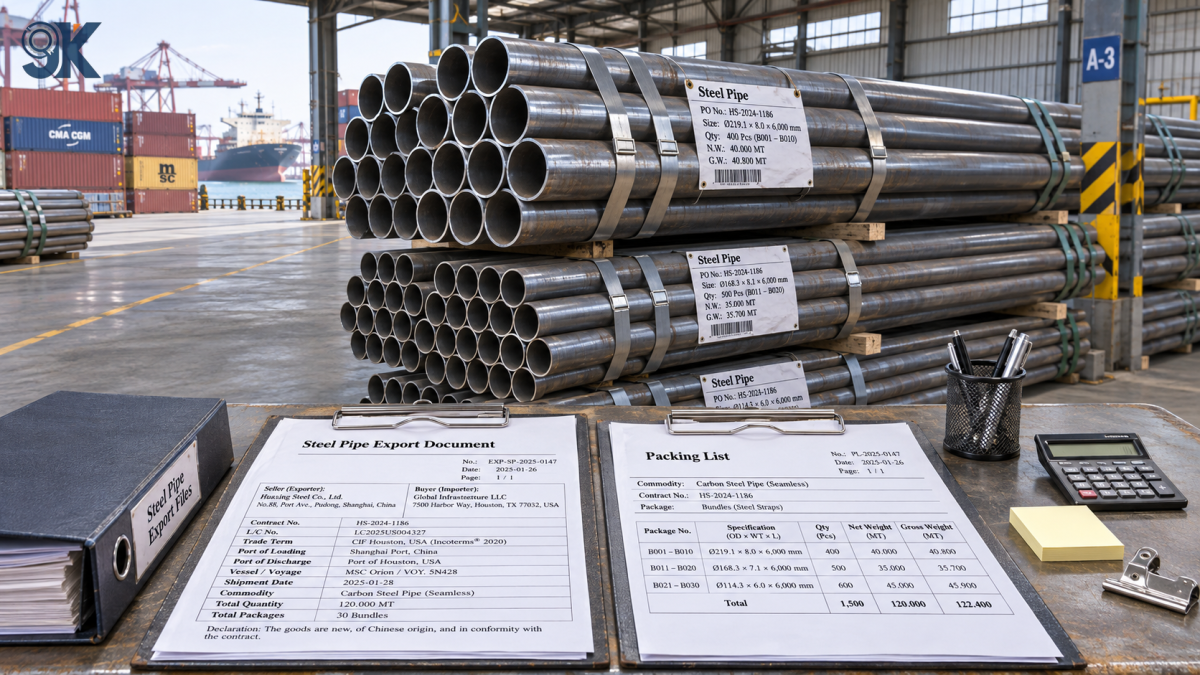
The packing list explains how the goods are physically presented. It typically shows the number and type of packages, bundle marks, quantities, net and gross weights, and package dimensions where available. For pipe shipments, the list may identify bundles, pieces per bundle, lengths, and corresponding weights.
Customs officers and logistics providers use this information to locate and check the cargo. The totals should agree with the invoice and the declaration, while the marks should correspond to the labels on the actual bundles. Net weight describes the goods without packing; gross weight includes the relevant packaging. Using one figure in place of the other can create questions during clearance or transport booking.
Sales contract or purchase order
A contract or purchase order is not a universal substitute for the invoice, and it is not necessarily required for every declaration. It can, however, help support the transaction terms when customs, a bank, or a service provider requests additional evidence. It may also clarify the agreed specification, price basis, payment terms, and division of responsibilities.
Keep amendments with the original agreement. A revised quantity or specification should be reflected consistently in the final shipping documents, rather than leaving the invoice to contradict the latest order.
Documents used to declare and move the cargo
Export customs declaration: The exporter or its authorized customs agent submits the declaration in the required form for the exporting country. It generally draws on the commercial documents and includes the exporter, consignee, goods description, classification, quantity, value, origin, and relevant shipment details. Supporting documents may need to be submitted or retained, depending on local procedures.
The tariff classification deserves particular attention. Steel products are not all classified together: a pipe’s composition, manufacturing method, dimensions, and processing can affect its Harmonized System classification. The international HS framework provides a starting point, but national tariff codes and requirements can differ. Confirm the export code and the destination import code separately when needed; do not assume that a code supplied by one party settles both declarations.
Bill of lading or other transport document: For ocean freight, the carrier or its agent issues a bill of lading or sea waybill. Air shipments use an air waybill; other modes have their own transport documents. These identify the parties, route, cargo, and other carriage details. A bill of lading can also have different release and title implications from a sea waybill, so its form should match the sales and payment arrangements.
A final ocean bill of lading may only be issued after the carrier has received or loaded the cargo, depending on its terms and procedures. Prepare the shipping instructions early, but do not assume that the final transport document will be available before export declaration. Check the draft promptly for the consignee, notify party, marks, package count, and weight, and arrange any corrections with the carrier or forwarder.
Certificates and permits that depend on the shipment
The following documents are not required for every steel export. Their relevance depends on the product and applicable rules, as well as the buyer’s contract or payment arrangements. Establish who needs each document and who can issue it before the goods are dispatched.
Certificate of origin
A certificate of origin states the origin of the goods under the applicable rules. A buyer or destination authority may request a non-preferential certificate, while a preferential certificate or other prescribed proof of origin may be needed to claim a reduced tariff under a trade agreement.
Shipment from a country does not automatically make that country the product’s origin for every purpose. Preferential claims depend on the agreement’s origin rules and documentary conditions. Check the destination’s requirements, the relevant agreement, and the authorized issuing process before promising a particular tariff benefit. An origin claim on an invoice may be acceptable in some circumstances, but it should not be assumed to replace a certificate everywhere.
Material test certificate and inspection records
A material test certificate, often called a mill test certificate, may show the steel grade, production or heat identification, chemical composition, mechanical properties, and referenced product standard. It helps the buyer connect the supplied material to the agreed specification. An inspection certificate or third-party inspection report may also be required by contract, a letter of credit, or a destination rule applicable to the goods.
These records serve a different purpose from a certificate of origin: evidence of material properties does not automatically establish customs origin. Check that the grade, standard, heat numbers, and product identification correspond to the goods and commercial documents. A test certificate can support a description, but it does not by itself determine the tariff code or guarantee acceptance by customs.
Export licenses and destination-specific documents
Some steel products or transactions may be subject to licensing, controls, or additional reporting. The requirement can depend on the goods, their classification, destination, end use, or parties involved. Check the rules in force for the export and import countries before shipment; do not treat an ordinary commercial invoice as a replacement for an authorization when one is required.
The destination may also require product conformity evidence, import permits, or additional declarations for particular steel goods. For some markets, origin, production, or emissions-related information may be relevant under applicable measures. These obligations are separate from the exporting country’s clearance process. The importer should confirm which information must be supplied, in what format, and by when.
Match the paperwork to the actual steel
A description that is adequate for a quotation may be too vague for customs. Before the documents are finalized, compare the physical product and order specification with the description used for classification. For pipe, the distinction between seamless and welded construction, for example, can matter. Composition, cross-sectional shape, dimensions, surface treatment, and further processing may also affect the correct classification or destination requirements.
Pay attention to units. One document may show pieces and another tonnes, which can be acceptable if the relationship is clear and both totals are accurate. Confusion arises when a declared quantity cannot be reconciled with the bundle count or when nominal dimensions are presented as if they were measured weights. Use the units required for the relevant customs declaration and retain the supporting calculation or packing records.
Mixed consignments need enough detail to distinguish different products. Combining several grades or pipe sizes under one generic invoice line may obscure differences relevant to classification, valuation, or origin. Separate lines where necessary, and link them to the corresponding packing list entries and certificates.
Prepare the document set in the right order
- Confirm the product and route. Record the steel specification, manufacturing method, quantities, exporting and importing countries, and planned transport mode. Identify the parties responsible for export and import formalities under the contract.
- Check classification and controls. Use the product details to determine the applicable tariff classifications and investigate any licenses, origin evidence, or destination-specific requirements. Resolve uncertain classifications before declaration rather than selecting a code from a similar-looking invoice.
- Agree on document wording. Align the product description, seller and buyer details, delivery terms, currency, and units across the invoice and packing list. Confirm any bank or contract requirements separately from customs requirements.
- Obtain supporting records. Arrange applicable certificates, inspection documents, and permits with the relevant issuer. Check whether originals, electronic records, signatures, or a particular format are required by the receiving party.
- Review the final shipment details. Compare actual package counts, weights, marks, and shipping instructions with the commercial documents. Submit the export declaration through the appropriate process and review the transport document when its draft becomes available.
Allow for the fact that not every document is produced at the same stage. The packing list may change after final weighing, while transport information can change after booking. When a legitimate change occurs, tell the affected parties and amend the relevant documents and declarations through the proper channels; avoid correcting only one copy while leaving the rest of the set inconsistent.
Where export paperwork ends and import paperwork begins
Export clearance authorizes goods to leave the exporting country under its procedures. Import clearance is a separate process in the destination country, with its own declaration, duties, taxes, and possible permits. The buyer may need copies of the exporter’s invoice, packing list, transport document, and origin evidence to prepare that import entry, but the importer remains responsible for meeting the obligations assigned by law and contract.
Payment arrangements can add another layer. A bank handling a letter of credit may examine document wording, dates, and presentation conditions that are stricter or different from customs requirements. A document acceptable to customs is not automatically compliant with the letter of credit, and a bank’s acceptance does not establish that import rules have been met. Compare both sets of requirements before issuing the final documents.
When a forwarder or customs agent handles the declaration, provide the underlying product information and supporting records rather than only a generic product name. The exporter should still review the declaration details it supplies or approves. Questions about classification, controlled goods, or preferential origin should be resolved with the relevant customs authority or a qualified customs professional, particularly when an error could affect clearance or duties.
Latest News
- How do iron ore prices affect steel pipe price trends?
- How do tariffs affect square tube export markets?
- How steel pipe price trends affect inventory valuation
- Steel pipe price forecast for 2026 amid changing raw material costs
- Square Tube Export News: What Buyers Should Watch in Freight and Supply
- What new trade investigations mean for steel pipe exports
Send Us A Message

