
News center
Where are seamless rectangular and square pipes used?
Seamless rectangular and square pipes are used in machinery frames, construction components, transport equipment, and other structures that need hollow sections to carry loads while providing flat surfaces for fabrication. Their suitability depends on more than shape: the steel grade, wall thickness, manufacturing route, connection details, and service conditions all influence the final choice.
The most useful way to assess the applications of seamless rectangular and square pipes is to start with the component’s job. A machine frame may need dimensional consistency for assembly, while an exposed support may require corrosion protection and careful drainage. In either case, a seamless section is one option; it should be selected because its specified properties and manufacturing characteristics fit the application.
Machinery frames and equipment supports
Machinery manufacturing is a common setting for square and rectangular hollow sections. They can form equipment bases, support frames, columns, guards, and structural members around moving assemblies. Their flat faces provide practical surfaces for mounting brackets, guide rails, covers, and other fabricated parts.
Rectangular sections can be particularly useful when bending is more demanding in one direction than another. Orienting the deeper side in the direction of the main bending load can make better use of the section’s geometry. That benefit depends on how the member is supported and loaded; turning a rectangular section without checking the load direction can have the opposite effect.
For machine frames, buyers should consider straightness, twisting, wall-thickness variation, and dimensional tolerances alongside the steel grade. Even when a section is strong enough, excessive distortion or variation can complicate alignment and machining. The required tolerances should be tied to the assembly method: a welded support for a cover generally has different dimensional needs from a machined mounting surface for precision equipment.
Seamless manufacture does not eliminate the need to control welding distortion in the finished frame. Joint design, welding sequence, fixtures, and any machining after fabrication still affect whether the assembly meets its alignment requirements.
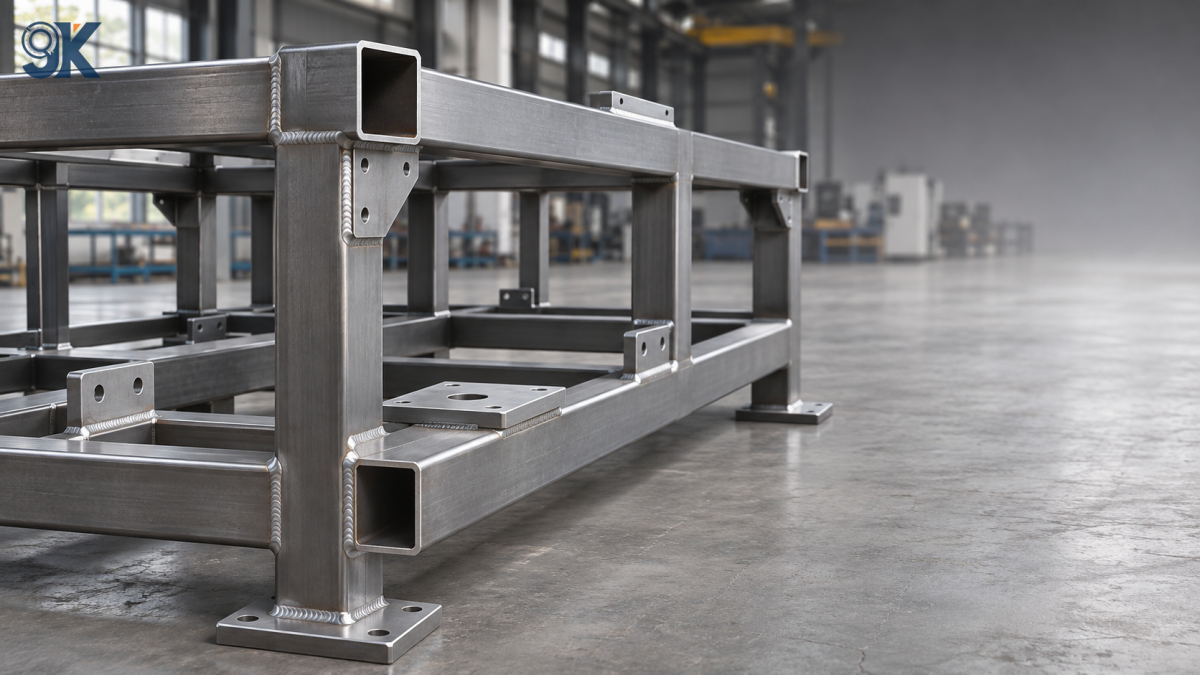
Structural members in buildings and industrial facilities
Square and rectangular hollow sections are also used as columns, beams, bracing, equipment platforms, and secondary steelwork. Their enclosed profile provides a clean external shape, while the flat sides make it convenient to connect plates and other members.
In structural applications, the section must be assessed as part of the whole frame. A member that is adequate in bending may still need attention to buckling, local deformation, or the transfer of force at a connection. Thin walls can be vulnerable to local distortion around concentrated loads, bolt holes, and welded attachments, even when the overall member appears substantial.
A seamless section may be considered where the project specification calls for that manufacturing route or where its available material and dimensional characteristics suit the design. It is not automatically necessary for every building frame. Welded hollow sections can also be suitable when their specified properties, quality requirements, and connection details meet the project’s needs.
Outdoor exposure introduces another selection issue. Water can collect inside an open or poorly detailed hollow member, creating corrosion that is difficult to inspect. End closures, drainage, ventilation, surface preparation, and the selected protective coating should be considered together with the structural design.
Transport equipment and mobile structures
In transport and material-handling equipment, hollow sections can be used in chassis structures, trailer components, support frames, and fabricated equipment bodies. Their enclosed geometry can provide useful resistance to bending and torsion, while flat faces simplify the attachment of crossmembers and mounting plates.
These structures often experience repeated loading rather than a single steady force. Road vibration, starting and stopping, uneven loads, and impacts can concentrate stress at welds, holes, and abrupt changes in section. The choice of a seamless tube does not remove those fatigue-sensitive details: the geometry and quality of the completed joint remain central to service performance.
Weight also matters, but reducing wall thickness is not a decision to make from member strength alone. Designers must account for local buckling, attachment loads, manufacturing tolerances, and the effects of corrosion over the intended service life. A lighter section is useful only if the complete structure can withstand its actual operating conditions.
Where seamless hollow sections fit in industrial assemblies
Conveyors and material-handling systems
Conveyor frames and handling equipment use rectangular and square sections for legs, longitudinal supports, and crossmembers. Flat surfaces help fabricators attach rollers, brackets, and guarding. For long runs, straightness and consistent dimensions can also affect installation and alignment.
The loading pattern matters as much as the weight of the section itself. A conveyor carrying a concentrated load at midspan has different demands from one with an evenly distributed load. Supports, vibration, impact during loading, and the stiffness needed to keep the system aligned all belong in the design assessment.
Protective structures and equipment enclosures
Hollow sections can form the skeleton of guards, access enclosures, and protective frames. In these applications, designers should distinguish between a frame that supports a panel and one expected to resist an impact. The latter requires an assessment of the complete assembly, including fasteners, anchorage, panel behavior, and the path by which impact forces reach the supporting structure.
A heavy-looking tube alone does not establish that an enclosure will contain a moving or released component. The relevant loads and acceptance requirements need to be defined before the section and its connections are selected.
Fabricated components with machined interfaces
Some equipment combines hollow structural members with machined solid parts. For example, a frame may support shafts, pins, or fittings made from a different material. Material selection for those separate parts follows their own mechanical and environmental requirements.
In a corrosion-sensitive assembly, a designer might consider a material such as Monel Alloy Bar for a separately specified solid component. Its selection does not establish the suitability of the surrounding steel pipe; corrosion conditions, contact between dissimilar metals, and joint details must be assessed for the complete assembly.
How to choose a section for the application
Start with the load path. Identify where forces enter the member, where it is supported, and whether bending, compression, torsion, impact, or repeated loading governs the design. A square section can be convenient when the structural arrangement calls for similar dimensions in both directions. A rectangular section offers different bending characteristics about its two principal axes, which can be useful when one direction carries the greater demand.
Choose dimensions with fabrication in mind. Outside dimensions and wall thickness influence stiffness, strength, weight, and connection design. Wall thickness also affects the space available for welds and attachments. A section selected only from nominal outside dimensions may leave insufficient material at a highly loaded connection or create unnecessary weight elsewhere.
Specify the material and manufacturing requirements separately. “Seamless” describes a manufacturing characteristic; it does not, by itself, identify the steel grade or guarantee a particular strength, weldability, toughness, or tolerance. The purchase specification should state the required grade, dimensions, tolerances, surface condition, and inspection or documentation requirements appropriate to the intended use.
Consider the finished part, not just the delivered tube. Cutting, drilling, welding, bending, and machining can affect fit and performance. For parts that require close alignment, agree on which dimensions are critical after fabrication and whether machining or other finishing operations are needed.
Match corrosion protection to the environment. Indoor machinery, outdoor structures, and equipment exposed to chemicals face different risks. Steel grade, coating system, drainage, access for maintenance, and contact with other materials all influence durability. A seamless wall does not prevent corrosion at exposed surfaces or at fabricated joints.
When another section or manufacturing route may be a better fit
Seamless square or rectangular pipe is not the only way to build a strong frame. A welded hollow section may satisfy the same structural requirements when the design and purchase specification permit it. Open sections can be easier to inspect, connect, or protect in some assemblies, while solid bar may be more appropriate for a compact component that needs extensive machining.
The choice also depends on what is actually available in the required grade, dimensions, and condition. Rectangular and square seamless products may be produced through different forming and finishing routes, so the word “seamless” should not be treated as a complete description of the finished product. For a critical application, define the required manufacturing and inspection details in the order rather than relying on shape or product name alone.
Shandong Jiukai Metal Materials Co., Ltd. offers custom production, processing, warehousing, and export logistics for steel pipe orders. For a machinery project, a drawing and a clear description of the load-bearing role, required dimensions, processing needs, and documentation provide a practical starting point for discussing a suitable specification.
Latest News
- Which export market trends affect demand for square tubes?
- How do iron ore prices affect steel pipe price trends?
- How do tariffs affect square tube export markets?
- How steel pipe price trends affect inventory valuation
- Steel pipe price forecast for 2026 amid changing raw material costs
- Square Tube Export News: What Buyers Should Watch in Freight and Supply
Send Us A Message

