
Where are seamless rectangular and square pipes used in machinery?
The Applications of Seamless Rectangular and Square Pipes in machinery extend from structural frames and equipment supports to telescopic components and precision assemblies.
For technical evaluators, selecting the right pipe involves more than comparing dimensions: load requirements, wall thickness, material grade, tolerances, and fabrication methods all influence performance.
This article examines where these hollow sections are used, why seamless construction may be specified, and what engineers should consider when selecting pipes for machinery applications.
Where do these sections provide the most value?
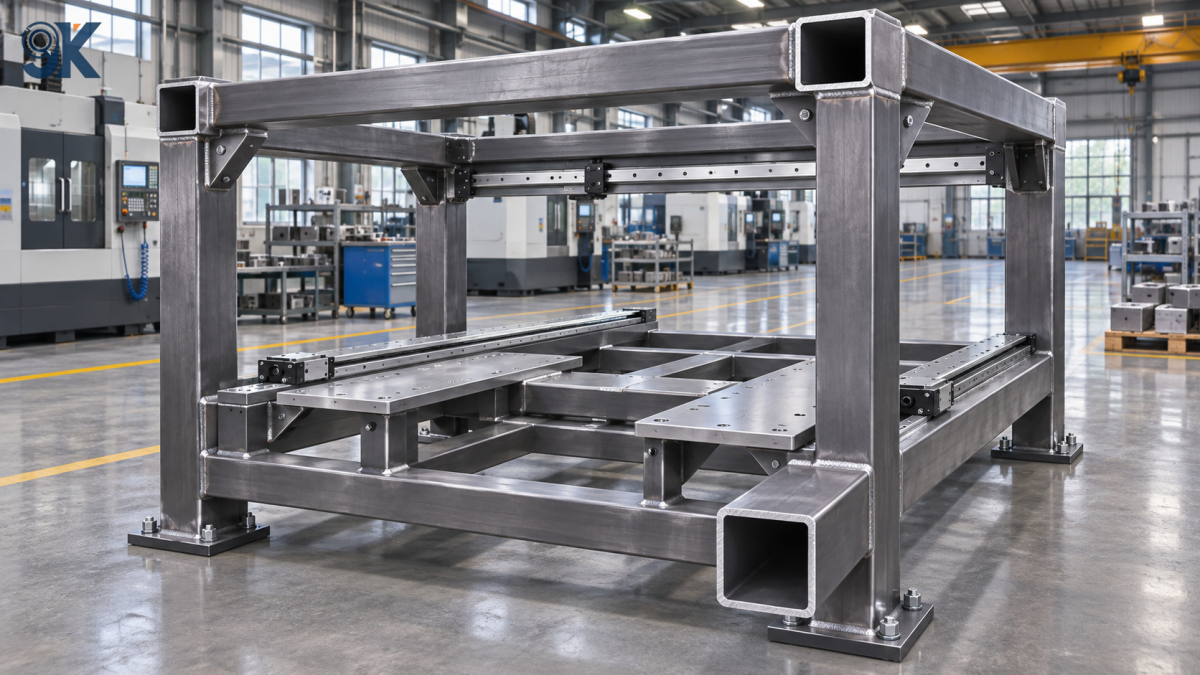
Seamless square and rectangular hollow sections are commonly considered for machinery members that must resist bending or torsion while offering flat surfaces for mounting components.
Typical applications include equipment frames, lifting structures, mobile machinery, telescopic assemblies, and protective supports. The best choice depends on the load case and manufacturing requirements.
A rectangular section can provide greater bending stiffness in one direction when its deeper side aligns with the dominant load. A square section offers more balanced directional properties.
Seamless construction eliminates a longitudinal weld seam in the starting tube. That feature can be relevant to a specification, but it does not automatically make every seamless section superior.
Evaluators should compare the actual grade, production route, tolerances, inspection results, and delivered condition against suitable welded alternatives before deciding whether the additional cost is justified.
Which machinery applications use square and rectangular pipes?
Machine frames and equipment bases
Frames for machine tools, automated workstations, packaging equipment, and assembly machines often use hollow sections as crossmembers, uprights, and bracing elements around the working envelope.
Flat faces simplify attachment of plates, linear guides, guards, and cable supports. Enclosed sections can also offer useful torsional stiffness when loads act away from supports.
For precision equipment, stiffness alone is insufficient. Engineers should assess joint deformation, vibration, thermal distortion, and machining allowances because these factors affect alignment and operating accuracy.
A seamless section may be selected when the project specification requires a seamless product or documented material properties. Welded structural sections can also be appropriate for many frames.
Construction and agricultural machinery
Excavator attachments, agricultural implements, utility vehicles, and similar equipment can incorporate hollow sections in supporting frames, linkage structures, protective structures, and noncritical boom members.
These components experience combinations of bending, torsion, impact, and repeated loading. Mud, moisture, and abrasive debris can further complicate inspection and long-term corrosion protection.
Selection must account for actual duty cycles and local stress concentrations around pins, holes, and welded brackets. A strong parent section cannot compensate for poorly designed connections.
For safety-critical structures, applicable machinery regulations and design standards govern validation. Material certificates alone do not establish that an assembled component meets the required performance.
Material handling and lifting equipment
Conveyors, transfer systems, pallet-handling machines, and lifting fixtures may use square or rectangular sections for columns, rails, crossbeams, and equipment supports.
In these applications, deflection can govern sizing before nominal strength does. Excessive movement may disrupt alignment, interfere with rollers, or affect the positioning of a handled load.
Lifting equipment also demands attention to load combinations, fatigue, stability, and connection design. Any required proof testing and inspection should follow the applicable equipment standard.
Where a component is exposed to repeated starts and stops, specify the expected load spectrum and examine details near weld toes, bolt holes, and abrupt section changes.
Telescopic and adjustable assemblies
Adjustable supports, positioning arms, and some machine extensions use nested square or rectangular sections to provide linear adjustment while restricting relative rotation.
Successful nesting depends on the combined tolerances of both sections, including outside dimensions, inside dimensions, wall thickness, straightness, twist, and corner geometry.
Nominal sizes alone do not guarantee a sliding fit. Coatings, weld distortion, contamination, and the chosen bearing or wear pad arrangement also affect clearance.
For demanding motion requirements, define fit over the full engagement length and consider machining or guided wear surfaces. Confirm the arrangement with representative parts before production.
Designers should also verify overlap length and local bearing stresses at maximum extension. Reduced engagement can significantly increase deflection and concentrated loads on the guides.
Equipment guards and auxiliary supports
Machine guards, access platforms, sensor brackets, and service frames can use hollow sections where flat mounting faces and a clean, enclosed profile simplify fabrication.
These parts may carry relatively modest static loads, but they still require adequate resistance to foreseeable impact, vibration, and accidental contact during operation and maintenance.
For many auxiliary structures, a suitable welded section will meet the requirement economically. Specify seamless material only when the application or purchasing standard supports that choice.
When is seamless construction worth specifying?
A seamless starting tube has no longitudinal weld seam. Square or rectangular geometry is then produced through a forming route whose details depend on the manufacturer.
This distinction matters when a customer specification excludes longitudinal seams, when traceability requirements identify a seamless product, or when seam location would complicate a particular operation.
Seamless construction does not eliminate variation in wall thickness, corners, surface condition, or residual stress. Forming and heat treatment influence the finished section and must be controlled.
It also does not guarantee better fatigue life. Fatigue performance depends on material quality, surface condition, geometry, fabrication details, loading, and the condition of the finished assembly.
Compare seamless and welded options using equivalent standards and properties. Include procurement cost, availability, inspection scope, fabrication yield, and the consequences of failure in the decision.
For pressure-containing or hydraulically loaded components, do not assume a structural hollow section is suitable. Specify a product standard and design basis appropriate to pressure service.
How should engineers select the section and material?
Start with loads, stiffness, and stability
Define the load path before choosing dimensions. Include normal operation, start-up, emergency stops, transport, maintenance, foreseeable impact, and any relevant combinations required by the design code.
Calculate bending, shear, torsion, and axial effects as applicable. Check deflection and vibration against functional limits, especially where guides, sensors, or rotating equipment require stable alignment.
Use section properties for the actual outside dimensions and wall thickness. A deeper rectangular section can improve bending resistance about one axis, but orientation matters.
Assess member buckling, local wall instability, and connection behavior. Thin walls may be efficient in global bending yet vulnerable to concentrated forces from bolts or supports.
For cyclic loading, evaluate fatigue at the assembled detail rather than relying only on nominal material strength. Welded attachments and drilled features often deserve particular attention.
Specify dimensions and tolerances that match the function
State outside dimensions, wall thickness, length, and quantity, together with the dimensional standard or explicit limits for the features that affect assembly and performance.
For telescoping parts, define clearance using toleranced mating dimensions and corner radii. For machined interfaces, identify straightness, twist, and the surfaces used as datums.
Do not assume nominal wall thickness equals the minimum actual thickness. Use the applicable product tolerance and the design standard when determining the section properties to check.
Specify cut length and end condition according to the fabrication process. Squareness, burr control, and machining allowance can affect fit-up and welding productivity.
Choose the grade and delivery condition
Select a material grade using required strength, toughness, weldability, service temperature, and availability. Identify the applicable standard and edition rather than relying on a trade description.
Delivery condition matters because forming and heat treatment affect properties. Confirm whether the specified mechanical values apply to the finished section and its stated condition.
For cold environments or impact-sensitive duties, establish whether impact testing is required and specify the test temperature, acceptance criteria, and sampling arrangements under the applicable standard.
Corrosive or elevated-temperature service may require a different material strategy. Evaluate the complete assembly, including fasteners, coatings, joining methods, and exposure conditions.
For separate high-temperature components, engineers may also evaluate 309S / 310S Stainless Steel Bar where its properties suit the design and service environment.
That bar product is a solid component material, not a substitute for a seamless hollow section. Verify its grade, dimensions, and applicable specifications independently.
What fabrication and inspection details affect the result?
Welding, cutting, and machining
Confirm weldability from the material specification and qualified welding procedure. Depending on grade and thickness, fabrication may require controlled heat input, preheat, or other measures.
Plan the welding sequence and fixture arrangement to limit distortion. Measure critical datums after fabrication, particularly when long frames carry linear guides or precision mechanisms.
Holes, slots, and cutouts reduce local section capacity and can initiate cracks under cyclic loading. Reinforce or redesign openings where analysis shows unacceptable stresses.
Closed sections can trap moisture or expand trapped air during processing. Provide drainage, venting, or sealing as appropriate, while considering the effects on corrosion and strength.
Protective finishes also affect fit and service life. Define preparation, coating thickness, inaccessible internal surfaces, and any areas that must remain free of coating.
Inspection and traceability
Request material certificates identifying the product standard, grade, heat or batch, chemical composition, mechanical results, and delivery condition as required by the purchase specification.
Confirm the inspection document type and traceability level before ordering. The appropriate requirements depend on the component’s criticality, contractual obligations, and governing standards.
Agree on dimensional checks for wall thickness, straightness, twist, corner profile, and length where these affect fit or strength. Define sampling frequency and acceptance limits.
If surface or internal discontinuities are a concern, specify an appropriate nondestructive testing method, coverage, and acceptance criteria. Inspection capability should be confirmed before production.
For critical assemblies, a first article can verify cutting, fit-up, welding, and final dimensions together. Record results against the drawing before releasing volume production.
What should a machinery buyer include in an inquiry?
A useful inquiry connects the pipe specification to its intended function. This helps the supplier identify manufacturability concerns and clarify ambiguous requirements before quotation.
- Outside dimensions, wall thickness, lengths, quantities, and any telescoping or mating-part drawings.
- Material grade, product standard and edition, delivery condition, and the reason seamless construction is required.
- Operating loads, service temperature, environment, and any safety-critical or cyclic-duty requirements relevant to selection.
- Dimensional tolerances, surface condition, cutting or processing needs, and required inspection and certificate details.
- Delivery destination, packaging, schedule, and whether a trial quantity or staged supply is needed.
Shandong Jiukai Metal Materials Co., Ltd. offers drawing evaluation, specification selection, custom production, processing, warehousing, and export logistics for machinery manufacturers.
Its stated services include small-batch trial orders and larger ongoing orders, with shipping arrangements available through ports including Tianjin, Qingdao, and Rizhao.
Before placing an order, agree on the precise manufacturing route, applicable standard, inspection scope, and acceptance criteria for the requested section and quantity.
Conclusion: match the section to the duty
The most useful Applications of Seamless Rectangular and Square Pipes are found in frames, mobile equipment, handling systems, and adjustable assemblies with clearly defined structural requirements.
Choose the section by checking load capacity, stiffness, stability, fit, fabrication, and inspection together. Specify seamless construction when the requirement delivers identifiable value for the component.
A complete drawing and purchasing specification give both engineer and supplier a practical basis for confirming suitability, controlling variation, and reducing avoidable production delays.
Latest News
- How do iron ore prices affect steel pipe price trends?
- How do tariffs affect square tube export markets?
- How steel pipe price trends affect inventory valuation
- Steel pipe price forecast for 2026 amid changing raw material costs
- Square Tube Export News: What Buyers Should Watch in Freight and Supply
- What new trade investigations mean for steel pipe exports
Send Us A Message

