
Where Are Seamless Rectangular and Square Pipes Used in Machinery?
The applications of seamless rectangular and square pipes in machinery include load-bearing frames, equipment supports, moving assemblies, and protective structures. They are most useful where a hollow section’s flat faces simplify fabrication and where the specified material, dimensions, and production route suit the loads and operating conditions.
Seamless construction removes the longitudinal weld seam from the supplied hollow section, but it does not automatically make a component stronger or more suitable than a welded alternative. The choice depends on the whole assembly: how it is loaded, where joints and holes are located, what tolerances the machinery needs, and how the section will be manufactured and inspected.
Where are these sections used in machinery?
Square and rectangular hollow sections give designers flat surfaces for mounting plates, brackets, guards, and other components. Their enclosed shape can also provide useful resistance to bending and torsion relative to their weight. The right application, however, depends on more than the section shape.
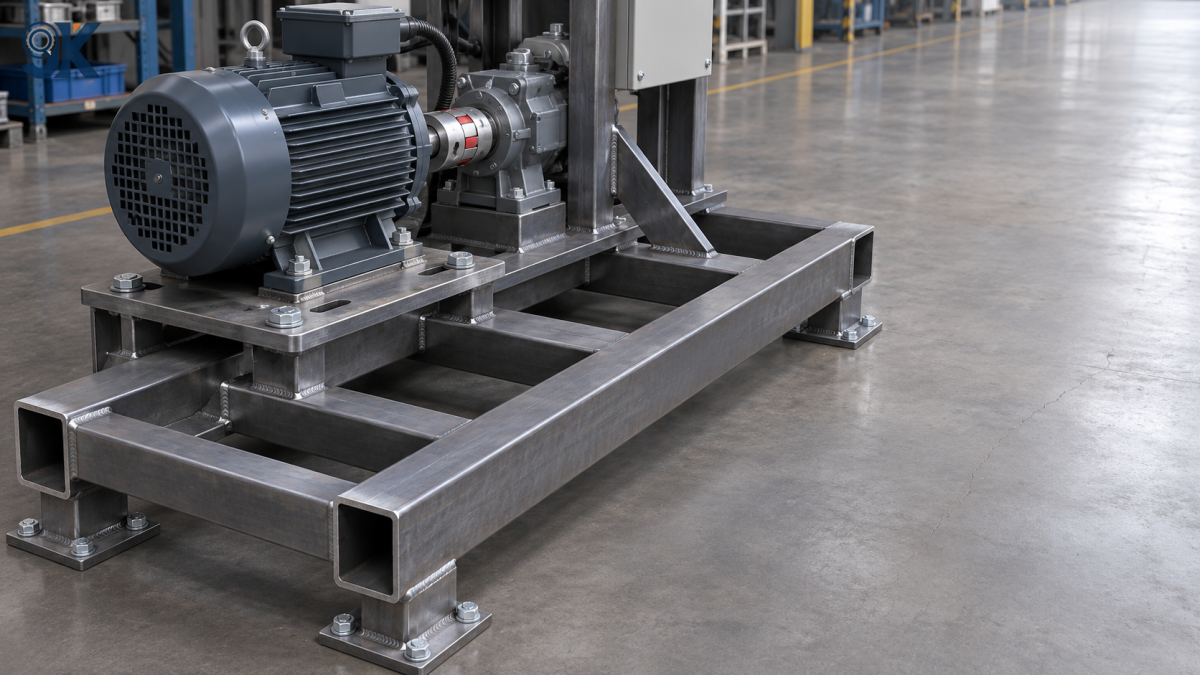
Machine bases and equipment frames
Fabricators use rectangular and square sections for the frames that support motors, pumps, gearboxes, processing equipment, and other machinery. Crossmembers connect the main rails, while mounting plates provide locations for bolted equipment.
A rectangular section can be useful when bending is greater in one direction: orienting its deeper dimension in the direction needed for resistance can improve stiffness compared with turning it the other way. A square section may be convenient when loads act in several directions or when consistent mounting faces simplify the frame layout.
For machinery that requires accurate alignment, the important question is not simply whether the member can carry the equipment. Frame deflection, weld distortion, mounting-surface flatness, and support conditions can affect alignment during operation. A section that is strong enough on paper may still be too flexible for the machine.
Supports, columns, and equipment skids
Hollow sections are also used in equipment skids, support legs, and columns. Their flat faces make it straightforward to attach base plates, lifting points, and secondary brackets. In a skid, rectangular members can form longitudinal rails, with transverse members distributing loads from the equipment into the supports.
The design must account for loads throughout the project, not only in the final installed position. A skid may experience different forces during lifting, transport, installation, and operation. Lifting points and fork pockets can introduce concentrated loads that require local reinforcement, even when the main rails are adequate for normal service.
For tall or slender supports, buckling and connection restraint can govern the design. Adding wall thickness is not always the most efficient answer; bracing, member length, and the way the column is fixed can also change its behavior.
Moving frames and arms
Machinery such as handling equipment, automated production systems, and positioning devices may use hollow sections in moving frames or arms. Here, the trade-off between stiffness and mass becomes especially relevant. A heavier member may reduce deflection but can also increase the load on drives, bearings, and supporting structures.
Repeated acceleration, deceleration, and vibration also make connection details important. Weld toes, abrupt changes in geometry, holes, and bracket attachments can create local stress concentrations. Seamless parent material does not remove fatigue concerns at those locations; the complete welded or bolted assembly still needs to be assessed for its duty cycle.
Conveyor structures and auxiliary equipment
Square and rectangular sections are commonly suited to conveyor frames, machine stands, guide supports, and auxiliary equipment structures. Straight lengths and flat faces help fabricators position rollers, tracks, sensors, and guarding. Modular assemblies may benefit from consistent dimensions because adjacent sections and mounting brackets must fit together during installation.
Not every conveyor or machine stand needs seamless material. If the loading is modest and an appropriate welded hollow section meets the design, fabrication, and inspection requirements, it may be the more practical procurement choice. The decision should be based on the specified performance and available material, not on the assumption that seamless is always necessary.
Guards and protective structures
Hollow sections can form the supporting framework for machine guards, enclosures, and access structures. The section provides attachment points for panels and doors, while the overall frame helps maintain the intended position of the guard.
Where a structure must resist impact or contain a hazard, section selection alone is not enough. The panels, fasteners, joints, anchorage, openings, and overall design must suit the specific protective function. A tubular frame should not be treated as proof that an enclosure can withstand a particular impact.
When does seamless construction make sense?
A seamless hollow section is made without a longitudinal welded seam in the supplied section. Depending on the product and manufacturing route, a seamless round hollow may be further formed into a square or rectangular shape. The finished section can still have variation in wall thickness, corners, straightness, and surface condition within its agreed specification.
Seamless material may be specified when a drawing or project requirement calls for a section without a longitudinal seam, or when the design and inspection plan are based on that product form. It can also be relevant where a purchaser needs a particular combination of grade, dimensions, and manufacturing route that is available as seamless material.
That absence of a seam does not mean the finished machine has no welds. Brackets, end plates, stiffeners, and connections may all be welded to the section. Their design and fabrication quality can be more consequential to the assembly than the presence or absence of a longitudinal seam in the original tube.
Welded rectangular and square sections remain legitimate options for many machinery frames. Compare the alternatives against the same requirements: mechanical properties, dimensional tolerances, weldability, inspection, availability, fabrication needs, and total delivered cost. Where a design specifically requires seamless material, a welded substitution needs the designer’s approval rather than a purchasing-only decision.
Choose the section around the load and the fabrication process
Start with the load path. Identify where forces enter the member, how they travel through the frame, and where the machine is supported. Include static loads, operational forces, vibration, and any lifting or transport conditions relevant to the assembly. The resulting design may require different sections in different parts of the same frame.
Check stiffness as well as strength. A frame carrying a motor or alignment-sensitive mechanism may need to limit movement under load. The section’s outside dimensions, orientation, span, and connections all affect deflection. Simply selecting a higher-strength steel grade does not, by itself, provide the same stiffness improvement as changing the section geometry or support arrangement.
Specify the grade and condition. The required material properties should match the design loads, service temperature, and fabrication method. If the frame will be welded, consider weldability and any welding procedure requirements alongside strength. Where impact toughness or other properties matter, include the applicable requirements in the purchase specification rather than relying on a general description such as “high-strength steel.”
Review wall thickness locally. The nominal wall may be adequate for the main span but insufficient around a heavily loaded bolt, pin, or welded attachment. Local crushing, tear-out, or deformation may require sleeves, reinforcement plates, or a different connection detail. For a rectangular section, also consider which wall carries the concentrated load and whether there is access to both sides during fabrication.
Allow for corners and internal space. Square and rectangular hollow sections have corner radii; they are not perfectly sharp inside or outside. This matters when plates fit against the section, another part must slide inside it, or a hole is placed close to a corner. Check the specified outside dimensions, wall thickness, corner geometry, and tolerances together before finalizing close-fitting details.
Match tolerances to the assembly. Straightness, twist, length, and section dimensions affect cutting, fixture setup, and alignment. A general structural frame may tolerate more variation than a precision machine base. State the features that matter to the finished assembly and allow for subsequent machining where the required mounting accuracy cannot reasonably be obtained from the supplied section and welding process alone.
Plan holes, drainage, and protection before release
Closed sections can trap water, cleaning fluids, or fabrication residue. In outdoor, washdown, or corrosive environments, consider how moisture can enter and whether the design should seal the section or provide suitable drainage and ventilation. The chosen approach must also account for welding, coating, and maintenance; an inaccessible cavity is difficult to inspect after assembly.
Holes introduced for bolting, cable routing, or processing can affect both strength and corrosion exposure. Place them with the load path and manufacturing sequence in mind. If sections will receive a coating after fabrication, discuss access to internal and external surfaces with the fabricator and coating provider before the drawing is released.
Surface protection should match the environment rather than the section’s seamless status. Seamless steel can corrode, and a closed profile does not protect exposed welds, cut ends, drilled holes, or damaged coatings.
What to put in the purchase request
A useful enquiry connects the pipe specification to the finished component. In addition to quantity and delivery location, provide the drawing or the following information where applicable:
- Required outside dimensions, wall thickness, lengths, and permitted tolerances.
- Material grade, delivery condition, and the product standard or agreed technical specification.
- An explicit seamless manufacturing requirement, if it is mandatory.
- Cutting, machining, drilling, surface condition, and identification requirements.
- Required inspection, test documentation, traceability, and any agreed acceptance criteria.
- Packaging, delivery schedule, and whether trial quantities and later production quantities are planned.
Discuss critical dimensions and processing before placing the order. A supplier may need to establish whether the requested size, grade, tolerance, and production route can be supplied together, especially for small batches or unusual section sizes. Agree on any proposed alternative with the equipment designer before changing the material or dimensions.
Shandong Jiukai Metal Materials provides drawing evaluation, specification selection, custom production coordination, processing, warehousing, and export logistics services. For an enquiry, sharing the intended application and fabrication drawing alongside the material schedule gives the supplier a clearer basis for discussing supply and delivery options.
Latest News
- How do iron ore prices affect steel pipe price trends?
- How do tariffs affect square tube export markets?
- How steel pipe price trends affect inventory valuation
- Steel pipe price forecast for 2026 amid changing raw material costs
- Square Tube Export News: What Buyers Should Watch in Freight and Supply
- What new trade investigations mean for steel pipe exports
Send Us A Message

