News center
When does custom steel pipe make sense for a project?
Custom steel pipe makes sense when a standard product cannot meet a requirement that materially affects safety, fit, fabrication, or project delivery—and when the benefit of changing the pipe exceeds the added cost and supply risk. The decisive question is not whether a drawing contains an unusual dimension, but whether that dimension must be achieved in the pipe itself.
A standard pipe cut, machined, or fabricated after purchase may solve the same problem with less production risk. Custom manufacturing becomes more compelling when those downstream operations create excessive waste, introduce critical interfaces, or cannot deliver the required performance consistently.
Identify what actually needs to be custom
“Custom pipe” can describe several different levels of change. They do not carry the same commercial or technical consequences.
- Standard pipe with custom processing: Existing stock is cut to length, beveled, drilled, machined, coated, or otherwise prepared for the application.
- Standard material with a nonstandard size or tolerance: The pipe is produced or further processed to achieve dimensions not readily available from stock.
- Special material or production requirements: The order calls for a particular steel grade, manufacturing route, heat treatment, inspection plan, or combination of properties beyond an ordinary stock specification.
The first option may be enough when the project’s difficulty lies in assembly rather than the pipe body. The latter options deserve consideration when a standard starting size would require extensive machining or leave an unacceptable technical compromise. The distinction matters because a custom length can sometimes be supplied from existing inventory, while a custom grade and size combination may require a dedicated production run.
Before comparing quotations, separate mandatory requirements from preferences. An exact outside diameter needed for a mating component is different from a convenient dimension on an early drawing. If the assembly can accommodate a standard size without compromising its function, preserving that flexibility may reduce both lead time and procurement exposure.
When dimensions justify custom production
Dimensional requirements are a strong reason to consider customization when a standard pipe cannot achieve a reliable fit or would require substantial downstream work. Examples include a mechanical assembly with a defined bore, a fabricated component constrained by available space, or a long member whose straightness affects alignment during installation.
The important detail is which dimension controls the function. A pipe specified by outside diameter and wall thickness has an inside diameter that varies with both dimensions and their tolerances. If the bore is the mating surface, an order based only on nominal outside diameter and wall thickness may not protect the fit. Conversely, paying for a tight bore tolerance is difficult to justify if the bore will be machined after delivery.
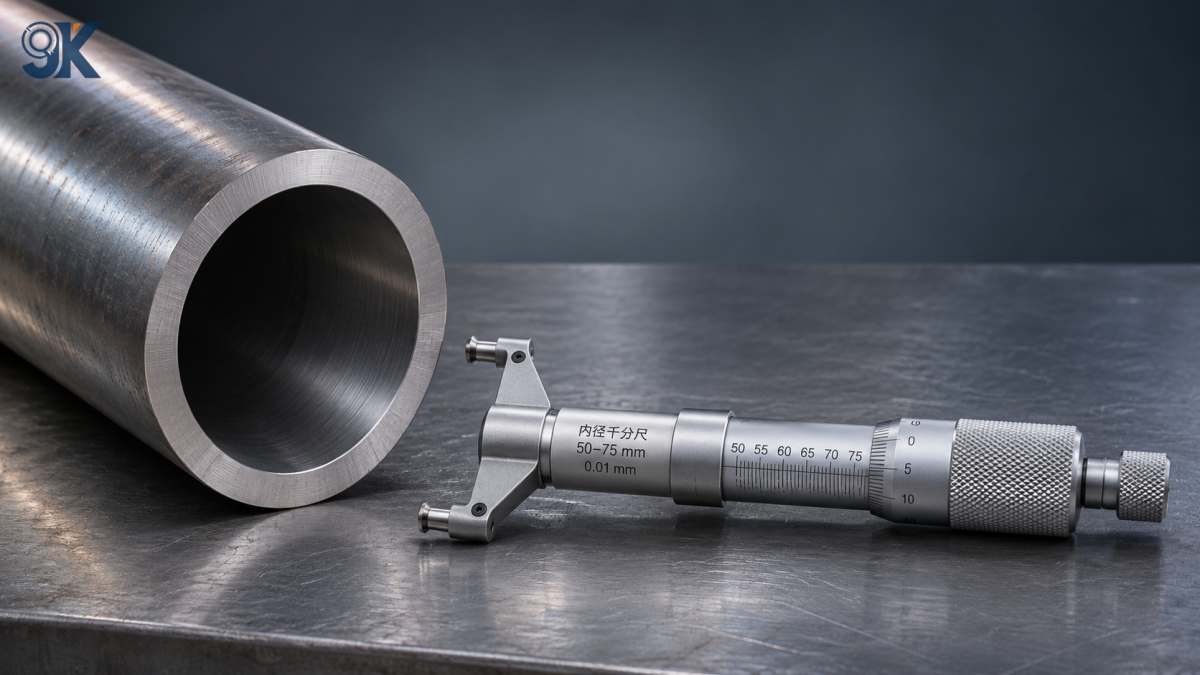
Consider the full tolerance chain rather than one dimension in isolation. If a pipe must fit into a housing, the result depends on variation in both parts, as well as any coating, distortion from welding, and the assembly method. A requirement that looks reasonable on a single-part drawing can become impractical when applied to a long pipe or across an entire fabrication sequence.
Custom tolerances should therefore be limited to the surfaces, lengths, and locations that need them. Specify how straightness, roundness, wall thickness, and length are to be measured, including the applicable reference standard or agreed method. A tighter number without an agreed inspection method can create a dispute without improving the finished assembly.
When the application demands more than dimensional fit
Material and manufacturing requirements can justify a custom order even when the size is available off the shelf. Pressure, temperature, fatigue, welding, impact loading, and exposure to corrosive media can all affect the suitability of a steel pipe. The required specification must be established by the project’s engineering requirements and applicable code, not inferred from size alone.
A pressure-containing line, for example, needs a specification appropriate to its service and governing design rules. A mechanical sleeve may instead be controlled by machinability, dimensional consistency, and the properties needed after fabrication. These applications should not be treated as interchangeable simply because their nominal diameters match.
Manufacturing route also matters. Seamless and welded products can both be suitable for demanding applications when they meet the relevant specification and service requirements. Neither should be selected solely on a generalized claim that it is always stronger or more economical. Where weld location, weld inspection, forming history, or subsequent machining affects the component, those details need to be addressed before an order is placed.
Custom production does not remove the need for an established material specification. A request such as “stronger steel” leaves too much open to interpretation. Identify the required grade or agreed chemical and mechanical properties, delivery condition, test requirements, and traceability. If the pipe will be welded or heat-treated after delivery, assess how those operations affect the specified properties and whether additional qualification or inspection is required.
Material substitution should be treated separately from pipe customization. For example, C24000 Copper Pipe is a copper-alloy product, not a steel equivalent. Changing the base material changes the design and joining questions; it is not a shortcut to meeting an unusual steel-pipe specification.
Compare the complete work package, not just the pipe price
A custom pipe can carry a higher purchase price and still be the less expensive project choice. The comparison should include the work needed to turn each option into an accepted installed component.
For a standard pipe, that may include surplus material, additional cutting and machining, fixture design, extra welds, inspection, transport between subcontractors, and disposal of scrap. For a custom pipe, include any production setup charge, minimum order quantity, special testing, tooling, freight, and the cost of holding spare material. Use the same delivery point and scope of inspection when comparing offers.
A useful approach is to calculate the difference on an equivalent finished-part basis:
Difference in total cost = custom supply and associated processing costs − standard supply and associated processing costs.
Then assess schedule and quality consequences separately. A lower calculated cost is not sufficient if the option leaves no recovery time for a failed inspection or a late shipment. Equally, a custom option should not receive an assumed schedule benefit unless its manufacturing and inspection milestones support it.
Consider a pipe that needs extensive internal machining to reach its final bore. A custom near-finished bore may reduce machining time and waste, but the saving depends on the actual machining allowance, achievable pipe tolerance, number of pieces, and whether finishing is still necessary. If only a few short pieces are needed and suitable stock is available, buying standard pipe and machining it locally may remain the better choice.
Lead time can outweigh the technical appeal
Custom production introduces activities that stock purchasing may avoid: technical review, production scheduling, raw material allocation, manufacturing, testing, and document approval. A quoted lead time should be understood as a sequence, not merely a number of weeks.
Establish when the clock starts. Production may depend on an approved drawing, final specification, purchase order, deposit, or agreed inspection plan. A project that releases an incomplete order early has not necessarily secured an early manufacturing slot. Changes to dimensions or testing after release can affect material allocation, cost, and delivery.
Ask for milestones that correspond to the actual work: drawing approval, production start, completion of required tests, document release, and readiness for dispatch. Where imported pipe is involved, include freight, customs clearance, and delivery to the fabrication site. Factory completion is not the same as material availability at the point of use.
For schedule-critical work, compare the custom route with a realistic fallback. This might be a standard size that the design team has already assessed, a locally machined alternative, or an approved second source. An unapproved substitute is not a contingency if it requires redesign after the original supply fails.
Order quantity and repeatability change the decision
A dedicated production run may involve setup costs and minimum quantities that are disproportionate to a small project. At the same time, a small order does not automatically rule out customization: cutting, machining, or other processing from available stock may be feasible without a dedicated pipe-production run.
Separate the quantity needed for the project from the quantity needed to make the supply route viable. If the supplier requires an order larger than immediate demand, account for storage, preservation, financing, and the chance that a future design revision makes the excess unusable. Spare quantities should be based on an identified maintenance or fabrication need, not treated as free material simply because they reduce the unit price.
Repeat orders can improve the case for a custom size when the design is stable and the same material can be used across multiple assemblies. The opposite is true when dimensions are still moving: a large commitment to a unique specification can lock the project into an obsolete part. In that situation, a smaller processed-stock order or an initial qualification quantity may be preferable, provided the supplier can support it and the schedule allows for subsequent production.
Turn the requirement into an order that can be verified
A custom pipe specification should describe the finished condition at delivery, not just the intended application. A drawing and purchase description need to agree on dimensions, tolerances, grade, manufacturing method where relevant, quantity, lengths, end condition, surface requirements, and any processing to be completed before shipment.
Inspection requirements deserve particular attention because they affect both cost and the point at which material can be released. Define which tests are required, which specification or agreed procedure governs them, the sampling basis, acceptance criteria, and the documentation to be supplied. If third-party witnessing is required, arrange access and hold points before production rather than after the pipe is finished.
Material certificates should provide the information required by the governing purchase specification and allow the supplied material to be traced as agreed. A certificate alone does not prove that every feature on a custom drawing has been inspected. Dimensional reports, coating records, nondestructive examination results, or other evidence may be needed when those characteristics are critical.
Also define how nonconforming material will be handled. A pipe that falls outside a tight tolerance may still be usable after engineering review, but acceptance should not be assumed by the supplier. Establishing a deviation and approval process before manufacture reduces the risk of an undocumented substitution or a late dispute.
A practical decision threshold
Choose custom steel pipe when the project can identify a specific requirement that standard supply cannot meet economically or reliably, and when the custom route has a credible production, inspection, and delivery plan. The case is strongest when customization removes a critical fabrication operation, protects a necessary fit, or provides a material condition that cannot be achieved through an acceptable stock alternative.
Stay with standard pipe when the supposed need is only a preference, when local processing can meet the final requirement with manageable risk, or when an unstable design makes dedicated production premature. The most effective specification is not the most restrictive one: it is the least restrictive specification that demonstrably delivers the required finished performance and fits the project schedule.
Latest News
- How do iron ore prices affect steel pipe price trends?
- How do tariffs affect square tube export markets?
- How steel pipe price trends affect inventory valuation
- Steel pipe price forecast for 2026 amid changing raw material costs
- Square Tube Export News: What Buyers Should Watch in Freight and Supply
- What new trade investigations mean for steel pipe exports
Send Us A Message

