
News center
When does breakbulk shipping make sense for steel pipe?
Breakbulk shipping makes sense for steel pipe when the cargo cannot be loaded safely or economically into standard containers, or when a sufficiently large shipment can justify the port handling and vessel arrangements it requires. Long pipe lengths, heavy individual pieces and substantial project volumes are typical reasons to investigate it. The decision is not settled by size alone: suitable vessel space, lifting equipment, port access and the required delivery sequence must also line up.
For a project working to a construction schedule, choosing on ocean freight alone can be costly. A breakbulk vessel may accept the cargo but arrive at a terminal that cannot discharge the pipe as planned, while a container option may require extra inland trips or multiple deliveries. Compare each route from the loading point through to the site before committing to either.
Start with the cargo, not the freight label
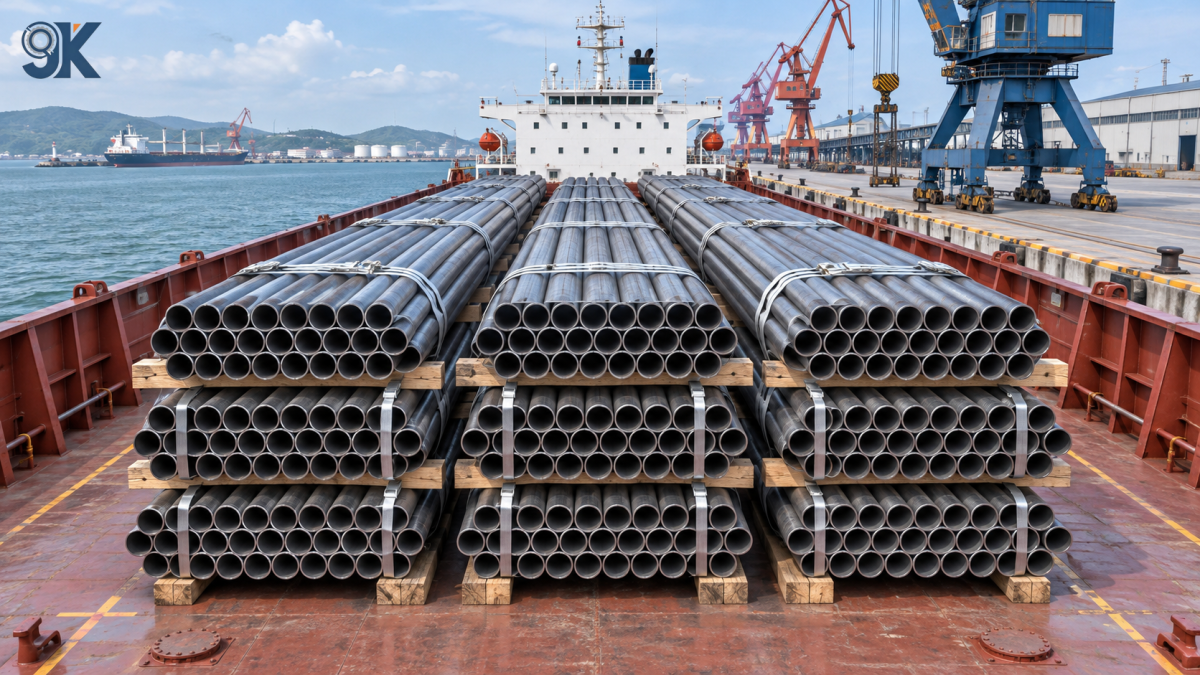
In breakbulk transport, pipe is shipped as individual pieces, bundles or other separately handled units rather than enclosed in standard freight containers. The vessel and terminal arrangements vary: cargo may be stowed in a hold or on deck, and lifting may use shore equipment, shipboard gear or a combination. The proposed stowage and handling method should be confirmed for the actual shipment, not assumed from the word “breakbulk.”
Container transport remains a strong option when the pipe fits within the equipment’s usable dimensions and payload limits, can be loaded and secured properly, and is available in quantities that match the project’s release schedule. Breakbulk becomes more compelling when one or more of those conditions fails.
Length and handling geometry
Pipe that exceeds a container’s practical internal length may still have alternatives, including suitable special equipment or a different transport configuration. Ask the carrier or forwarder to assess the finished shipping length, including any end protection, packaging and protrusions. Nominal pipe length alone does not establish whether loading is feasible.
For breakbulk, length creates a different set of questions: Can the terminal receive the pieces? Is there enough clear space to lift and turn them? Can the proposed vessel stow them without unacceptable overhang or unsupported spans? A long piece that fits aboard a ship may still be difficult to move through a congested terminal or onto the vehicle needed for final delivery.
Weight per lift and total volume
Provide both total shipment weight and the maximum weight of a single piece or bundle. A terminal may be able to handle the overall tonnage but lack the capacity, lifting arrangement or operating window for the heaviest lift. Bundle dimensions, center of gravity and approved lifting points matter as well. Increasing bundle weight can reduce the number of lifts, but only if the pipe, packaging and available equipment can safely accommodate it.
A large volume can make breakbulk worth pricing because the cargo may be planned as a substantial vessel shipment rather than divided across many containers. There is no universal tonnage threshold, however. Vessel availability, route, terminal charges and shipment timing can change the comparison. Request actual offers for the intended cargo rather than relying on a general rule.
Compare the transport options at the same boundary
For Steel Pipe Logistics, an ocean freight quote is only one part of the decision. Ask each provider to price the same origin, destination, cargo readiness date and delivery scope. A quote ending at the discharge port cannot be compared directly with one that includes delivery to the jobsite.
The table identifies candidates, not guaranteed services. Availability and acceptance depend on the cargo and route. For example, an open-top or flat-rack arrangement may solve a loading or dimensional problem, but it can introduce special handling charges and may still have equipment or carrier limits.
Build a comparable landed-cost view
Separate charges by movement so omissions are visible. Include inland collection, export terminal handling, loading, ocean freight, discharge, destination terminal handling, storage allowances and onward delivery where applicable. Add packing, lifting equipment, cargo securing and any special permits or escorts required for the proposed inland movement. Customs clearance, duties, taxes and cargo insurance should be treated consistently across the options, according to the proposed terms.
Look closely at charges that depend on time. A delayed truck, incomplete paperwork or a site that cannot receive pipe may generate storage or waiting costs. Ask when free time starts, what event ends it and which party pays if the vessel or terminal schedule changes. A lower quoted sea rate is not necessarily a lower delivered cost.
Test the route before reserving vessel space
Breakbulk handling is a chain of physical operations. A workable plan needs acceptance at every transfer, not just confirmation that a vessel serves the destination. Start with a cargo list showing outside diameter, wall thickness where relevant to handling, individual lengths, piece counts, weights and the proposed bundle arrangement. Identify coatings, beveled ends or other surfaces requiring protection.
Then ask the transport provider and terminals to review the following:
- Origin access: Can the loaded vehicle reach the berth or terminal, and where will the pipe wait before loading?
- Lifting: What equipment and lifting accessories will be used, and are their capacities suitable for the heaviest and longest units at the intended lift geometry?
- Vessel stowage: Will the cargo be carried under deck or on deck, subject to the carrier’s plan? What support, separation and securing arrangements are proposed?
- Destination discharge: Is appropriate equipment available during the expected arrival window, and can cargo be transferred directly to vehicles or must it enter storage?
- Last-mile delivery: Can vehicles negotiate the route and access the site, and does the receiving area have adequate unloading equipment and space?
Document any assumptions that could alter the quote or schedule. A port may be able to handle pipe in principle but require a booked crane, a particular lifting arrangement or advance approval for long loads. Equally, a site crane may have sufficient rated capacity but not at the radius needed to reach the vehicle. Those details need confirmation before the shipment is locked in.
Protect pipe through each lift and transfer
Breakbulk exposes cargo to handling outside an enclosed container. Damage can occur during lifting, stacking, vessel movement or storage, so the protection plan should reflect the pipe specification and the number of transfers. Agree on how the pipe will be supported and separated, and whether end caps, bevel protectors, wrapping or other measures are appropriate for the finish and intended use.
Coated pipe needs particular attention at contact points. Slings, supports and securing materials should be selected and positioned to avoid unacceptable coating damage or deformation. Do not assume that a method suitable for bare, heavy-wall pipe is suitable for thin-wall or coated material. The cargo owner, carrier and handling parties should agree on the method using the actual pipe properties and lifting requirements.
Weather exposure also belongs in the decision. Clarify whether the proposed carriage and storage leave pipe exposed, what protection is included, and whether that protection is compatible with the cargo. Wrapping alone should not be treated as proof that moisture-related damage is impossible. Record the visible condition at handover and discharge, including damage or wetting where observed, in the relevant receiving documents.
Match arrival timing to the construction sequence
A single large shipment may suit a site ready to receive and store the full quantity. It can be less attractive when fabrication or installation requires small releases in a specific order. Breakbulk schedules and port handling windows may not align neatly with phased consumption, and discharge does not automatically mean immediate site delivery.
Map the dates backward from the required installation sequence: cargo readiness, inland transport to port, terminal receiving window, vessel loading, transit, discharge, customs release and final delivery. Include realistic contingency for the route and identify which milestones are confirmed versus estimated. Compare that timeline with the storage space and inventory control available at destination.
Where pipe is needed in phases, ask whether separate sailings, partial deliveries from destination storage or a mix of transport modes are practical. Splitting the cargo may add handling and coordination, but it can reduce the risk of critical material arriving too late or the site receiving more than it can safely store. Price and schedule the split explicitly rather than assuming it is included.
Make the booking decision with open items visible
Before authorizing a breakbulk booking, obtain a written offer tied to the cargo list and route. It should identify the service scope, intended vessel or sailing window where available, applicable handling arrangements, responsibilities at each transfer and the validity of the quoted terms. Confirm who arranges export and import formalities, insurance and inland permits under the agreed commercial terms; do not assume those responsibilities follow from the shipping method alone.
Also establish how changes will be handled. A revised pipe length, heavier bundle or delayed readiness date can affect vessel acceptance, lifting equipment and price. Keep the cargo description consistent across the packing list, shipping instructions and transport documents, and resolve discrepancies before dispatch.
Breakbulk is the stronger choice when the cargo’s dimensions or volume create a clear advantage and the full route can receive, lift, secure and deliver it within the project’s cost and schedule constraints. If those conditions cannot be confirmed, a containerized, special-equipment or split-shipment alternative deserves a detailed comparison before the project commits.
Latest News
- How do iron ore prices affect steel pipe price trends?
- How do tariffs affect square tube export markets?
- How steel pipe price trends affect inventory valuation
- Steel pipe price forecast for 2026 amid changing raw material costs
- Square Tube Export News: What Buyers Should Watch in Freight and Supply
- What new trade investigations mean for steel pipe exports
Send Us A Message

