
News center
What drives freight costs in steel pipe logistics?
A low ocean freight rate does not necessarily mean a low delivered cost for steel pipe. A quotation can look attractive until inland trucking, loading, terminal charges, destination handling and delivery to the buyer’s facility are added. Pipe length and weight may also limit the available shipping options before the cargo reaches a port.
In Steel Pipe Logistics, the most useful comparison is therefore the total cost of moving a defined quantity of pipe to a defined delivery point, under the same commercial terms. Start with the physical shipment: its packed dimensions, gross weight, handling requirements and delivery schedule. Then compare the routes and shipping methods that can actually accommodate it.
Why pipe dimensions can matter as much as weight
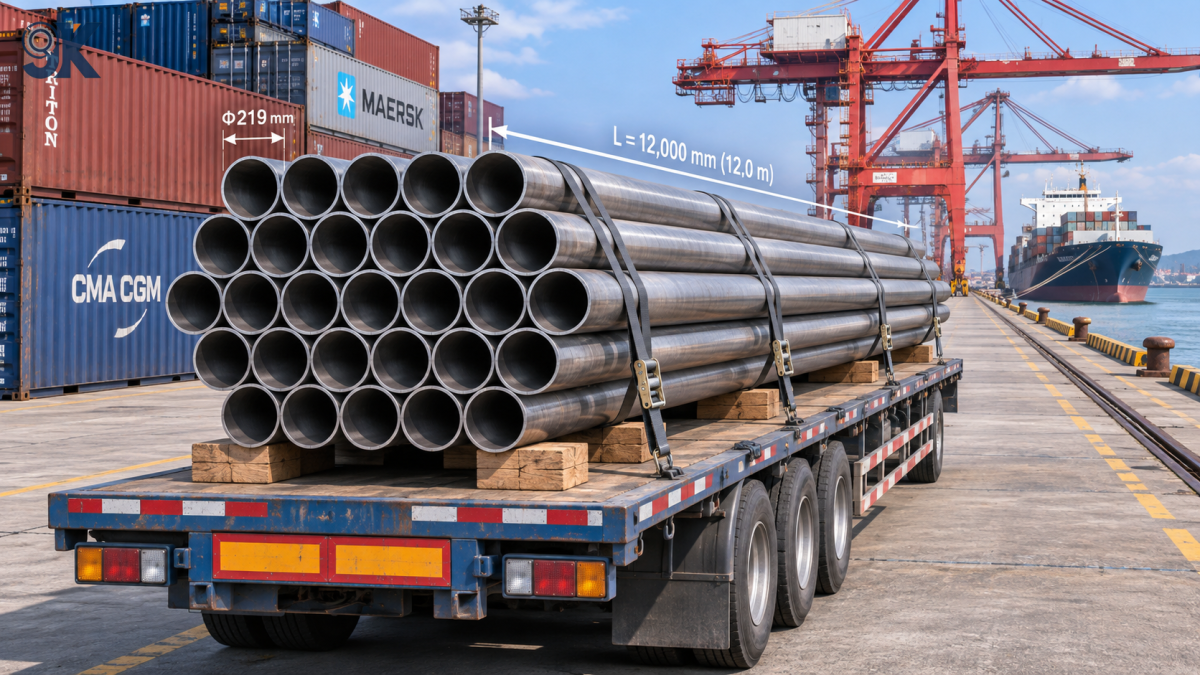
Steel pipe is heavy, but weight alone rarely tells a carrier enough to price the movement. The outside diameter, individual length, wall thickness, number of pieces and bundle arrangement determine how the cargo can be loaded and secured. A shipment may reach a container’s payload limit before filling its available space; a different shipment may be constrained by length or loading access instead.
Long pipes deserve particular attention. A length that fits inside a container in theory may still be difficult to load through the doors or handle safely with the equipment at the loading site. Overlength cargo may require a different container arrangement, specialized equipment or a breakbulk service. Each option can introduce extra handling and change the inland transport plan at both ends.
Diameter and wall thickness also affect the economics. Large-diameter pipe can occupy substantial space relative to its weight, while heavy-wall pipe may reach an equipment or road weight limit with unused space remaining. Small-diameter pipes are often bundled, but the size and weight of each bundle must suit the forklifts, cranes and lifting points available throughout the route.
When requesting a quote, provide the packed dimensions and gross weight, not just the nominal pipe size and net steel weight. Packing materials, supports and bundle configurations affect the actual load. If the order contains several lengths or diameters, ask the forwarder to assess the complete packing list rather than pricing a single representative bundle.
FCL, LCL or breakbulk: compare the whole movement
The choice between a full container load, a less-than-container load and a breakbulk shipment depends on more than order size. Pipe length, density, loading equipment and the destination’s ability to receive the cargo can narrow the practical choices.
FCL is not automatically the cheapest choice for a large order. Heavy pipe can exhaust the permitted payload before the container is full, leaving unused space. Conversely, paying for a full container can be reasonable for a smaller order if LCL handling and destination charges would otherwise erase the apparent freight saving. A dedicated container may also reduce the number of times the pipe is handled, although it does not remove the need for suitable packing and securement.
LCL can make a trial order commercially manageable because the buyer does not necessarily pay for exclusive use of a container. The trade-off is a more complicated handling chain: cargo is delivered to a consolidation point, combined with other shipments, and separated at destination. Long or unusually heavy bundles may not be accepted by every consolidator, and a low quoted ocean rate may represent only part of the total LCL cost.
Breakbulk can accommodate cargo that is unsuitable for standard container loading, subject to vessel and port capabilities. It also requires a close look at how the bundles will be lifted, stowed, protected and released. A lower freight rate per tonne can be offset by crane, terminal or inland delivery costs, especially when the shipment requires special handling at both ports.
Port choice changes the inland bill as well as the sailing options
The nearest port to the production site is not always the lowest-cost gateway. A port with a longer truck journey may offer a more suitable sailing, better equipment availability or lower handling costs. Equally, an attractive ocean rate can be outweighed by expensive inland transport or a difficult transfer between the warehouse and terminal.
Compare routes from the actual loading location to the buyer’s named destination. For shipments from Shandong, Tianjin, Qingdao and Rizhao are possible gateways in the logistics arrangements described by Shandong Jiukai Metal Materials Co., Ltd. The commercial comparison should include trucking to each port, loading constraints, terminal charges, the available ocean service and delivery after arrival.
Transit time belongs in the calculation too. A cheaper route may require a transshipment or have less frequent departures. If a delayed shipment interrupts production or forces the buyer to hold more inventory, the freight saving may be less valuable than it appears. Ask for the expected transit time as well as the sailing schedule and the points where cargo or containers change services.
Handling and protection are part of the freight decision
Pipe bundles must remain stable during loading, road transport, sea passage and unloading. The required approach depends on the pipe’s dimensions, surface condition and intended use. End protection, separators, dunnage, wrapping and suitable lifting arrangements can add cost, but they also address specific risks such as damaged ends, surface marking, moisture exposure or shifting cargo.
Protection should match the commercial consequences of damage. Pipe intended for machining or a surface-sensitive application may justify different precautions from material where minor surface marks are acceptable. Agree on the required condition at delivery before comparing packing charges; otherwise, the cheapest quotation may include less protection than the order needs.
Handling capability at the receiving site is just as important. A bundle that can be loaded at the supplier’s warehouse may be too heavy or awkward for the buyer’s forklift or crane. Repacking, an additional crane or delivery to a third-party facility can then become an unplanned expense. Share the maximum acceptable bundle weight, unloading method and site access restrictions before the supplier finalizes the packing plan.
Read freight quotations against the same delivery terms
Two prices cannot be compared fairly unless they cover the same responsibilities. The agreed Incoterms rule and named place help define where delivery occurs and how certain costs and risks are allocated. They do not, by themselves, provide a complete line-by-line freight budget. The quotation should state what each party is paying for and identify any charges that will be billed separately.
For example, a price covering movement to a destination port is not equivalent to delivery at a factory. The latter may include destination handling, customs-related services and inland transport, depending on the agreement. Duties, taxes, cargo insurance and unloading may also sit outside a freight quote. Include them in the landed-cost comparison when they are relevant to the purchase.
Ask each supplier or forwarder to identify:
- The origin loading point, port of shipment, destination port and final delivery point.
- The shipping method, equipment type, expected transit time and any planned transshipment.
- The basis used to calculate freight, including gross weight, volume and the carrier’s applicable chargeable basis.
- Origin and destination handling, documentation, customs clearance services and inland transport included in the price.
- Insurance, duties, taxes, unloading and other items excluded from the price.
- Any conditions that can change the quote, such as revised dimensions, waiting time, storage or equipment held beyond the permitted period.
Pay particular attention to destination charges on LCL shipments. A quote that includes consolidation at origin may still leave deconsolidation, terminal handling and local delivery for the buyer’s account. Requesting the same cost breakdown from each provider makes the difference visible before the purchase order is placed.
How order planning affects the final cost
Combining orders can improve container utilization and spread fixed handling or documentation costs across more tonnes. It can also delay material that is needed urgently, increase inventory and tie up working capital. Consolidation is most useful when the additional stock and waiting time cost less than the logistics saving.
Splitting an order can make sense when production needs an initial quantity quickly and the balance later. However, separate shipments may repeat minimum charges, customs documentation and inland deliveries. Ask for both a single-shipment price and a staged-delivery price, then compare them against the cost of holding stock and the risk of a production interruption.
For a small trial order, the cost per tonne may look high because handling and documentation do not fall in direct proportion to cargo weight. The decision should include what the trial is intended to establish and whether its delivery date matters. If the specification is likely to change after evaluation, paying more per tonne for a smaller shipment may be preferable to committing to a larger quantity too early.
Buyers combining different metal products should also assess the packing and handling requirements of each item. For example, an order that includes 7003 Aluminum Coil alongside steel pipe should be reviewed for compatible loading, protection and weight distribution before assuming that consolidation will reduce the total cost.
Turn the comparison into a usable purchase decision
Prepare one shipment brief for every quotation: pipe dimensions and quantities, packed bundle details, origin, delivery address, required arrival window and receiving equipment. If the packing plan is still being developed, request quotes based on the same stated assumptions and update the comparison when the final packing list is available.
Then compare each option as a delivered-cost calculation. Add the product price to the freight and logistics charges borne by the buyer, along with applicable duties, taxes, insurance and unloading. Keep exclusions visible rather than treating them as zero. For uncertain charges such as storage or waiting time, identify the conditions that would trigger them and which party would pay.
Finally, test the lowest-cost option against the operational requirement: can the pipe be loaded safely, arrive within the required window and be unloaded in the agreed condition? A quotation that meets those conditions and clearly assigns costs provides a stronger basis for a purchase decision than the lowest ocean rate alone.
Latest News
- How do iron ore prices affect steel pipe price trends?
- How do tariffs affect square tube export markets?
- How steel pipe price trends affect inventory valuation
- Steel pipe price forecast for 2026 amid changing raw material costs
- Square Tube Export News: What Buyers Should Watch in Freight and Supply
- What new trade investigations mean for steel pipe exports
Send Us A Message

