News center
What are steel coils used for in automotive manufacturing?
The uses of steel coils in automotive manufacturing extend from visible body panels to structural components hidden beneath the surface. Automakers and their suppliers process coiled steel into doors, roofs, chassis parts, brackets, and tubes, selecting grades and coatings to meet requirements for strength, formability, corrosion resistance, and cost. Understanding how these materials are selected and processed helps explain why steel coils remain important to modern vehicle production.
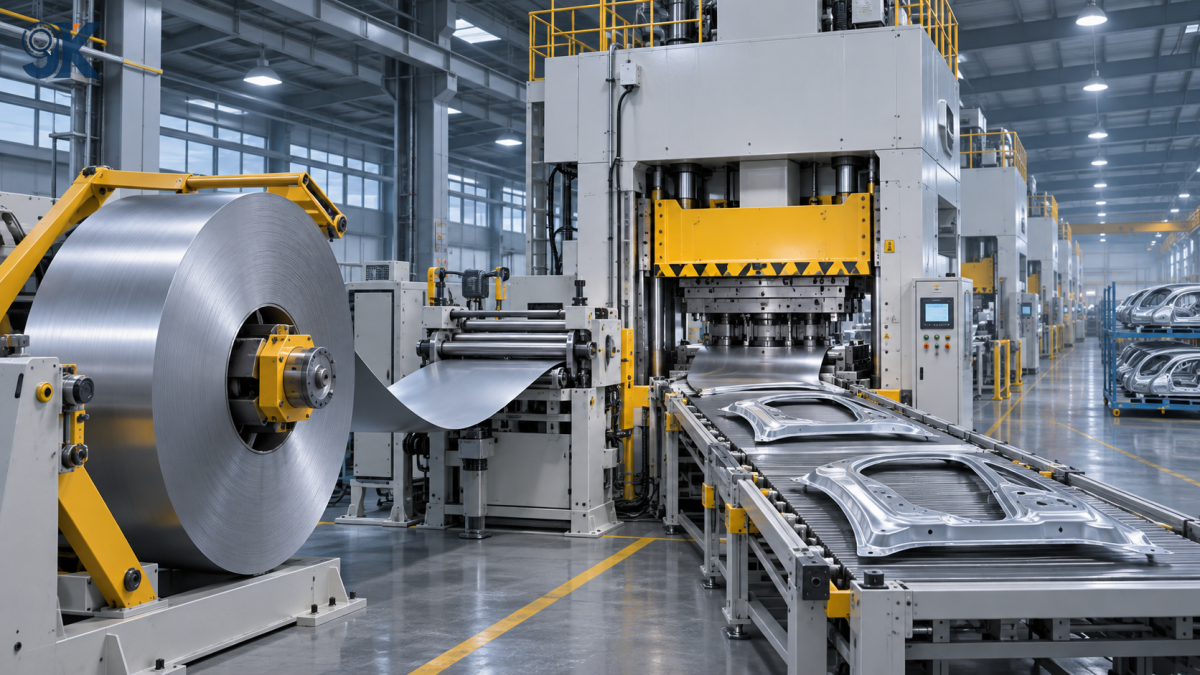
A steel coil is not a finished automotive part. It is a convenient form in which flat steel is supplied, stored, transported, and fed into production equipment. Once uncoiled, the material can be cut, stamped, formed, welded, or processed into tubing. The same delivery format can therefore serve several different manufacturing routes, although the steel itself must be matched to each application.
Where are steel coils used in a vehicle?
Look at a vehicle as a collection of surfaces, load-bearing structures, and smaller joining parts. Coiled steel may contribute to all three, but a smooth exterior panel and a heavily loaded reinforcement rarely call for the same material specification.
Exterior panels and closures
Doors, roofs, hoods, fenders, and other outer panels commonly begin as flat sheet supplied in coils. The sheet is cut into blanks and pressed into shape using dies. For visible surfaces, manufacturers pay close attention to surface condition and consistency because defects may remain noticeable after painting.
Formability matters just as much. A panel with deep contours must stretch and flow through the press without splitting or developing excessive wrinkles. Depending on the part design and manufacturing process, an automaker may choose a suitable low-carbon or other forming-grade steel. Coated sheet can also be specified where corrosion protection is needed.
Body structure and safety-related reinforcements
Beneath the exterior are pillars, rails, crossmembers, sills, and reinforcement components that contribute to the body structure. Some are stamped from sheet; others are roll-formed or made using additional fabrication steps. These applications can require higher-strength steels than those used for easily formed outer panels.
Advanced high-strength steels are used in selected structural areas to help engineers manage loads and crash energy while controlling vehicle mass. The right grade depends on the component’s function and design. Higher strength alone does not guarantee better performance: the material must also be compatible with the intended forming, joining, and crash-management requirements.
Chassis parts, wheels, and brackets
Steel coil is also a starting material for various chassis components, wheel components, mounting brackets, and reinforcements. Some parts are stamped and assembled; others are formed from strip or tube. Their requirements may include fatigue performance, dimensional accuracy, weldability, and resistance to damage in service.
A bracket may look insignificant beside a door panel, yet its hole positions and thickness can determine whether an assembly fits correctly. For this reason, manufacturers consider not only the steel grade but also coil width, thickness tolerance, flatness, and edge condition when planning production.
Tubular components
Another important route takes steel strip from a coil into a tube mill. The strip is formed into a tubular shape, its edges are joined by a suitable welding process, and the tube is sized and cut or supplied for further processing. Depending on the specification and vehicle design, such tubing can be used for seat frames, structural members, supports, and other fabricated components.
This distinction matters when sourcing: a coil specification is not automatically a finished-tube specification. Tube dimensions, weld condition, straightness, mechanical properties, and any subsequent bending or end-forming requirements must also be considered. Some automotive tubes are made by other processes, including seamless production, rather than from welded coil strip.
Electric vehicle components
Electric vehicles use many of the same steel-based body and chassis solutions as other vehicles. Steel sheet and formed sections may also be used in battery enclosures and associated protective structures, depending on the enclosure design. These parts must be evaluated as a system, with attention to stiffness, impact protection, joining, corrosion, and packaging.
Electrical steel supplied in coils has a different role: it can be processed into thin laminations for electric motors. Its magnetic properties and coating requirements are distinct from those of ordinary structural sheet, so it should not be treated as an interchangeable body-panel material.
From coil to component: the processing route
The uses of steel coils become clearer when the production sequence is considered. A coil typically arrives at a service center or component manufacturer with a specified grade, thickness, width, and surface condition. The next steps depend on whether the destination is a stamped panel, a roll-formed section, or a tube.
- Uncoiling and preparation: The coil is unwound and may be leveled to improve flatness before further processing.
- Slitting or blanking: Wide coil can be slit into narrower strips, while sheet can be cut into blanks sized for a press or another forming operation.
- Forming: Stamping, roll forming, bending, or tube forming gives the material its required geometry.
- Joining and finishing: Parts may be welded, assembled, coated, painted, or otherwise finished according to the component design.
- Inspection: Dimensions, surface condition, and relevant material or weld characteristics are checked against the agreed requirements.
Each operation can affect the next. A coil with poor surface condition may create visible defects on an exterior panel; inconsistent dimensions can interrupt an automated line. Similarly, a tube intended for tight bending needs a specification and processing route appropriate to that bend, not merely the correct outside diameter.
Which steel coil properties matter most?
For researchers comparing materials, the most useful question is not “Which steel is best?” but “What must this particular component do?” The following considerations provide a starting point for that discussion.
- Strength and ductility: Structural parts may need high strength, while complex formed parts require sufficient ductility. Engineers assess the balance against the actual design and process.
- Formability: Draw depth, bend radius, part geometry, and press conditions influence whether a grade can be formed reliably.
- Weldability and joining: Material chemistry, coating, thickness, and joint design affect how a component can be assembled.
- Corrosion resistance: Exposure to water, road salt, trapped moisture, and damaged coatings varies by location. Coated steel and additional finishing may be appropriate, but the complete protection system matters.
- Surface quality: A visible painted panel generally requires closer attention to appearance than a concealed reinforcement, although both still need surfaces suitable for their manufacturing process.
- Dimensions and tolerances: Thickness, width, flatness, and edge condition influence feeding, forming, fit, and material utilization.
Hot-rolled, cold-rolled, and coated steels can each have a place in automotive production. Hot-rolled material is used in various formed and structural applications; cold-rolled sheet is often selected where surface quality and dimensional control are important; and metallic-coated sheet can provide corrosion protection. These are broad distinctions, not substitutes for checking the grade and component specification.
Steel coil versus aluminum: is it always a choice between the two?
Not necessarily. Vehicle manufacturers use several materials because different parts solve different problems. Steel may be selected for a structural or formed component, while aluminum can be appropriate elsewhere when its properties suit the design and manufacturing route.
Even within aluminum products, form and grade matter. For example, 1100 Aluminum Foil is a foil product, not a direct replacement for automotive structural steel coil. Comparing materials requires looking at the intended component, thickness, strength, joining method, and service conditions rather than the metal name alone.
What should buyers clarify before requesting material?
An application description is more useful than a generic request for “automotive steel.” If the part is still being designed, sharing the expected manufacturing process and operating conditions can help identify questions early. If a drawing or approved specification already exists, it should guide the inquiry.
A practical request can include:
- The component’s intended use and whether it is visible, structural, or exposed to corrosion.
- The required material grade or applicable specification, including any agreed mechanical-property requirements.
- Coil or tube dimensions, tolerances, quantity, and required surface or coating condition.
- Planned operations such as stamping, roll forming, welding, bending, painting, or further machining.
- Required inspection records, traceability, packaging, and delivery arrangements.
For tubing, include the outside dimensions, wall thickness, length, intended bends, and any special end-processing requirements. A drawing can reveal fit and fabrication considerations that a short product description misses. Equally, a grade suitable for one supplier’s process may need review before it is introduced into another production line.
Connecting material selection with supply
The path from a coil or tube specification to a production-ready component involves more than choosing a nominal size. Processing capability, documentation, packaging, and transport all affect whether the material arrives in a form the manufacturer can use.
Based in Shandong Province, Shandong Jiukai Metal Materials Co., Ltd. provides steel pipe services that include custom production, deep processing, warehousing, logistics, and export customs clearance. For manufacturers investigating tubular applications, a discussion can begin with drawing evaluation and specification selection, then move to processing and shipping requirements. The company handles both long-term orders and small-batch trial orders, with shipping arrangements available through ports including Tianjin, Qingdao, and Rizhao.
Ultimately, steel coils support automotive manufacturing because they offer a practical starting form for many different parts. Their value comes from matching the steel, processing route, and inspection requirements to the job the component must perform—not from assuming that one coil grade can serve every part of a vehicle.
Latest News
- How do iron ore prices affect steel pipe price trends?
- How do tariffs affect square tube export markets?
- How steel pipe price trends affect inventory valuation
- Steel pipe price forecast for 2026 amid changing raw material costs
- Square Tube Export News: What Buyers Should Watch in Freight and Supply
- What new trade investigations mean for steel pipe exports
Send Us A Message

