Steel Pipe Warehousing Basics: Segregation, Supports, and Traceability
Steel Pipe Warehousing Basics: Segregation, Supports, and Traceability
A misplaced bundle, an uneven support, or a missing identification tag can turn routine pipe handling into a safety hazard or a costly production delay. Effective steel pipe warehousing helps operators prevent these problems by separating materials by grade and specification, using stable supports to limit bending and surface damage, and preserving identification through every stock movement.
The difficult part is keeping those controls intact when a delivery arrives late, a bundle is opened for cutting, or someone needs a few lengths urgently. A warehouse arrangement should remain understandable under those conditions—not just look orderly immediately after a stock count.
Receiving: settle material identity before choosing a storage bay
Receiving is the best opportunity to catch discrepancies before material disappears into stock. Compare the purchase order, delivery paperwork, physical markings, and bundle tags. Depending on the order, the checks may include the specified standard and grade, outside diameter, wall thickness, length, manufacturing route, finish, quantity, and heat or lot reference.
Do not treat a similar description as confirmation. Pipes with the same outside diameter can have different wall thicknesses or material requirements. A familiar paint color is also not proof of grade unless it belongs to a documented identification system and agrees with the records.
Look for bent lengths, flattened ends, damaged bevels, wet packaging, loose restraints, and coating damage before accepting the load into normal stock. Photographs are useful when they show both the defect and the associated identification. A close-up of a damaged end without a bundle reference is much harder to resolve later.
Material with missing identification, conflicting paperwork, or questionable condition needs a designated hold location and a blocked inventory status. Moving it into an available production bay “temporarily” makes accidental use more likely. Operators should have a clear person or function to contact for release decisions.
Segregate by what could cause a picking error
Grouping pipe only by diameter is convenient for space planning, but it is not enough for reliable picking. The practical question is: which differences would matter if the wrong length reached the saw or machine shop?
- Grade and specification: Keep non-interchangeable materials distinguishable, even when their dimensions match.
- Wall thickness and length: Separate close-looking sizes that are difficult to identify visually.
- Surface condition: Protect coated, polished, or machined material from rough stock and abrasive contact.
- Release status: Physically distinguish available stock from material awaiting inspection, returned items, and rejected material.
- Order allocation: Identify project-reserved stock so an urgent general-stock pick does not consume it.
Not every distinction requires a separate rack. Where space is limited, clearly divided locations and individually identified bundles may work. However, two nearly identical specifications loose in the same compartment create an avoidable dependence on memory.
Mixed steel warehouses also need to distinguish product shapes. A neighboring item such as SM 400A SS490B U-Shaped Steel Sheet Pile needs storage arrangements suited to its section geometry and interlocks, rather than being treated as another pipe bundle. Shared handling equipment does not mean shared stacking rules.
Where stainless steel is handled alongside carbon steel, use suitable separation and clean contact materials to reduce iron contamination. The required precautions depend on the surface finish and end use; appearance alone may not reveal contamination at the time of storage.
Supports must carry the pipe, not just keep it off the floor
A pipe bundle can look stable while individual lengths are poorly supported. This is especially easy to miss with mixed lengths, thin walls, or partly depleted bundles. Supports should be level, sound, and arranged so that the load is carried without excessive unsupported spans or concentrated contact pressure.
There is no universal support spacing or safe stack height for all steel pipe. Diameter, wall thickness, length, bundle weight, rack design, floor capacity, and handling method all matter. Use approved rack capacities and a storage arrangement assessed for the actual material. If those limits are unavailable, adding another tier is not a reasonable way to find them.
For stacked bundles, keep intermediate bearers vertically aligned with the supports below unless an engineered arrangement specifies otherwise. Offset bearers can transfer loads through unsupported pipe sections. Replace split, crushed, unstable, or contaminated dunnage rather than compensating with loose scraps.
Round pipe also needs effective roll restraint. Use appropriate chocks, cradles, or purpose-designed racks, with restraints that remain effective as stock is removed. Packaging bands should not be assumed to provide lifting capacity or to make an otherwise unstable stack safe.
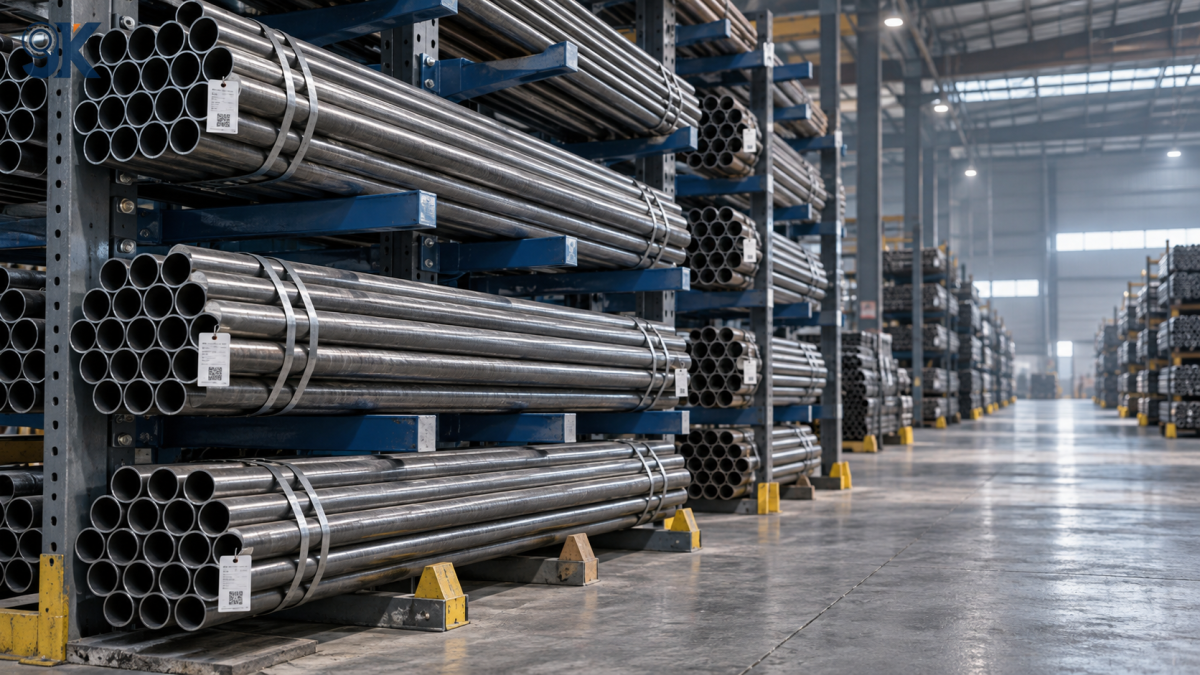
Before cutting bands, assess how the pipes may move and follow the site's controlled unbundling procedure. Stored tension and rolling lengths can endanger anyone nearby. Keep people outside the potential movement zone, and never try to stop a rolling pipe by hand or foot.
Protect the surfaces that matter downstream
A heavy structural pipe and a tube intended for precision machining may tolerate very different handling contact. Choose contact surfaces, lifting equipment, and separators to suit the product. Dragging a finished tube over a steel bearer can create damage that only becomes obvious during machining or inspection.
Keep pipe clear of standing water and inspect outdoor storage after wet weather. Covers should shed water without trapping persistent condensation. End protection may be necessary for threads, bevels, or cleanliness requirements, but caps are not a substitute for checking whether moisture has entered. Preservation methods should follow the product and customer requirements.
Traceability usually breaks when a bundle is split
A tag attached to an unopened bundle is straightforward. The real test comes when three lengths go to cutting, several return, and the remainder moves to another bay. Each resulting stock unit must retain an unambiguous link to its source records wherever traceability is required.
A usable inventory record connects the stock identifier with the specification, dimensions, quantity, location, release status, and relevant heat or lot reference. Where inspection documents are required, that reference must lead to the correct document—not simply to a folder containing certificates for similar pipe.
Transfer identification before cutting or separating material, while the original identity is still certain. Apply an approved marking or tagging method that will survive the next operation without harming the product. Permanent marking is not automatically acceptable for every service or customer requirement.
Remnants deserve particular attention. A short piece marked only with its diameter and length may be useful physically but unusable for a traceability-controlled order. Record its source identity, remaining dimensions, and storage location. If identity is lost, quarantine the piece for an authorized disposition; do not reconstruct its grade from appearance or nearby stock.
Barcodes can reduce transcription errors, but they cannot correct a tag attached to the wrong bundle. Scanning should confirm a physical relationship between material, label, and location. Make the movement transaction part of the move itself, rather than paperwork someone plans to complete at the end of the shift.
Processing and dispatch need a second identity check
At issue to production, compare the physical material identification with the work order before processing begins. This is particularly important when the same diameter is stocked in several grades or wall thicknesses. A correct warehouse location helps, but it is not independent confirmation that the correct material was picked.
For an integrated supplier such as Shandong Jiukai Metal Materials Co., Ltd., whose services connect custom production, deep processing, warehousing, logistics, and export customs clearance, those handovers are practical control points. Material identification needs to remain connected to the order as pipe moves from stock into processing and then into shipment preparation.
Before loading, reconcile the physical bundles with the packing list and required inspection documents. Check quantities, identifying references, end protection, packaging condition, and destination labels. Where weighing forms part of the order or shipping process, investigate unexplained differences rather than silently adjusting records.
Jiukai Metal's shipping options through Tianjin, Qingdao, and Rizhao include FCL, LCL, and bulk shipment. These routes can involve different handling and consolidation stages. Warehouse packaging must therefore be planned for the selected transport method; a storage banding arrangement is not automatically adequate cargo securing. Loading restraints require their own competent assessment.
Keep the controls usable on a busy shift
A short warehouse walk should reveal blocked aisles, damaged supports, loose lengths, unreadable labels, and stock placed outside designated locations. Pay particular attention after partial picks and bundle opening: yesterday's stable arrangement may no longer be stable today.
Stock rotation also needs judgment. Older material may deserve earlier use, but inspection status, corrosion condition, customer allocation, and traceability requirements take priority over a simple first-in, first-out rule.
If only one check is added to the next shift, inspect a partly used bundle. Confirm that its remaining lengths are restrained, properly supported, accurately counted, and still linked to their source records. That is where steel pipe warehousing controls are most likely to be tested—and where a small correction can prevent the next wrong pick or unsafe movement.
Latest News
- How do iron ore prices affect steel pipe price trends?
- How do tariffs affect square tube export markets?
- How steel pipe price trends affect inventory valuation
- Steel pipe price forecast for 2026 amid changing raw material costs
- Square Tube Export News: What Buyers Should Watch in Freight and Supply
- What new trade investigations mean for steel pipe exports
Send Us A Message

