News center
Steel Pipe Solutions for Slurry Lines: Managing Abrasion at Bends
Steel Pipe Solutions for Slurry Lines: Managing Abrasion at Bends
Abrasion at slurry line bends can turn a small design compromise into unplanned shutdowns, costly replacements, and schedule delays. Choosing the right Steel Pipe Solutions means evaluating more than wall thickness: slurry velocity, particle characteristics, bend geometry, and material selection all influence wear performance. The practical challenge is to protect the vulnerable sections without making the entire pipeline unnecessarily expensive or difficult to maintain.
That requires decisions across engineering, procurement, and site operations. A bend that looks economical on a purchase order may need frequent replacement; a more wear-resistant assembly may introduce lifting, inspection, or connection problems. Shandong Jiukai Metal Materials Co., Ltd. supports project-specific pipe sourcing through drawing evaluation, specification selection, custom production coordination, deep processing, and export logistics. Those services are most useful when the operating conditions are defined before material is ordered.
Read the wear pattern before changing the specification
In a slurry bend, solid particles do not simply follow the liquid around the curve. Their inertia can carry them toward the outer radius, where impact and sliding contact remove material. The actual wear pattern depends on particle size, shape, density, concentration, and the local flow field. Settling can also concentrate solids near the bottom of horizontal runs, changing how the next bend is attacked.
This is why “the elbow failed” is not enough information for a replacement specification. Was there a narrow groove, a broad thinned area, or a localized hole near the outlet? Did damage start in the bend or continue into the downstream straight pipe? Were there weld protrusions, changes in internal diameter, or a valve immediately upstream?
For an existing installation, mark the flow direction and installed orientation before removing the failed component. Compare thickness readings with shutdown records, throughput changes, and feed changes. Photographs of the outside alone rarely explain the problem; an internal inspection or sectioned component, where safe and practical, can be much more informative.
Also distinguish erosion from corrosion-assisted damage. If the carrier liquid attacks the steel surface, selecting a harder material alone may not resolve the failure mechanism.
Set the operating window, not just the design pressure
Pressure and temperature remain essential for mechanical design, but they do not describe abrasive duty. A useful slurry specification also records the solids size distribution, maximum particle size, particle hardness and angularity, solids concentration, and carrier-liquid chemistry. Specify whether concentration is reported by mass or volume; confusing the two can undermine hydraulic calculations and material comparisons.
Include normal, minimum, and maximum flow conditions rather than one nominal velocity. Higher velocity often increases erosive wear substantially, although the relationship is specific to the slurry and material. Simply slowing the line is not always safe: operation below the required transport condition can allow deposition, unstable flow, or blockage.
The engineering task is to establish a workable transport window using representative slurry information and an appropriate hydraulic assessment. Start-up, flushing, pump changes, and partial-load operation belong in that assessment. A line that behaves well at full production can still accumulate solids during reduced output, then expose bends to concentrated material when flow recovers.
Use bend geometry to reduce the problem
A longer-radius bend can make the change in direction less abrupt and may reduce localized particle impact compared with a tight elbow. It is a sensible option to investigate, not a universal cure. Particle trajectories, available space, upstream flow disturbances, and downstream layout all affect the result. A longer bend also needs more installation room and may complicate removal.
Look beyond the elbow itself. A reducer, partly closed valve, or misaligned joint immediately upstream can deliver an uneven solids stream into an otherwise well-selected bend. Internal steps at connections can create local disturbance and concentrated wear. Alignment, bore continuity, and weld quality therefore deserve attention alongside bend radius.
Two changes of direction are not automatically better than one. Dividing a turn between separate bends can help in some layouts, but it also introduces additional joints and potential wear locations. Where previous failures have been costly, geometry changes should be reviewed against operating evidence; complex arrangements may justify specialist flow modelling supported by suitable input data.
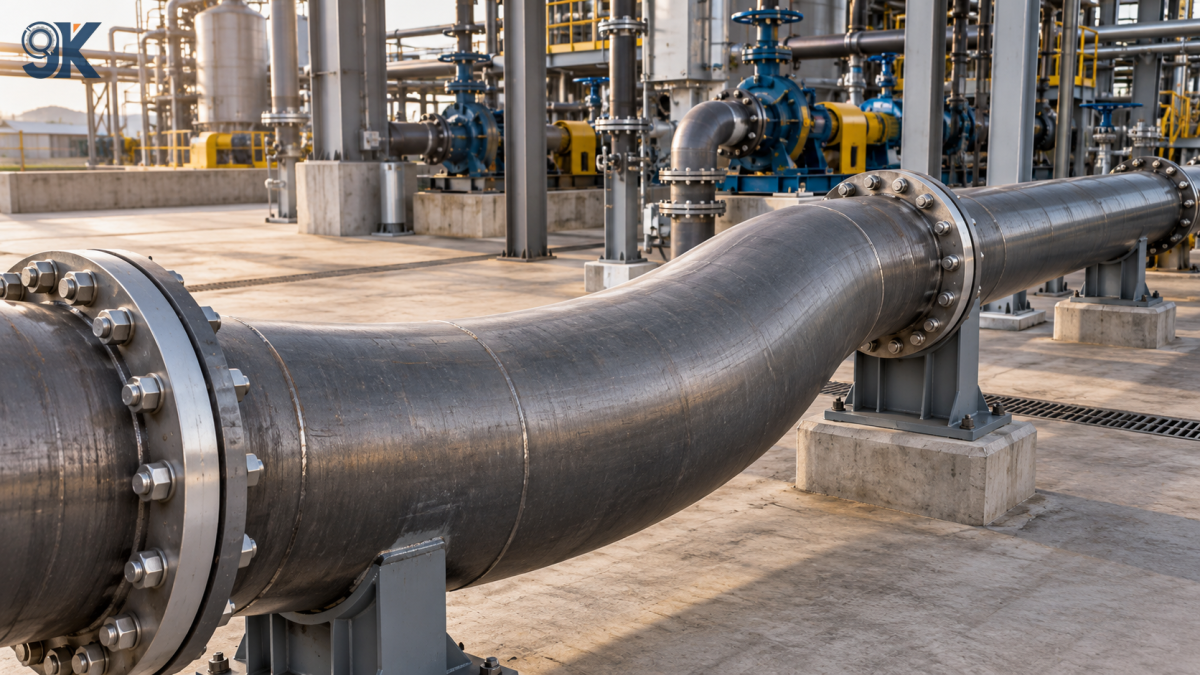
Include the downstream tangent in the inspection plan. Solids leaving the curve can continue striking the pipe after the nominal elbow has ended. Protecting only the curved section can move the next failure into a less accessible straight spool.
Choose a wear strategy that fits the failure mechanism
There is no single best slurry pipe material. The sensible comparison is between complete assemblies operating in the same duty, including connections, inspection access, and replacement work.
- Thicker carbon steel: Often straightforward to fabricate and integrate with an existing steel line. Additional wall provides sacrificial material, but it does not inherently reduce the erosion rate. Weight, supports, and handling requirements increase.
- Abrasion-resistant steel: May offer better wear resistance in suitable duties. Hardness alone is insufficient for selection; toughness, weldability, forming limits, and pressure-service suitability require review.
- Rubber or polyurethane lining: Can suit certain abrasive slurries, but performance depends on particle impact, temperature, chemical compatibility, and liner attachment. Sharp particles or unsuitable operating conditions can cause damage.
- Ceramic-lined steel: Worth evaluating for severe abrasion. Impact resistance, thermal cycling, tile or liner joints, and end details need attention. The steel shell and ceramic lining have different functions, and pressure containment must be established separately.
For lined assemblies, specify the finished internal diameter. A lining added inside the same nominal steel shell reduces flow area and can increase velocity at a fixed volumetric flow rate. It may also create a transition at adjoining unlined pipe. Ignoring that change can weaken the benefit expected from the lining.
Seamless construction is not, by itself, an abrasion solution either. Manufacturing route matters for fabrication and integrity requirements, but wear performance still depends on the material, geometry, internal condition, and operating duty. Likewise, stainless steel should not be selected solely because it sounds more durable; corrosion resistance and abrasion resistance are different properties.
Make the bend replaceable before making it expensive
A replaceable wear spool can be a better investment than upgrading an entire slurry pipeline. It concentrates the higher-cost material where evidence shows the greatest damage and gives maintenance teams a defined replacement boundary. The assembly should include enough adjoining pipe to cover the expected wear zone, rather than stopping at a convenient drawing break.
Connection choice needs practical review. Flanges may simplify replacement, but they require adequate access, alignment, suitable gaskets, and appropriate pressure ratings. Welded connections can suit permanent layouts but extend shutdown work and introduce field-welding requirements. Neither arrangement compensates for poor support or an inaccessible lifting position.
Plan thickness monitoring at repeatable, marked locations around the bend and downstream spool. Conventional ultrasonic measurements on lined or multilayer components may need a qualified procedure and suitable equipment. Establish the retirement criterion through the applicable piping design basis, remaining pressure-containment requirements, and an engineering review—not an arbitrary percentage of original wall thickness.
Bend rotation is sometimes proposed to distribute wear. Only consider it where the assembly, supports, connections, and observed wear pattern allow safe reorientation. It is not a substitute for checking the remaining wall.
Write a purchase package that survives fabrication and shipping
A useful procurement package identifies bend angle and radius, end-to-end dimensions, finished bore, wall or lining requirements, connection details, installed orientation, and inspection requirements. State the applicable piping code, material specifications, and acceptance criteria for the project. A material certificate alone does not establish that a finished custom bend meets the required service conditions.
Keep unrelated metal requirements separate. A wider machinery package might include Brass Coil, but that item belongs under its own material specification, not as an implied substitute for an abrasive slurry bend. Clear line-item descriptions help prevent purchasing substitutions based on material availability rather than engineering suitability.
Based in Shandong Province, Jiukai Metal combines steel pipe sourcing and custom production services with deep processing, warehousing, and export coordination. Its support for drawing evaluation and specification selection can help translate an approved design into a defined supply scope. For specialist linings or wear materials, confirm manufacturing capability, inspection arrangements, and responsibility for the completed assembly before placing the order.
Delivery planning also affects maintainability. Jiukai Metal coordinates shipments through ports including Tianjin, Qingdao, and Rizhao, with FCL, LCL, and bulk shipping options. A replacement bend needs packaging that protects its ends, flange faces, and any lining during handling. Match-marking, component identification, and accessible documentation matter when site teams must install a spare during a short shutdown.
Approve the solution against the next shutdown
Compare alternatives using installed cost and expected maintenance exposure, not purchase price alone. Include supports, lifting, inspection, replacement labour, spare inventory, and delivery time. Where wear-life evidence is weak, a controlled trial on a replaceable spool is more defensible than promising a service interval from hardness or wall thickness alone.
Before releasing an order, resolve three questions: what operating conditions will the bend actually see, where will wear be measured, and how will the assembly be replaced? Steel Pipe Solutions become practical when those answers are reflected in the drawing, inspection plan, and spare-parts schedule—not left for the maintenance crew to discover after the first leak.
Latest News
- How do iron ore prices affect steel pipe price trends?
- How do tariffs affect square tube export markets?
- How steel pipe price trends affect inventory valuation
- Steel pipe price forecast for 2026 amid changing raw material costs
- Square Tube Export News: What Buyers Should Watch in Freight and Supply
- What new trade investigations mean for steel pipe exports
Send Us A Message

