
Steel Pipe Logistics: Container or Breakbulk for Long-Length Orders?
Container shipping is the practical choice when the longest packed pipe fits the equipment, the shipment stays within weight limits, and loading and unloading can be completed safely. Breakbulk becomes more attractive when pipe length exceeds workable container dimensions, bundles require direct crane access, or shipment volume supports a suitable vessel booking. Between these options, open-top and flat-rack containers deserve separate evaluation because their handling, pricing, and acceptance conditions differ from standard enclosed containers.
Effective Steel Pipe Logistics starts with a feasible loading arrangement. A low freight quote has little value if the pipes cannot pass through the container opening, the lifting gear cannot be removed after positioning, or the destination lacks equipment to discharge the cargo. Establish those constraints before comparing the full cost of each route.
Start with the longest packed piece
The nominal container size does not establish the usable cargo length. Internal dimensions, door openings, structural obstructions, and space needed for blocking all affect what fits. Confirm the dimensions of the actual equipment offered for the booking rather than relying on a generic container diagram.
Use the maximum finished pipe length, including positive manufacturing tolerance and any projecting end protection. A loading plan based only on the ordered nominal length leaves no allowance for longer pieces within the permitted tolerance. Bundles also need sufficient clearance for insertion and securing without forcing pipe ends against container walls or doors.
A pipe that fits inside the container still needs a workable loading path. Long bundles entering through the end doors require suitable support and controlled movement throughout insertion. The loading arrangement must also allow slings or other handling equipment to be removed without disturbing the stow. Destination extraction deserves the same attention: equipment available at the origin warehouse may be absent at the receiving site.
Do not treat diagonal loading as an automatic solution to excess length. A theoretical diagonal ignores bundle width, door geometry, maneuvering space, and securing access. Any proposed angled arrangement needs a dimensioned plan and acceptance from the relevant carrier and loading facility.
Separate standard containers from special equipment
“Container or breakbulk” is not always a two-way choice. Special container equipment can retain access to liner services while accommodating cargo that cannot enter a standard dry container. Its feasibility still depends on the specific equipment and route.
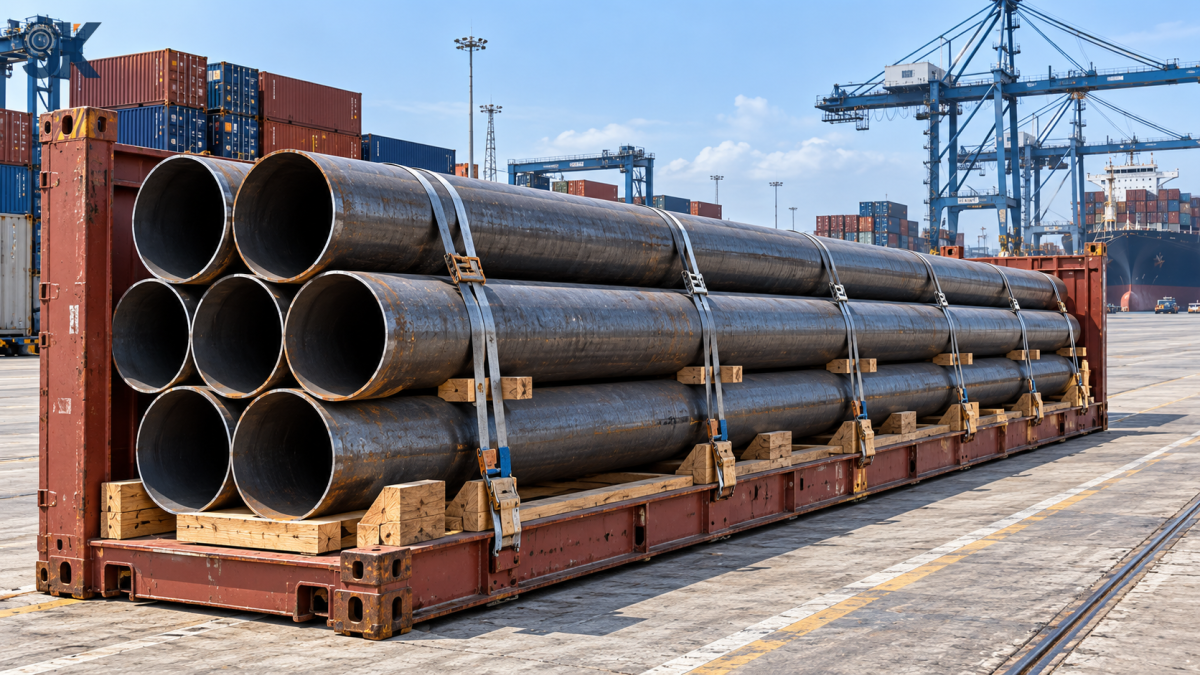
An open-top container improves access from above; it does not automatically provide additional usable length. A flat rack also has structural and operational boundaries. Overlength cargo needs explicit acceptance, and occupying space beyond the normal container envelope can affect the freight calculation and routing options.
Weight distribution can rule out an otherwise suitable container
Steel pipe shipments often reach a weight constraint before filling the available space. However, total cargo weight is only one limit. Container payload, floor loading, support reactions, terminal handling restrictions, and road transport limits must all be compatible with the proposed shipment. The lowest applicable limit controls the arrangement.
A heavy bundle resting on a few narrow timber bearers creates concentrated loads. Adding bearers helps only when their dimensions and positions distribute the load effectively. Container condition, floor structure, bundle stiffness, and contact area belong in the assessment. Simply dividing cargo weight by the full container floor area conceals the actual loading pattern.
Pipe geometry changes the calculation. Thick-wall pipes can exhaust payload with considerable empty space remaining. Large-diameter, thin-wall pipes occupy more volume and need protection against ovality or local deformation. Small pipes nested inside larger ones can improve space utilization, but nesting requires agreement on separation, restraint, identification, and removal. Unrestrained inner pipes can shift and damage internal surfaces or ends.
For a mixed shipment containing pipes and structural sections such as A36 H Beam-(1), the securing plan must account for different contact shapes. Beam edges and flanges should not bear directly against vulnerable pipe walls or coatings. A shared container is justified only when segregation and restraint remain workable.
When breakbulk earns its place
Breakbulk deserves serious consideration when the pipes exceed feasible container dimensions without cutting, or when container loading would introduce excessive handling. Direct crane lifts can suit long, rigid bundles, provided the lifting arrangement controls bending and prevents slippage. Larger shipment volumes can also make vessel space and dedicated port handling more practical.
Length alone does not settle the decision. A small parcel of unusually long pipes may face limited vessel options, minimum handling charges, or a wait for compatible cargo. Conversely, a substantial order that technically fits containers may generate many loading operations and costly destination unloading. Compare the actual shipment configuration rather than assuming that all container-compatible cargo belongs in containers.
The proposed vessel and stowage location matter. Underdeck carriage and deck carriage create different exposure conditions. Hatch access, hold geometry, available lifting equipment, and nearby cargo affect handling and protection. Terms such as “breakbulk service” do not establish whether the cargo will remain sheltered or how many times it will be moved.
Confirm whether the route is direct or includes transshipment. Each intermediate discharge and reload introduces another handling interface, with implications for bundle integrity, identification, and delivery timing. Breakbulk scheduling also needs to be assessed against the actual service offered; vessel arrival windows and cargo assembly requirements can affect dispatch planning.
Match protection to the pipe condition and handling route
Round pipes need positive restraint against rolling. Bundle straps keep pieces together, but they do not replace the blocking and securing that restrain the cargo during transport. Support locations should control movement without imposing damaging local pressure. Long bundles require lifting arrangements that limit sagging and avoid concentrating force at unsuitable points.
Surface condition changes the packaging requirement. Bare pipe intended for later processing has different acceptance criteria from coated pipe, machined tube, or finished mechanical tubing. Coatings need protection from sling abrasion and contact with adjacent steel. Beveled, threaded, or precision-finished ends require protection that remains secure through lifting and vibration.
For breakbulk, agree suitable lifting points, sling contact protection, bundle weights, and identification before dispatch to the port. A spreader arrangement may be necessary where sling angles or unsupported length create unacceptable bending or compression. Its need follows from the cargo and lift geometry, rather than from the shipping mode alone.
Enclosed containers reduce direct exposure to rain and spray, but moisture inside the container still requires attention. Wet dunnage, damp packaging, and temperature changes can produce condensation. Moisture-sensitive pipes need an agreed preservation and packaging method, including compatibility with subsequent machining or coating. Wrapping wet material can trap moisture against the steel.
Compare landed cost using the same scope
A container freight quote and a breakbulk freight quote often cover different activities. Build the comparison around the same delivery point and the same cargo quantity. Otherwise, a favorable ocean rate can conceal additional terminal work, special equipment, or destination handling.
- Origin preparation: packaging, dunnage, loading labor, cranes, securing materials, and any engineering or survey work required for acceptance.
- Special container equipment introduces availability and positioning questions. An attractive rate is incomplete if the required flat rack cannot reach the loading location within the production schedule.
- Port and vessel charges: establish which terminal movements, lifting operations, and securing or releasing activities are included in each quotation.
- At destination, account for unloading equipment, storage, container return obligations, and onward transport of the full pipe length. Road access can remain the controlling constraint after an uncomplicated sea voyage.
For container shipments, clarify the free-time terms and where unloading will occur. A slow extraction process or unavailable crane can generate additional charges even when the vessel arrives on schedule. For breakbulk, identify who arranges discharge, when cargo becomes available for collection, and what storage terms apply.
Cutting pipes to fit containers requires a separate commercial and technical decision. Shorter lengths may simplify freight but introduce joining, inspection, fabrication waste, or drawing changes. If continuous length serves a functional requirement, a freight saving does not justify altering it. Compare any permitted length change using the complete downstream cost.
Turn the preferred option into a bookable shipment
For an order that fits standard equipment with adequate clearance and a proven unloading method, a dry container is a strong starting point. If length fits but end-loading is impractical, evaluate top access. Where the cargo exceeds the container envelope, compare an accepted flat-rack arrangement with a specific breakbulk service, including handling and destination delivery.
The booking information should identify maximum piece length, outside diameter, wall thickness, piece count, bundle dimensions, individual and total weights, surface condition, and permitted lifting methods. Include a loading drawing showing support positions, securing access, and projections. State whether dimensions describe bare pipes or completed packages; that distinction can change equipment acceptance.
Before production lengths and packaging are finalized, resolve the remaining interfaces in writing: the equipment offered, cargo acceptance, loading responsibility, discharge method, and onward transport arrangement. These confirmations turn a plausible shipping choice into an executable plan and prevent a dimensional or handling problem from appearing after the pipes reach the port.
Latest News
- How steel pipe price trends affect inventory valuation
- Steel pipe price forecast for 2026 amid changing raw material costs
- Square Tube Export News: What Buyers Should Watch in Freight and Supply
- What new trade investigations mean for steel pipe exports
- The role of scrap supply in steel industry development
- How energy costs shape steel pipe price trends
Send Us A Message

