
Steel Pipe HS Classification: How Material, Process, and Use Affect the Code
A steel pipe’s HS classification can affect duty rates, documentation requirements, and shipment planning—making it a critical checkpoint in supplier and cost evaluations. Two pipes with similar dimensions may fall under different tariff provisions because one is seamless and the other welded, or because their chemical compositions place them in different material categories.
For buyers comparing international sourcing options, these distinctions matter before a purchase order is signed. A quotation based on an unverified code can produce a misleading landed-cost estimate, even when the product price and freight calculation are accurate. Reliable Export Customs Clearance starts with identifying the goods precisely, then checking the applicable tariff schedule in the importing country.
Start with the classification system—not the supplier’s familiar code
The Harmonized System organizes internationally traded goods into headings and subheadings. The first six digits are internationally harmonized for countries using the same HS edition. Importing jurisdictions then add further digits to identify national tariff lines and statistical categories.
This means a Chinese export declaration code should not simply be copied into an overseas import entry. The underlying product characteristics should support both declarations, but the complete codes may differ in length and detail. Classification must follow the applicable General Rules for Interpretation, legal notes, and heading or subheading wording—not whichever description looks closest in a search result.
For commercial evaluation, separate three questions:
- What is the product? Establish its material, manufacturing method, dimensions, condition, and objective characteristics.
- Where does it fit? Determine the appropriate HS heading and subheading, followed by the destination’s national tariff line.
- What charges and controls apply? Check ordinary duties, origin requirements, trade remedies, and any relevant import restrictions separately.
A valid HS code does not itself certify product quality or guarantee a particular duty rate. ASTM, EN, API, and other technical standards can provide useful classification evidence, but they do not replace customs analysis.
The main steel pipe headings: a practical starting map
Most conventional iron or steel pipe and hollow-section products are considered within headings 7304, 7305, or 7306. The table below is an orientation tool, not a substitute for checking the legal text and national subdivisions.
Cast-iron tubes and pipes require separate consideration under heading 7303. Likewise, flexible metal tubing and products that have become identifiable machine components may require examination outside the ordinary pipe headings. Classification begins with the goods as presented to customs, not merely the raw material from which they originated.
Material composition: why a grade name is not enough
Buyers commonly distinguish between carbon steel, stainless steel, and alloy steel. Customs classification requires those descriptions to be checked against the relevant legal definitions. A commercial label such as “alloy tube” is not sufficient evidence on its own.
A mill test certificate or material inspection certificate is particularly useful because it records the grade and chemical composition. Stainless steel has a specific definition in the Chapter 72 notes, including carbon and chromium criteria. Other alloy steel is also defined through specified elemental thresholds. These distinctions can lead to different subheadings within the same manufacturing category.
For example, two seamless round tubes with identical dimensions may need different subheadings if one is non-alloy steel and the other is stainless steel. Classification should therefore be linked to the actual grade supplied, not a generic code retained from an earlier order.
Material separation also matters in mixed shipments. A copper-alloy product such as H62 Brass Coil should not inherit a steel pipe code simply because it appears on the same invoice. Its composition and product form require a separate classification assessment. Clear invoice lines help prevent unrelated goods from being grouped under one convenient description.
Manufacturing process changes the classification route
Seamless versus welded construction
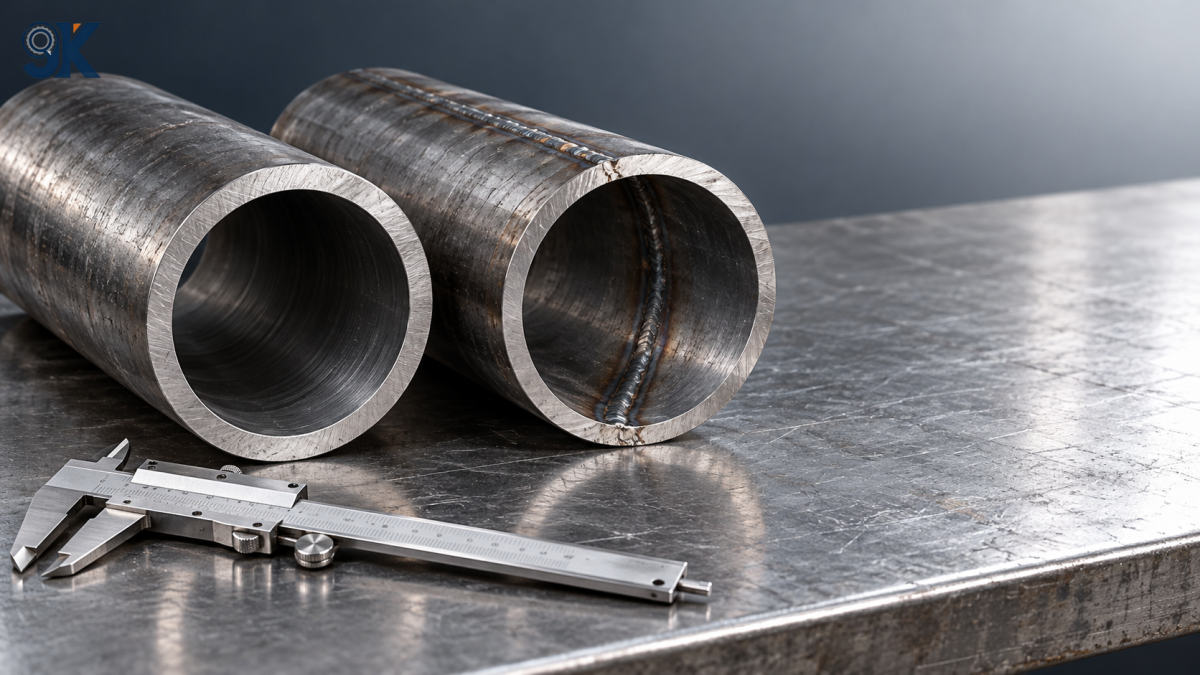
Seamless pipe and welded pipe generally follow different heading routes. A seamless tube may be pierced, extruded, or otherwise produced without a welded seam. Welded pipe is formed from flat material and joined along a seam, although the welding technology and seam arrangement vary.
Surface appearance alone is unreliable. Finishing operations can make a weld difficult to see, while machining marks can be mistaken for a seam. Ask the supplier to confirm the manufacturing route in writing, supported by production specifications or inspection documentation.
Diameter and welding method
For non-seamless circular tubes and pipes, the 406.4 mm external-diameter threshold is an important distinction when considering headings 7305 and 7306. Nominal bore, internal diameter, and outside diameter are not interchangeable. A purchasing description expressed only as a nominal pipe size may leave an essential classification fact unresolved.
Longitudinal and spiral welding can also matter within relevant subdivisions. “Welded steel pipe” may therefore be too broad a description for a dependable classification decision.
Cold drawing, rolling, and subsequent processing
Within certain seamless pipe subheadings, whether the product is cold-drawn or cold-rolled can affect classification. Descriptions such as “precision tube,” “bright tube,” or “finished tube” do not necessarily establish that processing condition.
Heat treatment, honing, cutting, coating, threading, and machining should also be disclosed. Not every operation changes the heading, but substantial processing can alter the identity of the imported article. A coated pipe does not automatically stop being a pipe; equally, a highly finished component should not automatically retain its starting tube classification.
Intended use matters—but it must be supported by the product
Some tariff provisions distinguish line pipe used for oil or gas pipelines, casing and tubing used in drilling, and other pipe categories. These descriptions should not be selected merely because a buyer operates in the energy sector.
The product’s specifications, design, applicable standards, and objective characteristics must support the category claimed. A general mechanical tube delivered to an oilfield equipment manufacturer is not necessarily oil or gas line pipe. Conversely, qualifying line pipe should not be treated as generic mechanical tubing simply because that wording is easier to place on an invoice.
Standards offer useful clues. An API specification may support an assessment of oilfield or pipeline applications, while an EN precision-tube standard may help describe a mechanical product. Neither should be treated as a one-to-one conversion table to an HS code.
Use becomes particularly sensitive when tubes are deep-processed into machinery components. Consider a tube cut to length versus a part supplied with machined mounting features and a specific assembly function. The latter may require analysis as a component, depending on its condition and the applicable legal notes. Where the boundary is unclear, obtain a destination-country customs opinion before production and shipping commitments become difficult to change.
A classification file that supports Export Customs Clearance
The strongest classification file is not necessarily the largest. It is the one that allows a customs broker or authority to understand the goods without reconstructing the order from scattered emails.
Before shipment, assemble a consistent record containing:
- Material identification: steel grade, applicable standard, and chemical composition evidence.
- Manufacturing details: seamless or welded construction, welding method where relevant, and cold-drawn or cold-rolled condition.
- Dimensions and shape: outside diameter, wall thickness, length, and circular, square, rectangular, or other cross-section.
- Delivery condition: coating, heat treatment, threading, end preparation, and further machining.
- Application evidence: drawings, technical specifications, and relevant design standards where use affects classification.
- Classification reasoning: proposed heading, destination tariff line, and the evidence supporting the choice.
The commercial invoice, packing list, purchase order, and inspection documents should tell the same story. An invoice describing “seamless mechanical tubes” conflicts with a certificate identifying welded construction, even if the dimensions match. Such inconsistencies can trigger questions, inspections, or declaration corrections.
A useful invoice description might identify “seamless non-alloy steel mechanical tubes, cold-drawn,” followed by the actual grade, dimensions, and condition—provided each statement is accurate. Avoid broad descriptions such as “metal materials” when the available specifications permit greater precision.
What business evaluators should check beyond the code
Correct classification is only one part of landed-cost control. Anti-dumping or countervailing measures, safeguards, additional tariffs, and preferential origin rules can materially affect a steel pipe purchase. Their applicability may depend on origin, producer, dimensions, grade, or product scope—not just the tariff number.
Trade-remedy notices may list tariff codes for reference while defining their scope through a detailed written product description. A code match does not always establish coverage, and a different code does not necessarily exclude it. Ask the destination broker to check the current measures against the actual goods.
Compare supplier quotations using the same assumptions: identical product specifications, origin, proposed import classification, delivery terms, and treatment of duties and clearance charges. Otherwise, a seemingly lower quotation may simply omit a cost another supplier has recognized.
For recurring or high-value shipments with genuine classification uncertainty, consider an advance or binding ruling where available. Its value depends on accurate product disclosure and compliance with the issuing authority’s conditions; a ruling for a different product or jurisdiction is not automatically transferable.
Resolve uncertainty while the order is still flexible
For machinery manufacturers, classification questions are easiest to resolve during drawing review and specification selection. At that stage, missing details can be clarified before production, document preparation, or freight booking introduces avoidable pressure.
Shandong Jiukai Metal Materials Co., Ltd. combines custom steel pipe production, deep processing, warehousing, logistics, and export customs clearance services. That integrated workflow provides a practical opportunity to align drawings, material records, finished-product descriptions, and shipment documents before dispatch through ports such as Tianjin, Qingdao, or Rizhao. The destination importer and its customs representative should still verify the applicable import classification.
Whether the shipment is a small trial order or a recurring full-container purchase, the essential discipline is the same: classify the product actually supplied, document the reasoning, and verify destination-specific requirements before shipping. A familiar code is a starting point—not a substitute for a defensible classification decision.
Latest News
- How do iron ore prices affect steel pipe price trends?
- How do tariffs affect square tube export markets?
- How steel pipe price trends affect inventory valuation
- Steel pipe price forecast for 2026 amid changing raw material costs
- Square Tube Export News: What Buyers Should Watch in Freight and Supply
- What new trade investigations mean for steel pipe exports
Send Us A Message

