News center
Seamless vs. Welded Steel Pipe: Which Is Better for Your Project?
Choosing between seamless and welded steel pipe requires more than a simple comparison of price or strength. Manufacturing method, dimensional tolerances, material grade, operating pressure, and inspection requirements can all affect suitability for a given application. For machinery manufacturers, the decision also has consequences for machining yield, weld placement, traceability, and delivery. The better option is the one that satisfies the finished component’s requirements with a controlled, verifiable manufacturing route.
The manufacturing difference—and why it matters
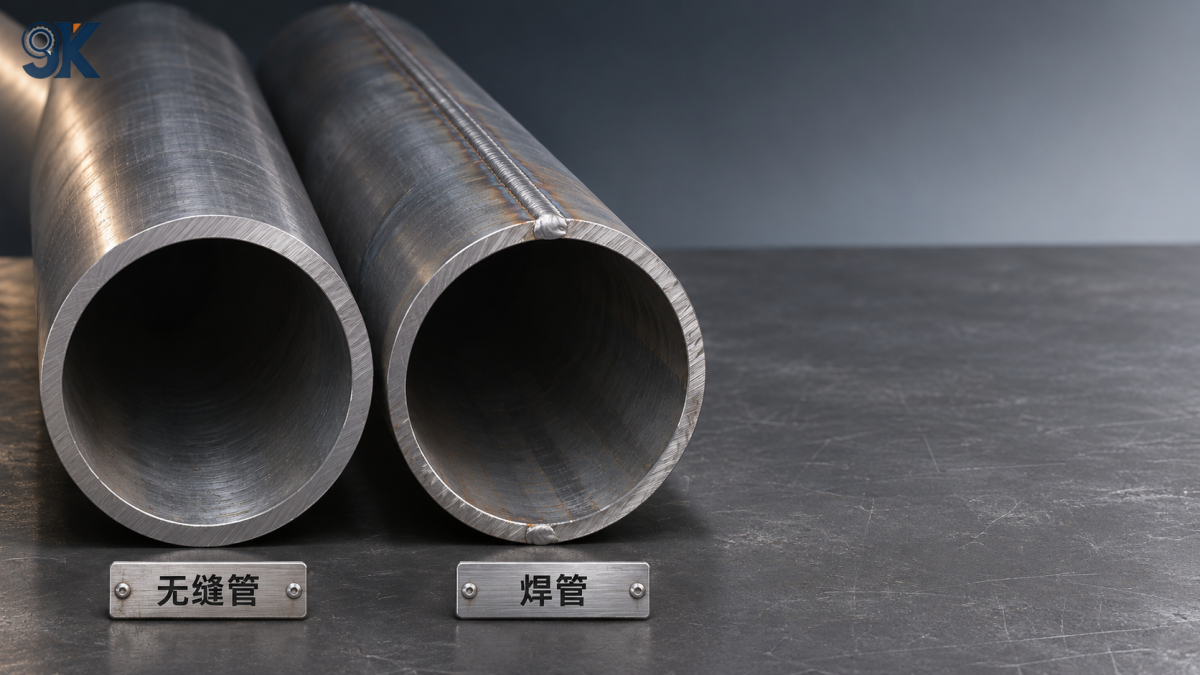
Seamless pipe is made without a longitudinal or helical weld seam, generally by piercing and working a heated solid billet. Depending on the product and required dimensions, subsequent processes such as hot finishing or cold drawing may be used. The absence of a seam removes one location that would otherwise require specific consideration in inspection and design. It does not, however, make the material free from surface defects, dimensional variation, or other manufacturing imperfections.
Welded pipe starts as flat steel that is formed into a cylinder and joined along a longitudinal or helical seam. Common manufacturing routes include electric resistance welding and submerged arc welding. The weld and adjacent heat-affected zone become part of the component’s material condition, so the applicable product specification and inspection plan matter as much as the fact that the pipe is welded.
In practical terms, seamless pipe is often considered when a project calls for heavy walls or when a seam would be difficult to accommodate. Welded pipe can be attractive when a suitable size, wall thickness, and inspection route are available at a better overall cost. Neither description alone establishes whether a particular pipe is fit for pressure service or precision machining.
Pressure capability is a design question, not a pipe label
A frequent assumption is that seamless pipe always handles more pressure than welded pipe. That is too broad to support a purchasing decision. Pressure capability depends on the governing design code, outside diameter, minimum wall thickness, material properties, temperature, allowances, and any applicable joint or weld factors. The product standard establishes requirements for the pipe; the design code determines how the component is assessed in service.
A welded product manufactured and inspected to the specified requirements may be suitable for demanding pressure applications. Equally, a seamless pipe can be unsuitable if its grade, wall thickness, temperature rating, or documentation does not meet the design basis. Avoid comparing two quotations on nominal size and price alone: check whether they use the same grade, wall basis, manufacturing route, and testing requirements.
For cyclic pressure, vibration, or repeated mechanical loading, fatigue deserves separate attention. A seam, weld geometry, local stress concentration, surface finish, and the location of attachments can all influence performance. The design team should evaluate the actual load path and governing rules rather than assuming that a hydrostatic test by itself demonstrates fatigue life.
Dimensions can determine the real cost
A pipe that meets its nominal dimensions is not necessarily the most economical starting material for a machined part. If a component is bored, turned, or honed, the evaluator should establish how much stock is needed at the thinnest wall and at the most unfavorable combination of diameter, straightness, and eccentricity permitted by the order.
For example, a sleeve machined from pipe may require a specified finished bore and outside diameter. If wall distribution varies, a nominally adequate blank can leave insufficient material on one side after the bore is centered. Conversely, ordering excessive wall thickness may increase cutting time and scrap. A drawing that identifies the critical finished surfaces is more useful than a request for a nominal pipe size alone.
Welded pipe may offer dimensional advantages for some sizes and manufacturing routes, while seamless pipe may be available in configurations better suited to thick-wall machining. Neither is universally more precise. Compare the actual tolerances offered, including outside diameter, wall thickness, straightness, ovality, and length. If the internal weld bead is relevant to flow, fitting, or machining, specify the permitted condition and how it will be verified.
When the bore is a functional surface
For cylinders, bearing housings, and similar parts, the inside surface may need further processing. Pipe supplied to a general specification should not automatically be treated as a finished hydraulic cylinder tube. Confirm bore tolerance, surface condition, straightness, machining allowance, and any honing or other finishing requirements separately. If the component will be welded into an assembly, discuss how fabrication heat and distortion could affect the final bore.
Match material and specification to the service
The term “steel pipe” covers products intended for very different duties. A grade selected for structural fabrication is not automatically interchangeable with one specified for pressure piping, elevated temperature, or low-temperature service. Chemistry, mechanical properties, heat-treatment condition, and supplementary testing can all change the suitability of an otherwise similar-looking tube.
ASTM A106/A106M, for example, covers seamless carbon steel pipe for high-temperature service. ASTM A53/A53M includes seamless and welded pipe within its scope. These names are useful starting points, not blanket approvals for a project. Check the current applicable edition, grade, ordered type, and any supplementary requirements, then confirm compatibility with the governing design code and end-use conditions.
Substitution needs the same discipline. Two grades with overlapping tensile requirements may differ in chemistry, impact testing, heat treatment, or permitted manufacturing methods. Before accepting an alternative, ask the design authority to review the complete specification rather than relying on a supplier’s description of the material as “equivalent.”
Inspection should address the actual failure risk
Inspection requirements are most useful when they are tied to a defined concern. For pressure containment, that may include verification of wall thickness and specified pressure or nondestructive testing. For a machined component, surface condition and dimensional checks may be equally consequential. For welded pipe, the order should make clear what weld inspection is required under the chosen specification and what, if anything, must be added by the project.
A practical purchase specification should identify:
- The product standard, edition where required, grade, and permitted manufacturing route.
- Outside diameter, wall thickness or schedule, length, and any tighter tolerances needed for processing.
- Service conditions and applicable supplementary requirements, such as impact testing when specified by the design.
- Required examination methods, coverage, acceptance criteria, and the party responsible for review.
- Material certificates, heat traceability, marking, and records required through cutting or other processing.
Terms such as “ultrasonic tested” or “fully inspected” are not complete acceptance criteria. The method, area examined, sensitivity or acceptance basis, and reporting requirements must be agreed against the applicable standard and project documents. Likewise, hydrostatic testing and nondestructive examination answer different questions; one should not be assumed to replace the other without confirmation from the governing specification.
Where welded pipe can be the sensible choice
If the design permits a weld seam, welded pipe deserves a serious comparison rather than being treated as a second-tier option. For a fabricated frame, casing, or noncritical conveying line, the key questions may be dimensional consistency, weldability, surface condition, and availability—not the absence of a seam. In larger diameters, welded production routes may also offer practical sourcing choices that are not available in the same form as seamless material.
The seam still needs a plan. A machined opening, bracket, or circumferential joint placed near it can complicate fabrication or inspection. If seam orientation matters, put that requirement on the drawing and agree how it will be marked. Where the pipe will be bent, formed, or subjected to further heat treatment, verify that the selected product and weld condition are appropriate for those operations.
When seamless may justify the premium
Seamless pipe can simplify the selection when the design specification requires it, when a longitudinal seam is incompatible with the intended processing, or when an appropriate heavy-wall size is more readily sourced through a seamless route. It may also reduce uncertainty around seam placement in a complex machined component. Those benefits should be weighed against the actual quotation, tolerances, inspection scope, and machining allowance.
A premium is not justified merely by assuming that seamless means defect-free. Review the mill documentation and inspection requirements with the same care applied to a welded product. Internal surface condition, wall variation, straightness, and traceability remain relevant, particularly when much of the original wall will be removed during machining.
Compare delivered blanks, not just prices per tonne
The lowest material quotation may not produce the lowest component cost. Cutting yield, excess machining stock, inspection charges, freight, packaging, and the risk of rejected blanks all affect the comparison. A lower-priced pipe with unsuitable lengths or wide tolerances can be more expensive once it reaches the machine shop.
Lead time also needs to be compared on equal terms. Ask whether the quoted material is available in the required grade and dimensions, whether additional testing or processing is included, and when certificates will be provided. For trial quantities, establish whether the same manufacturing route and inspection requirements can be maintained for later production orders.
Shandong Jiukai Metal Materials Co., Ltd. supports this kind of review through drawing evaluation, specification selection, processing, warehousing, and export coordination. Depending on shipment size and destination, arrangements can include full-container, less-than-container, or bulk shipping through ports such as Qingdao, Tianjin, and Rizhao. Those logistics choices are worth discussing early when cut lengths, protection against damage, or delivery sequence affect production planning.
Before requesting a final comparison, assemble the drawing, service conditions, governing specification, finished dimensions, inspection plan, quantity, and delivery location. Then ask for seamless and welded alternatives only where both are permitted. The meaningful decision is not which category is generally better, but which documented supply route meets the design and processing requirements with the fewest unresolved risks.
Latest News
- How do iron ore prices affect steel pipe price trends?
- How do tariffs affect square tube export markets?
- How steel pipe price trends affect inventory valuation
- Steel pipe price forecast for 2026 amid changing raw material costs
- Square Tube Export News: What Buyers Should Watch in Freight and Supply
- What new trade investigations mean for steel pipe exports
Send Us A Message

