
Preventing Coating Damage During Steel Pipe Loading and Sea Transport
Preventing coating damage starts before the first pipe is lifted: the coating must be ready for handling, every contact surface must be suitable, and the cargo must remain restrained throughout the voyage. Extra wrapping cannot compensate for a sharp support edge, an overloaded sling contact point, or a pipe bundle that moves at sea.
Effective Steel Pipe Logistics controls abrasion, impact, concentrated pressure, and moisture as separate risks. A shipment can leave the factory looking sound yet arrive with crushed coating beneath its straps or corrosion hidden under wet packaging. Protection therefore needs to cover the entire route, including warehouse transfers, port handling, vessel loading, and discharge.
Establish what the coating can tolerate before packing
“Coated steel pipe” does not describe a single handling condition. A temporary protective paint, fusion-bonded epoxy, a multilayer polyethylene system, and an internal lining may require different supports, packaging, and inspection methods. A method suitable for one surface may mark, soften, or damage another.
Start with the coating specification and the coating supplier’s handling instructions. Confirm the following before releasing the shipment:
- Handling readiness: the required curing or cooling condition has been reached. A surface that feels dry may still be vulnerable to pressure marks or blocking, where contacting surfaces stick together.
- Contact restrictions: permitted sling materials, padding, support arrangements, and any limits on stacking or sustained pressure.
- Inspection requirements: the agreed visual criteria and any specified thickness, adhesion, or holiday testing. A holiday is a discontinuity in an insulating coating that may expose the steel.
- Repair acceptance: approved repair materials, preparation methods, curing conditions, and who can authorize release after repair.
Separate cosmetic changes from defects that affect protection. A removable packing mark differs from a cut through the coating, exposed steel, peeling, or a compressed area with cracking. Establish these distinctions before loading so that the team does not have to negotiate acceptance while a crane is waiting.
Design the lift around contact pressure and pipe stability
Lifting damage often comes from a small contact area carrying a large force. Bare chains, wire ropes, hooks, and worn lifting attachments can cut or scrape an otherwise sound coating. Coating-compatible web slings or purpose-designed padded equipment can reduce this risk, provided their capacity and configuration suit the lift.
A soft sling is not automatically harmless. Embedded grit can turn its surface abrasive, and a twisted sling can concentrate pressure along a narrow strip. Inspect the sling and its protective sleeves for contamination, damage, and exposed hard components. Padding must remain in position throughout lifting; loose material that slides away provides unreliable protection.
The lifting plan should account for pipe length, weight, flexibility, sling angles, and the stability of individual pipes or bundles. A suitable spreader arrangement can help maintain the intended sling geometry and reduce unwanted inward forces. Support locations should control bending and prevent pipes from slipping, tipping, or striking adjacent cargo.
Do not assume that shipping bands are lifting points. Bands may hold a bundle together without being designed to carry its suspended weight. Likewise, inserting forks or hooks into pipe ends can damage bevels, internal coatings, or end protection unless an approved handling arrangement specifically allows it.
During movement, lift the pipe clear before translating it. Dragging it over timber, pulling it sideways from a stack, or allowing it to roll against neighboring pipes creates damage that additional wrapping rarely prevents. Keep people clear of suspended loads and potential rolling paths; adjust misplaced protection only after the cargo is safely supported.
Protect the places where pipes actually touch
Supports, separators, bundle bands, and restraint points deserve more attention than the open surface of the pipe. These are where pressure and movement combine. Before loading, inspect the truck bed, container floor, dunnage, chocks, and handling area for protruding nails, metal fragments, rough edges, and trapped grit.
Use sound, clean dunnage with a bearing area appropriate to the pipe and coating. Timber can provide useful separation, but damaged or contaminated timber can scratch a coating. Where cushioning is needed, select material that remains compatible with the surface under the expected load, temperature, and voyage duration.
Very soft padding can compress or creep, allowing the cargo to settle and restraints to loosen. Rough or hard padding may protect against impact while creating abrasion. The support arrangement must therefore provide both surface protection and stable load transfer.
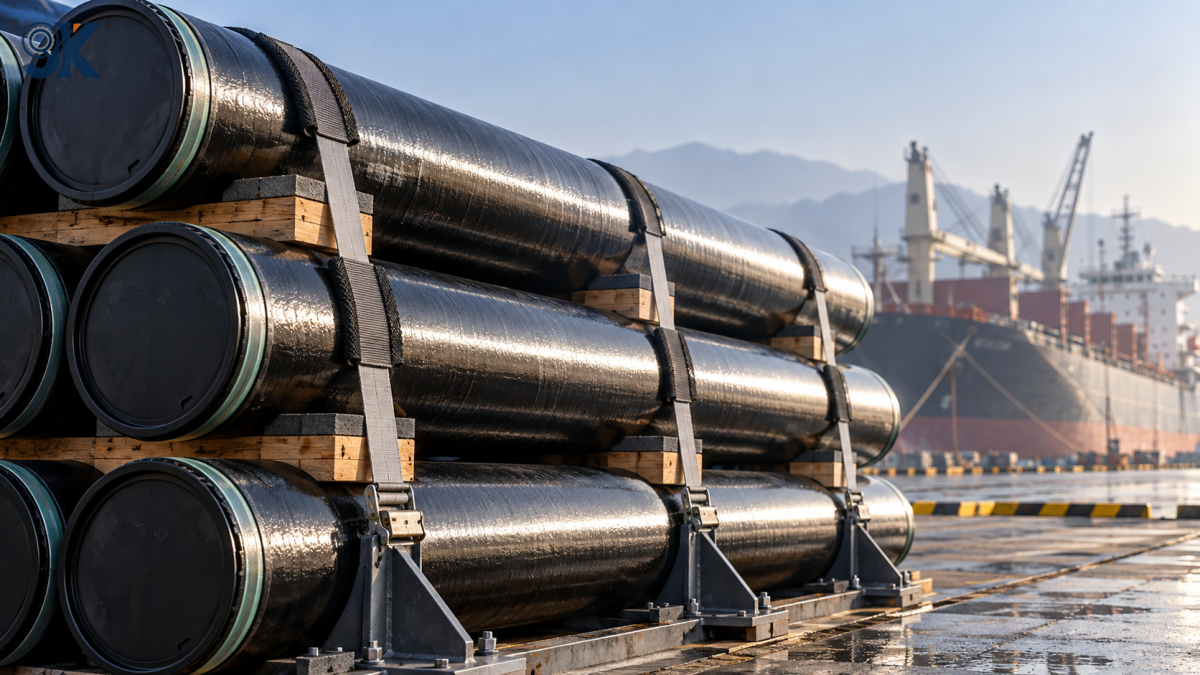
For stacked pipes, keep support positions aligned vertically so that upper loads transfer through the intended bearing points. Use properly secured chocks or cradles to prevent rolling. Place separators so neighboring pipes cannot rub against each other as the vessel moves. Avoid relying on loose wedges that can work free during handling.
Protect pipe ends separately. End caps and bevel protectors help limit contamination and impact damage, but they are not load-bearing supports. Make sure they remain secure without trapping water or damaging an internal lining. Any exposed coating cutbacks or bare end areas need the temporary protection specified for the order and subsequent fabrication process.
Restrain the cargo without crushing the coating
Cargo restraint has to prevent movement while keeping pressure within acceptable limits. Tightening a strap until the pipe “feels secure” can leave a deep indentation, particularly where the coating is warm or the force acts over a narrow area.
Use a securing arrangement designed for the cargo mass, transport mode, support geometry, and available securing points. Blocking and bracing should resist rolling and displacement; lashings should work with that arrangement. Bundle bands alone do not secure the shipment to a vehicle, container, or vessel.
At each lashing contact point, provide suitable load spreading and abrasion protection. Keep buckles, tensioners, and other hard fittings away from coated surfaces. Protective sleeves must remain positioned where movement could occur, rather than merely covering the easiest section to reach.
Check the arrangement after the cargo has settled and before access is lost. Compressed padding, shifted dunnage, or a changed bundle shape can reduce restraint effectiveness. If the planned arrangement cannot secure the pipes without excessive coating pressure, revise the support or restraint design instead of adding tension.
Match the packing plan to the sea transport route
Full-container, shared-container, and breakbulk shipments expose pipes to different handling and moisture conditions. Choose packaging around the actual transfer points and stowage conditions, including any outdoor storage before vessel loading.
For shared consignments containing other metal products, such as 6003 Aluminium Bar, give each product its own supported and restrained position. Loose bars, sharp bundle corners, and protruding packing components can damage adjacent coated pipes even when both products are individually wrapped.
Port selection also affects the handling plan. For shipments arranged through Tianjin, Qingdao, or Rizhao, identify who controls each transfer between the warehouse, truck, terminal, and vessel. An integrated service provider such as Shandong Jiukai Metal Materials Co., Ltd., whose scope includes production, warehousing, logistics, and export clearance, can carry the same packing and handling instructions through those stages. The instructions still need to be specific enough for each operator to apply.
Control moisture without trapping it against the pipe
Salt contamination and persistent moisture can turn a small coating defect into a corrosion site. However, wrapping everything tightly in plastic does not necessarily keep a shipment dry. Water already present on the pipe, inside packaging, or in damp dunnage can remain trapped. Temperature changes during the voyage can also cause condensation inside a container.
Pack clean, dry pipes using dry packaging materials. Inspect containers for water entry, floor condition, and contamination before loading. Weather protection should shed external water while avoiding pockets where it can collect against the pipe.
A sealed moisture-barrier system needs a deliberate design: suitable barrier material, sealed joints, protection against punctures, and moisture-control capacity matched to the enclosed space and expected exposure. Desiccants placed in an otherwise open package cannot reliably control the surrounding marine atmosphere.
Ventilated protection serves a different purpose and may suit some temporary storage conditions, but it does not exclude humid or salt-laden air. Choose the approach according to the coating, exposed steel areas, route, and storage period. Avoid absorbent wraps that can stay wet against the surface unless they form part of an approved protective system.
Use inspection points that can reveal hidden damage
A final photograph of a closed container proves little about the coating beneath a support or band. Inspect when vulnerable areas are accessible, and record the condition before the next operation conceals them.
- Before packing: record pipe identification, coating condition, accepted repairs, and completion of specified coating tests.
- During packing and loading: check contact surfaces, separators, end protection, sling placement, and any marks created by handling.
- Before dispatch or closure: document the support and restraint arrangement, packaging condition, cargo identification, and visible dryness.
- At receipt: inspect accessible surfaces before unloading, then examine previously hidden contact areas as supports and bands are removed safely.
Take both overall photographs and close views tied to pipe or bundle identification. Include areas beneath accessible sling positions, around supports, and near pipe ends. Record unusual handling events, shifted packaging, or visible water entry while the evidence is still available.
Where holiday testing is specified, use the method and settings appropriate to the coating system and thickness. It does not replace visual inspection: a dent, disbonded area, or pressure mark may require assessment even if the test does not identify a discontinuity.
Stop loading when damage changes the acceptance decision
Exposed steel, coating separation, deep cuts, crushed areas, or impact damage should trigger segregation and assessment before the affected pipe becomes inaccessible. Mark and record the location, establish the extent of damage, and use the agreed repair procedure. Painting over a defect without suitable preparation can conceal contamination or loose coating.
After repair, allow the required curing or cooling period and complete the specified inspection before handling resumes. Also correct the cause: replace contaminated sling protection, remove the sharp edge, reposition the support, or revise the restraint arrangement. Otherwise, the repaired pipe may be damaged again during the next transfer.
Before releasing the shipment, resolve three practical questions: what will touch the coating, what will prevent the pipes from moving, and what evidence will show their condition at handover? Those answers should be visible in the loading arrangement and inspection record, giving the receiving team a clear basis for acceptance.
Latest News
- How do iron ore prices affect steel pipe price trends?
- How do tariffs affect square tube export markets?
- How steel pipe price trends affect inventory valuation
- Steel pipe price forecast for 2026 amid changing raw material costs
- Square Tube Export News: What Buyers Should Watch in Freight and Supply
- What new trade investigations mean for steel pipe exports
Send Us A Message

