
News center
How warehouse location affects steel pipe delivery costs
A warehouse close to a port does not automatically produce the lowest delivered cost for steel pipe. The saving on the final inland journey can be offset by an earlier transfer from the mill, extra handling, longer storage, or an ocean route that does not suit the destination. The better choice is the location that keeps the cost of the entire movement under control while meeting the required delivery date.
For a purchase approval, Steel Pipe Warehousing and Logistics should therefore be assessed alongside the pipe price and ocean freight, not as a separate administrative detail. A comparison between warehouses serving Qingdao, Tianjin, or Rizhao is useful only when the quotes cover the same pipe, quantities, delivery point, schedule, and allocation of responsibilities.
Start with the complete route, not the distance to port
Steel pipe may move from a mill or processing facility to a warehouse, then to a port or consolidation point, and finally to the destination. Each transfer can create transport, loading, unloading, and waiting costs. A warehouse that looks convenient on a map may add an extra leg if production or cutting takes place elsewhere.
A mill-side warehouse can be practical when pipe is produced or processed inland and dispatched in larger, planned batches. It may reduce the need to move stock before an export booking is ready. Its disadvantage is that every shipment still needs inland transport to the chosen port, and limited trucking availability can affect the dispatch schedule.
A port-area warehouse may be useful when several inland suppliers contribute to one shipment, when export lots need to be consolidated, or when dispatch timing depends on vessel availability. However, the inland journey has not disappeared; it has merely happened earlier. Storage and handling at the port-area facility also need to justify their cost.
Neither model should be approved solely on a per-tonne trucking rate. Ask for the route from the point where the pipe becomes available, including any intermediate warehouse, processing facility, consolidation depot, and port. Then identify who pays for each movement and operation.
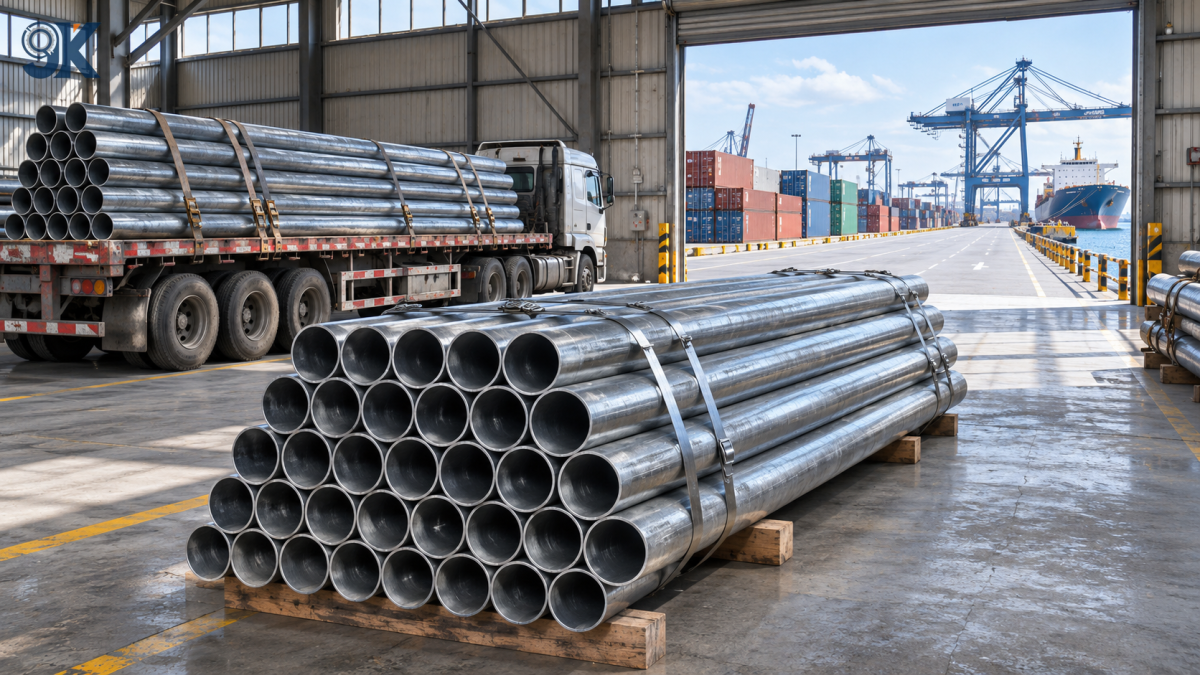
Where location changes the transport bill
The road distance between a warehouse and port matters, but it is only one part of the inland freight calculation. Pipe dimensions, shipment weight, vehicle availability, loading arrangements, and delivery appointments can all change the rate. Long pipe may require a vehicle or handling arrangement that differs from one used for shorter, bundled material.
Weight and usable space do not always work together. A shipment of relatively small-diameter pipe may reach a vehicle’s weight limit before its available space is filled. Large-diameter or long pipe can constrain loading by space, length, or load configuration instead. A lower rate per vehicle is not necessarily a lower rate per tonne if the vehicle cannot be loaded efficiently.
Order frequency matters as well. A warehouse close to a port may be attractive for repeated small dispatches if it allows several orders to be combined before export. For one large order that can move directly from the mill to port, an intermediate warehouse may add unloading and reloading without providing a corresponding benefit.
Ask suppliers whether the proposed inland rate is based on a full vehicle, shipment weight, or another charging basis. For partial loads, establish whether the rate assumes consolidation with other cargo and what happens if suitable cargo is unavailable by the planned dispatch date.
Handling costs can outweigh a shorter journey
Pipe is often bundled, lifted, staged, and secured more than once before it leaves the origin country. Each operation can generate a charge and create an opportunity for damage, particularly where pipe ends, coatings, threads, or finished surfaces need protection.
Compare the actual sequence of operations, not just a single line labelled “warehouse handling.” A quote may include unloading into storage but charge separately for sorting by size, retrieving specific bundles, repacking, or loading for dispatch. If pipe is cut or otherwise processed after arrival, there may also be movement between storage and the processing area.
Extra handling is not always wasteful. Sorting and consolidation may be necessary to assemble a mixed order correctly, and inspection before dispatch can help prevent costly shortages or specification errors. The financial question is whether the operation is required for the order and whether its cost is included in the price being approved.
For coated or finished pipe, discuss protection at lifting points, stacking arrangements, and the condition in which bundles will be released. Damage can lead to inspection, rework, replacement, or disruption at the receiving plant. Those consequences may not appear in the freight quotation, but they belong in a comparison of logistics risk.
Compare ports by the complete shipment, not by name
Qingdao, Tianjin, and Rizhao can each be relevant to a steel pipe export route, but a port’s suitability depends on where the material is stored, the destination, the shipment format, and available sailings. A lower inland charge to one port may be outweighed by a higher ocean freight quotation, an unsuitable schedule, or additional local charges.
Compare each option using the same delivery date and final destination. Include the cost of getting pipe to the port, origin handling, freight, and the destination charges assigned to the buyer. Also consider whether the proposed transit plan has enough time for cargo readiness, export documentation, and loading. A nominally cheaper route may become expensive if a missed booking leads to storage or rescheduling charges.
A port farther from the warehouse may still be competitive when the ocean service better fits the destination or shipment. Conversely, a nearby port can be preferable when the full route is cost-effective and its schedule supports the buyer’s receiving plan. The comparison should be made for the particular order rather than carried over from a previous shipment.
FCL, LCL, and bulk shipping change the warehouse decision
For a full container load, or FCL, a warehouse with suitable loading arrangements can help assemble and secure the order before the container moves to port. The calculation should include container positioning, loading, inland movement, and any waiting charges. Pipe length and loading configuration affect whether a proposed container solution is practical and how much material can be carried.
Less than container load, or LCL, can suit a smaller trial order that does not justify a full container. Its financial appeal depends on the total charges, not only the ocean freight rate. Consolidation, handling, documentation, and destination fees may make a small shipment more expensive per tonne than a larger one. Dimensions also matter: an LCL operator’s ability to accept long or heavy pipe bundles affects which route is workable.
Bulk shipping may be considered for larger volumes where the cargo and sailing arrangements suit it. A lower quoted freight rate should be evaluated alongside transport to the loading point, cargo handling, scheduling, and discharge arrangements. The right comparison is not “container versus bulk” in isolation; it is the delivered cost and timing of each feasible route.
Storage is a cost decision as well as a scheduling decision
Keeping pipe in a warehouse can bridge the gap between production, vessel departure, and the buyer’s required delivery date. It can also allow several production batches to be combined. But stock held longer than planned ties up working capital and may incur storage, insurance, and additional handling costs.
The warehouse location affects how much inventory needs to be moved and when. Stock held close to production may be easier to allocate across future orders, while stock staged closer to port may be better positioned for a booked shipment. The latter approach can be less attractive if bookings change frequently or the buyer has not finalized quantities.
Before approving a storage arrangement, establish when charges begin, how they are calculated, what free time is included, and who pays if dispatch is delayed. Clarify ownership, insurance responsibilities, and the evidence used to record the quantity and condition of stock. These terms matter especially when material will remain in storage after production is complete.
Storage conditions should match the product and its intended use. Pipe with coatings, machined ends, or surface requirements may need different protection from material intended for less demanding applications. An inexpensive storage rate is poor value if the arrangement increases the likelihood of damage or rework.
Build a like-for-like approval comparison
A useful comparison separates committed charges from items that depend on time, volume, or events. Ask each supplier to quote against the same specification, quantity, packing, origin readiness date, destination, and requested delivery schedule. Include the chosen Incoterms rule and named place so that each party’s transport responsibilities are clear.
A landed-cost estimate should avoid counting a charge twice when it is already included in a quoted price. It should also expose exclusions: “freight included” does not necessarily mean every origin and destination charge is covered. Separate the quoted total from an allowance for identifiable variable costs, such as storage beyond the included period or a change in dispatch date.
For a meaningful sensitivity check, change one assumption at a time. For example, compare the expected cost if dispatch occurs as planned with the cost if the pipe remains in storage longer. Then test a smaller shipment quantity or a different port. This shows which warehouse option remains acceptable when the order does not follow the original schedule.
What to request before signing off
Ask the supplier for a written route and cost breakdown, including the warehouse location, planned port, shipment method, estimated dispatch window, and the charges included at each stage. Confirm whether the quoted warehouse actually holds the specified pipe or whether material will be transferred there after production. That distinction can change both lead time and inland cost.
For a mixed order, request a packing and loading proposal that accounts for pipe lengths, diameters, bundle weights, and any protection requirements. For recurring orders, ask how inventory will be identified and released, and whether charges change with shipment size or storage duration. The approval can then reflect the operating arrangement, not just an attractive initial rate.
Shandong Jiukai Metal Materials Co., Ltd. offers pipe production, processing, warehousing, and export logistics services, with shipping options through ports including Qingdao, Tianjin, and Rizhao. For an order being evaluated with the company, those services can be discussed as a single route or as part of a wider comparison. The decision should still rest on the itemized delivered cost, the suitability of the handling plan, and the schedule for the specific shipment.
Latest News
- How do iron ore prices affect steel pipe price trends?
- How do tariffs affect square tube export markets?
- How steel pipe price trends affect inventory valuation
- Steel pipe price forecast for 2026 amid changing raw material costs
- Square Tube Export News: What Buyers Should Watch in Freight and Supply
- What new trade investigations mean for steel pipe exports
Send Us A Message

