
News center
How should steel pipes be secured for road transport?
Steel pipes should be transported on a suitable vehicle with firm support beneath the load, effective restraint against rolling, and enough rated tie-down capacity to control movement in every direction. The exact arrangement depends on the pipe diameter, length, weight, bundle condition, vehicle and route. A strap pulled tightly over the top is only one part of the solution.
For practical Steel Pipe Logistics, start by identifying how the pipes could move during braking, acceleration and cornering. Then select the supports, chocks and restraints as a coordinated system. The load must remain stable even if the road is uneven or the vehicle makes an unexpected maneuver.
Assess the load before choosing restraints
Confirm the total load weight, the weight of individual bundles or pipes, their lengths and outside diameters, and whether they are bare, coated, threaded or fitted with end protectors. These details affect the equipment needed for loading, the position of supports and the way tie-downs contact the pipes.
A bundle can be easier to handle than loose pipe, but its packaging bands are not automatically road-transport restraints. Bands may hold pipes together during handling without being designed to resist vehicle braking or cornering forces. Check the bundle’s condition and use a transport restraint system suited to the load.
Also look for differences within the load. Mixed diameters can leave gaps that allow smaller pipes to move, while unequal lengths can change the position of the center of gravity. Loose fittings, end caps and paperwork containers need their own secure storage.
Before loading, establish who is responsible for the loading plan and final checks. The loader and driver both need to understand where the restraints attach and how the load will be unloaded. Applicable road rules, vehicle limits and the carrier’s procedures determine the required restraint capacity and any specific arrangements.
Build a stable base on the vehicle
Use a vehicle and deck suitable for the load’s weight and dimensions. Position the pipes so that axle loads and overall vehicle limits are respected. A load that fits on the deck can still be unsafe if too much weight is concentrated at one end or on one axle.
Place sound dunnage beneath the pipes to support them and provide clearance for handling equipment. Dunnage should sit on firm parts of the deck, be arranged to prevent excessive sagging, and stay in position under the load. Its spacing depends on the pipe dimensions, bundle weight and loading method; long or thin-walled pipes may need closer attention to support and bending.
Keep the deck and contact surfaces clear of loose debris, ice, oil and other material that could reduce friction or make the dunnage unstable. Friction can contribute to restraint, but its effect changes with surface condition and should not be assumed to hold a heavy pipe load by itself.
For round pipe, use properly positioned chocks, cradles or other purpose-designed devices to prevent rolling. The outer pipes in a layer need effective lateral support, and the chocks themselves must be secured or otherwise held in place by a suitable arrangement. A loose wedge placed beside a pipe can be pushed away as the load shifts.
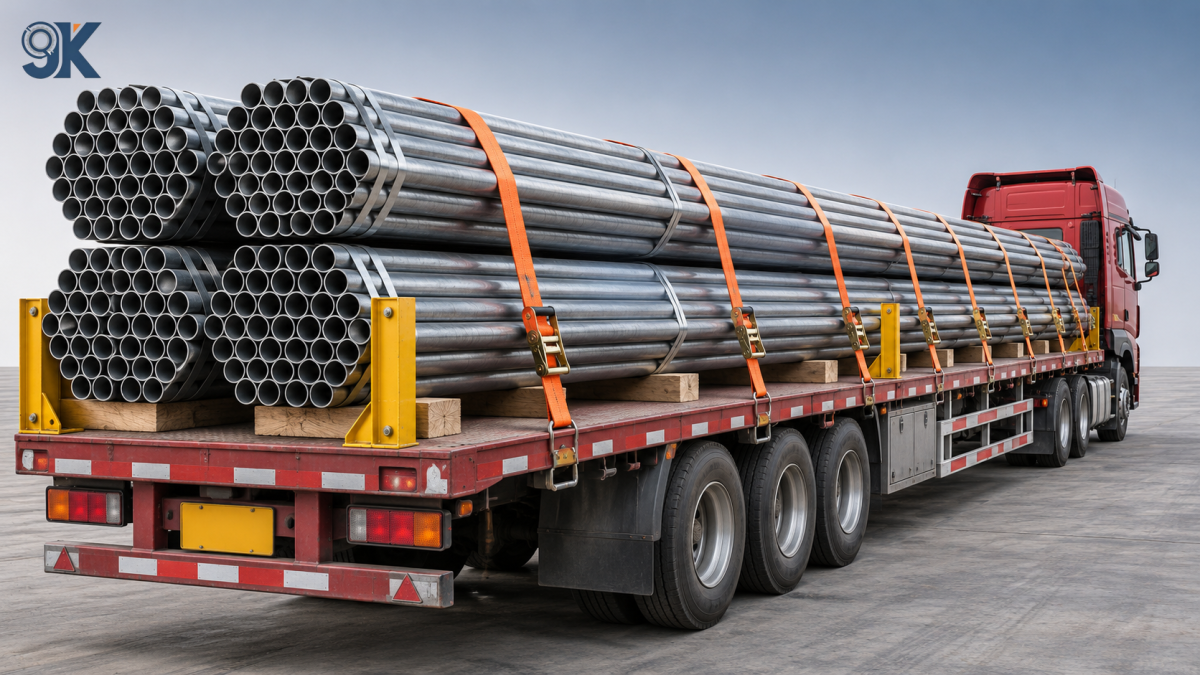
When loading multiple layers, place suitable separators between layers where the loading plan calls for them. Align supports so that weight is transferred through the stack to the vehicle rather than leaving individual pipes suspended or unevenly loaded. Do not build a stack higher than the vehicle, restraint system or loading arrangement can safely control.
Stop rolling before relying on tie-down tension
Round pipes create a particular challenge: a pipe can rotate, and a small amount of movement can loosen a restraint or alter the shape of the stack. Chocks or a correctly designed cradle address rolling at the support points. Tie-downs then help hold the load against the supports and provide the required restraint against movement.
Do not assume that the weight of the upper pipes will keep the lower layer in place. Under cornering or on an uneven road, forces can act sideways while vibration changes how the pipes bear against one another. Each layer and the overall stack need to be considered in the restraint plan.
A single large pipe may require a different arrangement from a bundle of small pipes. With a large pipe, the contact points, restraint angles and rolling tendency deserve particular attention. With small pipes, the concern may be whether individual pieces can escape from a bundle or move beneath a tie-down. If the bundle is damaged or uneven, repair or reconfigure it before treating it as one stable unit.
Choose and position the tie-downs
Use chains, webbing straps or another approved restraint method appropriate to the load and the carrier’s requirements. The choice depends on the required restraint capacity, the vehicle’s anchor points, the shape of the load and the risk of damage to the pipe surface.
Chains can be useful for heavy loads when their capacity and attachment arrangement are suitable. Webbing straps may be preferable where surface protection is important, provided they have sufficient rated capacity and are protected from edges and abrasion. Neither option is effective if the anchor points, tensioning devices or the vehicle structure cannot carry the forces involved.
Check the markings and condition of every component, including hooks, tensioners and anchor points. A restraint assembly is limited by its weakest component. Remove damaged, cut, distorted or otherwise unserviceable equipment from use, and do not improvise repairs to make it fit the job.
Arrange tie-downs so they contact the load securely and cannot slide off the ends or settle into a position where they lose tension. Restraint angles matter: the same tension can have a different effect when the angle changes. Follow the applicable load-securing method when calculating capacity and choosing the number and placement of restraints; tightness alone is not a capacity calculation.
Consider forward movement separately. Heavy pipes can exert substantial force during braking, so the plan may require suitable direct restraints, blocking or a combination of methods. A front bulkhead or headboard should only be counted on to restrain the load when it is designed and rated for that purpose and the load is positioned appropriately against it.
For coated, painted or finished pipe, use suitable edge protection and contact materials wherever restraints could cut, crush or abrade the surface. Protection must remain in place and must not prevent the tie-down from gripping or bearing on the load as intended.
Deal with mixed loads and overhanging pipe carefully
Mixed loads need a loading plan, not just a convenient place for each item. Different shapes can create unstable contact points, and one item may prevent a tie-down from bearing properly on another. Separate incompatible items where necessary and assess how each part of the load is restrained.
For example, a shipment may include round pipes alongside Carbon Steel Square Bar. The square bar has flat faces, but that does not make a mixed stack automatically stable. Support and restrain the two shapes according to their weight, contact surfaces and likely movement; do not assume a strap over the highest item is also holding the lower items effectively.
Pipe extending beyond the vehicle needs particular attention to support, clearance, visibility and the applicable route requirements. Excessive overhang can increase bending and make the load harder to control. Plan the vehicle and route around the pipe length, including turns, overhead restrictions and access at the delivery point.
Where loads are split between destinations, plan the unloading sequence before departure. Removing one bundle must not leave the remaining pipes without their chocks, supports or required tie-down capacity. The driver and unloading crew should be able to restore the restraint system before the vehicle moves again.
Inspect the secured load before departure
Walk around the vehicle after tensioning the restraints. Look at the load from both sides and, where it is safe to do so, check the front and rear. The purpose is to find movement paths that may be less obvious from the side where the straps were tightened.
- Check that pipes and bundles are seated on their supports and that dunnage is not split, displaced or carrying the load unevenly.
- Inspect chocks and cradles for firm contact and secure placement, especially at the outside edges of round-pipe layers.
- Confirm that tie-downs are correctly routed, tensioned and attached to suitable anchor points, with hooks and tensioners properly seated.
- Look for loose pipes, damaged bundle bands, unprotected contact points and gaps that could let items settle or escape.
- Confirm that restraints and loose equipment do not interfere with lights, wheels, brakes or other vehicle components.
Stay clear of suspended loads during loading and never put hands or feet between pipes to adjust their position. If a pipe or bundle is unstable, stop the operation and have it repositioned with suitable equipment. Attempting to correct a shifting load by hand can expose the crew to a crushing hazard.
Recheck the load during the journey
Pipe stacks can settle after departure, particularly when dunnage compresses, a bundle changes shape or restraints bed into their contact points. Inspect the load at a safe stopping place after the initial part of the journey and again as required by the route, conditions and operating procedures. Check more often if there are signs of movement or if the load configuration makes settling likely.
Look for slack restraints, shifted chocks, damaged edge protection and pipes that no longer line up as loaded. Retensioning may correct normal settling, but it does not fix a failed support or an unstable stack. If a pipe has rolled, a chock has moved or a restraint has been damaged, stop in a safe location and arrange for the load to be properly stabilized before continuing.
At the destination, assess the load before releasing any restraint. Pipes may have shifted against a tie-down or chock during transit. Unloading equipment and personnel should be ready to control the load as restraints are removed, and the crew should release them in a sequence that does not allow pipes to roll or fall.
When arranging transport with a supplier or carrier, provide the pipe dimensions, total weight, bundle details, surface finish and delivery constraints early. Shandong Jiukai Metal Materials Co., Ltd. provides steel pipe processing, warehousing and logistics services, so these details can be included in transport planning alongside the selected shipping arrangement.
Latest News
- How do iron ore prices affect steel pipe price trends?
- How do tariffs affect square tube export markets?
- How steel pipe price trends affect inventory valuation
- Steel pipe price forecast for 2026 amid changing raw material costs
- Square Tube Export News: What Buyers Should Watch in Freight and Supply
- What new trade investigations mean for steel pipe exports
Send Us A Message

