
News center
How incorrect HS codes can delay steel export clearance
An incorrect HS code can interrupt a steel shipment before it leaves the exporting country or when it reaches the destination. The immediate problem may be a customs query, but the commercial consequences can extend to revised declarations, storage charges, missed delivery dates and a different landed cost from the one originally budgeted.
For export customs clearance, the most useful early check is whether the declared code is supported by the steel product’s actual specifications and condition at shipment. A familiar product name or a code used on a previous order is not enough. Material composition, manufacturing method, dimensions and processing can all affect classification, while the importing country may require a different national code beyond the shared international HS structure.
How a classification error becomes a shipment delay
Customs declarations describe what is being shipped and assign it a tariff classification. If the code does not fit the description, supporting documents or physical goods, customs may request an explanation, additional records or an inspection. The shipment can be held while the discrepancy is resolved.
Consider a steel pipe order described on the invoice simply as “seamless pipe,” while the mill documents identify welded pipe. Even if the dimensions and quantity are correct, the conflicting manufacturing descriptions give the broker and customs a reason to stop and clarify the entry. Correcting the description may also require a review of the declared code and associated documentation.
A delay is not limited to the customs office. A declaration amendment can affect the shipping schedule, and a missed vessel connection may create additional handling or storage costs. At the destination, a separate classification review can delay release even when the export declaration was accepted without difficulty. Export acceptance does not automatically establish that the importing country’s classification is correct.
The financial impact may also continue after release. An incorrect import classification can lead to a duty reassessment, additional taxes or other consequences under the destination country’s rules. In some situations, classification is also relevant to trade remedies, licensing or other controls; those measures may depend on details beyond the HS code, including origin and product specifications.
Why steel products are easy to misclassify
Steel descriptions often contain several technically meaningful terms, but commercial documents may reduce them to a short sales name. “Steel tube,” “alloy pipe” or “machinery component” can be useful in conversation without providing enough detail for a defensible customs classification.
The factors below are particularly important when reviewing pipes and other steel profiles. Their relevance depends on the product and the applicable tariff headings; no single characteristic should be used as an automatic shortcut.
- Material and composition: Stainless, alloy and other steel products may fall into different categories. A grade name helps identify the product, but the underlying chemical composition and applicable classification definitions matter.
- Manufacturing method: Seamless and welded tubes are not interchangeable descriptions. For welded products, the type of weld or manufacturing process may also be relevant.
- Shape and dimensions: Circular and non-circular hollow sections can be treated differently. Outside diameter, wall thickness and cross-sectional shape may affect the applicable subdivision.
- Product form and processing: A length of pipe, a pipe fitting and a fabricated article may require different analysis. Cutting to length, machining, bending or adding features should be described accurately, but processing alone does not automatically determine classification.
- Product condition and intended use: Intended use can be relevant in some classifications, but calling an item a “machinery part” does not by itself make it one for customs purposes. The product’s objective characteristics and the applicable tariff rules must be considered.
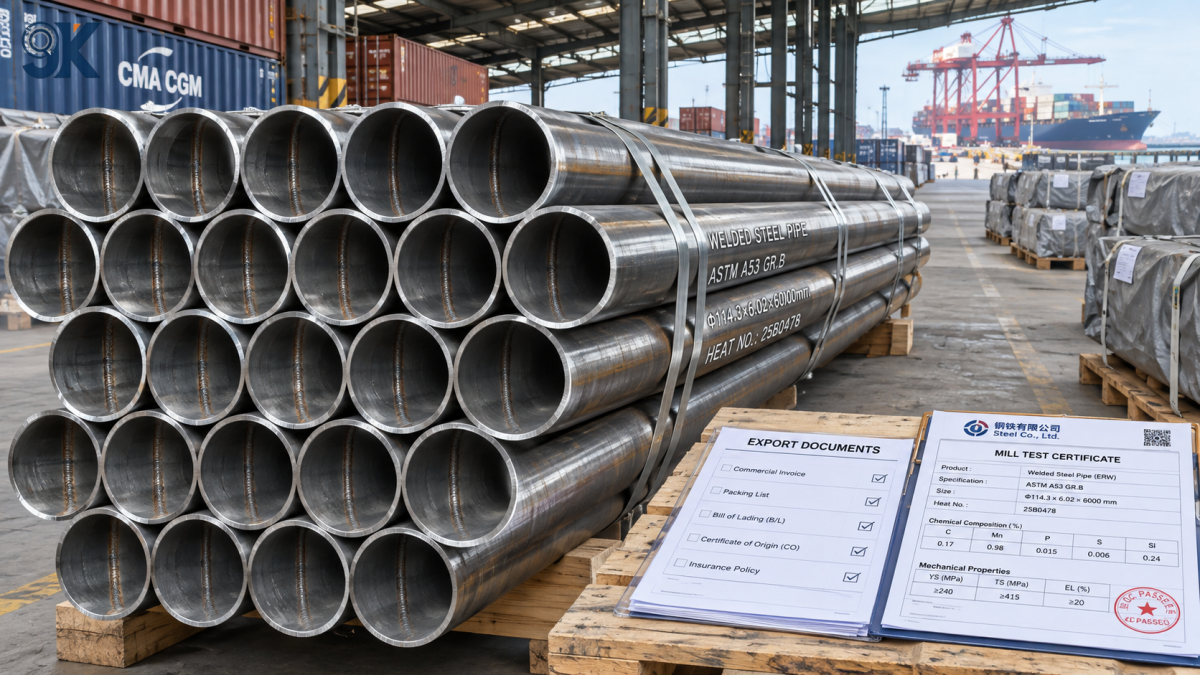
A mill test certificate can support the material and manufacturing description, but it may not show every feature of the finished shipment. A drawing, processing record or photograph may be needed when the goods have been machined or fabricated after the pipe was produced. Conversely, a drawing alone may not establish chemical composition.
Export and import codes: related, but not always identical
The Harmonized System provides a common international framework at the six-digit level. Countries then use their own tariff schedules and national subdivisions for declaration purposes. A code used on a Chinese export declaration should therefore not be copied automatically into the destination import entry as a complete national code.
The buyer and supplier should compare the product description and the relevant shared HS classification, then have the export and import declarations prepared under their respective national schedules. Differences in the additional digits can be legitimate. A disagreement at the shared level, however, deserves investigation before the goods are dispatched.
This distinction also affects cost comparisons. An export-side code is not a reliable substitute for an import-side duty calculation. To estimate landed cost, the importer or its customs broker needs the destination classification along with the relevant origin, customs value and other facts used in that country.
Check the evidence before the booking is fixed
The most efficient time to address classification is after the product specification is sufficiently defined but before the final documents and shipping arrangements are locked in. For a standard repeat order, that may mean confirming that nothing relevant has changed. For a new grade, custom-processed item or new destination, allow more time for review.
- Describe the goods as shipped. Record the material grade, available composition, product form, manufacturing method, dimensions, surface condition and any machining or fabrication. Include drawings where the finished item is difficult to describe in words.
- Collect matching evidence. Compare the purchase order and technical specification with mill certificates, processing records and the proposed invoice description. Resolve conflicting terms before they appear in a declaration.
- Ask for both sides of the classification. Obtain the proposed export code from the exporter and the proposed import code from the importer or its broker. Compare the six-digit basis and document the reasons for any difference.
- Review the commercial effect. Have the import-side team assess the duties and any measures relevant to the goods and origin. Include the resulting assumptions in the landed-cost comparison, rather than relying on the quoted steel price alone.
- Keep the documentation aligned. Ensure the commercial invoice, packing list, customs declaration and supporting records describe the same goods. Each document serves a different purpose, so wording need not be identical, but the facts should not conflict.
For repeat purchases, maintain a classification record that links the code to the specification, supporting documents and destination. Revisit it when the material, manufacturing method, dimensions, processing or destination changes. A previous shipment can be a useful starting point; it is not proof that a modified product belongs under the same code.
When the description is the real problem
Sometimes the proposed code is not obviously wrong, but the paperwork gives the broker too little information to support it. An invoice line such as “steel products” may match the purchase in a commercial sense while failing to distinguish pipe from a profile, welded tube from seamless tube, or raw stock from a fabricated item.
A more useful description identifies the product in ordinary trade language and includes the characteristics needed for classification. For example, a line describing circular welded steel tube, its grade, outside diameter, wall thickness and relevant processing gives the reviewer a clearer basis than “metal parts.” The description should reflect what is actually packed, not merely what the buyer plans to make from it.
At the other extreme, adding technical details that do not apply can create a different problem. Copying a description from an earlier order may introduce the wrong manufacturing method or grade. It is better to use a concise, accurate description supported by the records than an impressive-looking one assembled from unrelated specifications.
What to do if customs questions the code
Start by identifying the precise issue: the code itself, the product description, a document inconsistency or a physical feature of the goods. Ask the declaring party or broker what evidence customs has requested and whether the shipment is being reviewed on export, import or both. The answer determines which documents and parties are involved.
Gather the relevant specification, certificate, drawing, invoice and packing information. If the goods have been processed since the mill certificate was issued, include records that connect the finished items to the original material. Where samples, photographs or inspection are requested, coordinate their provision through the responsible broker or customs representative.
If a correction is needed, the party responsible for the declaration should arrange it through the applicable customs process. The buyer should also review the revised duty estimate and delivery schedule. Changing only the invoice while leaving the declaration or other conflicting records unchanged can create another discrepancy.
Commercial responsibility depends on the contract, agreed delivery terms and the circumstances of the error. Before approving extra costs, establish who selected the code, who supplied the product facts and which party was responsible for the affected declaration. Keep the correspondence and supporting records together in case the classification is questioned again.
Use supplier capability as part of the risk assessment
When comparing steel suppliers, ask who will prepare the export documentation, what technical records will accompany the goods and how specification changes are communicated before shipment. A supplier that can provide a clear document trail gives the buyer and broker a better basis for resolving classification questions; it cannot guarantee that customs will accept a declaration or that import clearance will proceed without review.
Shandong Jiukai Metal Materials Co., Ltd. describes its service as covering custom steel pipe production, processing, documentation and export customs clearance. For an order involving machining or other customization, a practical discussion with the supplier is to connect the final drawing and processing requirements to the goods description and the supporting records. The importer should involve its own destination-side broker early enough to assess the corresponding import classification and landed cost.
Before placing a time-sensitive order, make the classification assumptions part of the purchasing review: identify the goods in their finished condition, establish who owns each declaration and agree on the documents needed to support it. That gives all parties a chance to resolve a technical mismatch before it becomes a shipment hold.
Latest News
- How do iron ore prices affect steel pipe price trends?
- How do tariffs affect square tube export markets?
- How steel pipe price trends affect inventory valuation
- Steel pipe price forecast for 2026 amid changing raw material costs
- Square Tube Export News: What Buyers Should Watch in Freight and Supply
- What new trade investigations mean for steel pipe exports
Send Us A Message

