News center
How high can steel pipes be stacked safely in a warehouse?
There is no universal safe stacking height for steel pipes in a warehouse. The permitted height is the lowest limit established by the storage system’s rated capacity, the supporting floor, pipe and bundle stability, handling equipment, and applicable legal and fire-safety requirements. Where any of those limits is unknown, do not add another tier until the arrangement has been assessed.
A stack that looks orderly from the aisle can still be unsafe: an outer pipe may be free to roll, a lower bundle may be deforming, or a forklift may have to lift beyond its rated capacity to reach the top. In Steel Pipe Warehousing, the height decision must address both the risk of collapse and the risk of damaging the product during storage and retrieval.
Start with the storage method, not a height rule
Pipe can be held in engineered racks, bundled on supports, or stacked in restrained layers on the floor. Each arrangement transfers loads differently. A height accepted for a rack bay cannot automatically be applied to a floor stack, and a limit established for one pipe size or bundle configuration should not be reused without review.
For an engineered rack, use the manufacturer’s approved configuration and load ratings. Check not only the stated capacity of each arm or level, but also the permitted load per bay, the distribution of that load, anchorage requirements, and any restrictions on pipe overhang. A rack can be overloaded even when the pipes remain below the top arm.
For floor stacking, the assessment is more dependent on the actual arrangement: the strength and placement of supports, the means of preventing rolling, the number of tiers, and the load imposed on the lowest pipes. A bundle’s shipping straps alone should not be assumed to make it suitable for stacking. Their condition, intended purpose, and ability to control individual pipes during storage and handling must be established.
The result should be a documented maximum for a defined configuration—not a general instruction to stack “as high as practical.” Describe the pipe dimensions, bundle arrangement, supports, restraints and handling method to which the limit applies.
Identify the loads before setting the number of tiers
Pipe weight and load concentration
Calculate or obtain the mass of each pipe or bundle from reliable product information, including packaging and supports where relevant. Add the loads imposed at each level and compare them with the applicable capacities of the rack, supports and floor. Check the worst-loaded location, not just the average load over the storage area.
Long pipes may rest on only a few contact points. Those points can create concentrated loads on rack arms, timber supports or the floor. Confirm that the floor’s allowable loading covers the actual contact arrangement; an area-load figure by itself may not establish that a heavily loaded foot or support is acceptable. Changes in rack position, support spacing or bundle weight warrant a fresh check.
Diameter, wall thickness and surface condition
Large-diameter pipe can roll with substantial momentum, while thin-wall pipe may be susceptible to local denting or out-of-roundness under concentrated loads. Smaller pipes may shift within a loose bundle or escape through gaps in supports. Differences in diameter also affect how securely one layer bears on another.
Surface condition matters as well. Coated, oily or wet pipes can be slippery; damaged coatings may also make it difficult to distinguish handling marks from existing defects. Do not rely on friction as the only restraint against rolling. Separate incompatible sizes or use a storage arrangement specifically assessed for the mixed load.
Lowest-layer loading
Each additional tier increases the load carried by the pipes, bundles and supports below it. The limiting condition may be product deformation rather than the overall strength of the rack or floor. Consider the pipe specification, wall thickness, contact geometry, support spacing and any customer limits on surface damage or ovality.
There is no defensible way to derive an acceptable number of tiers from diameter alone. Where the effect of stacking loads on the product is uncertain, obtain the relevant handling limits from the pipe supplier or have the arrangement evaluated before increasing the height.
Control rolling and lateral movement
Round stock requires positive restraint. Depending on the approved storage design, this may involve rack arms with suitable end restraints, engineered cradles, or properly secured chocks and blocking. Restraints must be appropriate for the expected load and positioned so that pipes cannot bypass them or push them out of place.
Place supports on a sound, level surface and align them with the intended load-bearing points. Misaligned supports can cause pipes to sag, twist bundles or apply uneven pressure to lower layers. Wedges or loose pieces of timber should not be treated as a complete control unless their design, placement and resistance to movement have been assessed.
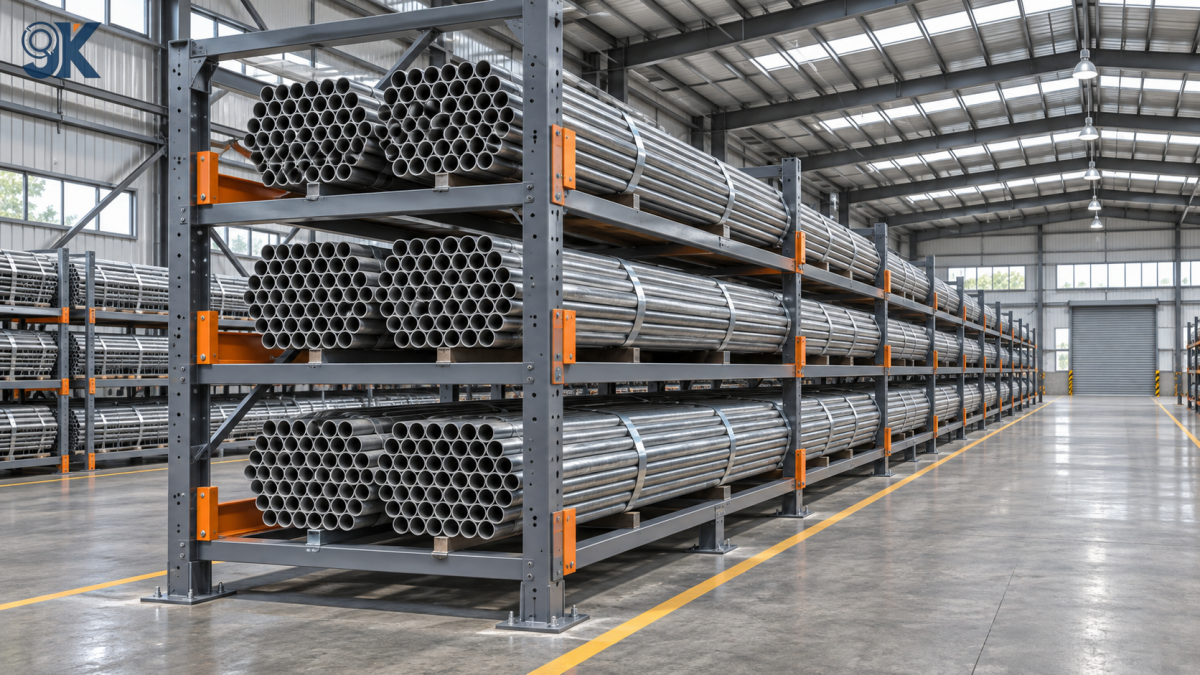
Pay particular attention to the outside edges and ends of a stack. An apparently stable middle section does not prevent an end pipe from moving. Where spacers separate tiers, they should be suitable for the load, placed consistently and protected against displacement during lifting. Do not climb a stack or put hands between pipes to reposition a support under load.
Loose pipe and bundled pipe present different removal hazards. Before a bundle is opened, establish how the remaining pipes will be restrained. Cutting a band while pipes are relying on it for stability can release stored movement; the work method must keep people out of the potential roll path.
Include forklift reach and removal in the height decision
A stack is not safely usable merely because it remains standing when fully loaded. The top bundle must be placed and removed without exceeding the handling equipment’s rated capacity or destabilizing the tier below.
Check the forklift or other lifting equipment’s load rating for the actual load center, lift height and attachment configuration. Long pipe bundles can have a different load center from a compact pallet, and attachments can change capacity. Fork spread and support length must suit the bundle so it does not bend, slide or tip. Operators also need sufficient visibility and space to approach squarely without striking adjacent stock.
Retrieval can create a less stable condition than storage. A forklift may pull against a neighboring bundle, dislodge a spacer or leave a partial tier with no lateral support. Plan the sequence so that stock can be removed without undermining the remaining stack. If that cannot be achieved at the proposed height, reduce the height or change the storage arrangement.
Keep travel aisles and access routes clear of pipe ends and overhanging loads. The chosen height must also leave the clearances required by the applicable fire code, sprinkler design and site rules. Do not infer those clearances from the rack height or roof height; confirm the requirements for the facility and its stored materials.
Turn the assessment into an operating limit
A useful limit tells staff exactly what they may place in a location and under which conditions. Establish it before filling the area, using the following sequence:
- Define the stock. Record pipe diameter, wall thickness, length, material condition, bundle dimensions and maximum bundle mass. Identify whether stock is loose, strapped or otherwise contained.
- Define the layout. Specify rack type or floor supports, support positions, restraints, orientation, permitted overhang and the intended arrangement of each tier.
- Verify capacities. Compare the expected loads with the documented limits for the rack, supports and floor, including concentrated loads and the lowest-layer load on the product.
- Check handling and access. Confirm that the equipment can place and retrieve the heaviest load at the proposed height and that the removal sequence preserves stability.
- Apply site and legal constraints. Check relevant occupational safety rules, fire protection requirements, manufacturer instructions and internal procedures for the location.
- Set and communicate the most restrictive limit. Mark the allowable load and arrangement where appropriate, and ensure the instructions identify when a different pipe or bundle requires reassessment.
Keep the supporting information with the storage procedure: equipment ratings, layout details, assumptions about bundle mass, and the basis for the floor and product-loading checks. This makes it possible to review the limit after a change rather than relying on an inherited practice whose conditions are unknown.
Signs that the current stack needs intervention
Inspect storage areas at a frequency suited to their activity and risk, and after an impact, layout change or other event that could affect stability. Look at the structure and the product together. Relevant warning signs include leaning tiers, displaced chocks or spacers, broken bundle bands, visible pipe movement, bent rack arms, damaged anchors, crushed supports, dents and pipe ends protruding into an aisle.
A warning sign does not establish how much reserve capacity remains. Restrict access to the affected area, stop loading and retrieval where they could disturb the stack, and follow the site’s procedure for making it safe. A damaged or shifted load may need a controlled unloading plan using suitable equipment; pulling out the apparently loose pipe can make the remaining material move.
After corrective work, determine whether the stated limit is still valid. A substitution from thick-wall to thin-wall pipe, longer lengths, heavier bundles, a different forklift attachment or a relocated rack can change the controlling limit even when the visible stacking height stays the same. Where rack capacity, floor loading or restraint design cannot be verified, keep the affected configuration out of service until the necessary assessment is completed.
Latest News
- How do iron ore prices affect steel pipe price trends?
- How do tariffs affect square tube export markets?
- How steel pipe price trends affect inventory valuation
- Steel pipe price forecast for 2026 amid changing raw material costs
- Square Tube Export News: What Buyers Should Watch in Freight and Supply
- What new trade investigations mean for steel pipe exports
Send Us A Message

