
Export Customs Clearance for Steel Pipes: Documents to Verify Before Filing
A steel pipe shipment is ready for export customs clearance when its commercial documents, physical cargo, and proposed declaration tell the same story. Before filing, verify the exporter and buyer details, product descriptions, quantities, weights, values, classification, and any shipment-specific document requirements. A complete folder can still contain a serious mismatch: the invoice may describe seamless pipe while the packing list or manufacturing records identify welded pipe.
For procurement and commercial evaluation teams buying from China, the practical question is whether the exporter can support every material declaration field with reliable records. Resolve differences that could change product identity, customs treatment, or shipment value before submission. Minor formatting differences deserve less attention than an unexplained grade substitution, an unsupported HS code, or a packing list prepared before the final bundles were weighed.
Build the filing around a controlled set of shipment records
Start by separating the records that support the export declaration from documents needed for transport, payment, or destination clearance. These purposes overlap, but their deadlines differ. A final on-board bill of lading, for example, may become available only after loading; its absence from an earlier filing review does not automatically indicate a problem. The underlying booking and shipping instructions should still be checked against the intended shipment.
For a China-origin steel pipe order, the pre-filing review should cover the following records, with additional documents determined by the goods, trade arrangement, and applicable requirements.
- Commercial invoice: Check the seller, buyer, invoice reference, currency, goods description, quantities, unit prices, total amount, and agreed delivery terms.
- Final packing list: Check the actual packages, bundle marks, piece counts, lengths, net weight, gross weight, and allocation of different specifications.
- Sales contract or purchase order: Use the agreed specifications and commercial terms to identify unauthorized changes or unexplained differences.
- Draft declaration data: Review the proposed product descriptions, classification, quantities and units, values, destination, and relevant transaction details.
- Supporting technical records: Use mill certificates, inspection reports, drawings, or production records where needed to establish what the pipes actually are.
- Shipping and representation records: Check booking details, shipping instructions, and the broker authorization or other representation documents applicable to the filing arrangement.
Assign one person to control the final document set. A broker working from an earlier invoice while the warehouse uses a revised packing list can create inconsistencies even when each department has completed its own checks. Record which versions were approved and replace superseded copies wherever they have been distributed.
The exporter’s legal identity also deserves attention. The manufacturer, invoicing seller, exporter named in the declaration, and payment beneficiary may differ under a legitimate trading arrangement. Their roles should be documented and understood. An unexplained company-name difference is a reason to investigate before filing, particularly where the buyer assumed it was purchasing directly from the exporting manufacturer.
Reconcile pipe identity, quantities, and weights before checking presentation
“Steel pipe” is too broad a description to support a dependable review. Classification and documentary requirements can depend on characteristics such as material, production method, cross-section, dimensions, and processing. The review should establish whether the shipment contains carbon, alloy, or stainless steel products; seamless or welded construction; and circular or other hollow sections. Capture further characteristics wherever they affect the applicable classification or declaration requirements.
Commercial descriptions do not have to repeat every technical detail in every document. They do need to remain compatible. A short invoice description can be supported by a specification schedule, provided the relationship between the documents and the physical goods is clear. A buyer’s internal stock code alone gives the broker little basis for checking the declaration.
Cross-check the following details at each specification line:
- Grade and standard: Confirm that the contract, technical records, and shipped material refer to the agreed grade and specification. Do not treat grades under different standards as automatically interchangeable.
- Dimensions: Distinguish outside diameter from nominal pipe size, and verify wall thickness, length, and the units used.
- Manufacturing and finishing: Check seamless or welded construction and relevant processing, such as galvanizing, threading, coating, or machining.
- Traceability: Where required by the order, connect bundle marks and heat numbers to the appropriate material certificates.
- Quantity basis: Establish whether the commercial sale uses pieces, metres, actual weight, or theoretical weight, and how these relate to the declaration quantities.
Actual and theoretical weight can differ without either record being fraudulent or careless. Dimensional tolerances and the agreed calculation method can produce a legitimate difference. The problem arises when a theoretical invoice quantity is copied into a field intended to represent a different measurement, or when nobody can explain the reconciliation.
Likewise, net and gross weight should not be interchangeable. Gross weight includes packaging; net weight represents the goods on the applicable reporting basis. Confirm how protective materials and packing components have been treated, and ensure the final figures come from the shipment being dispatched rather than an early production estimate.
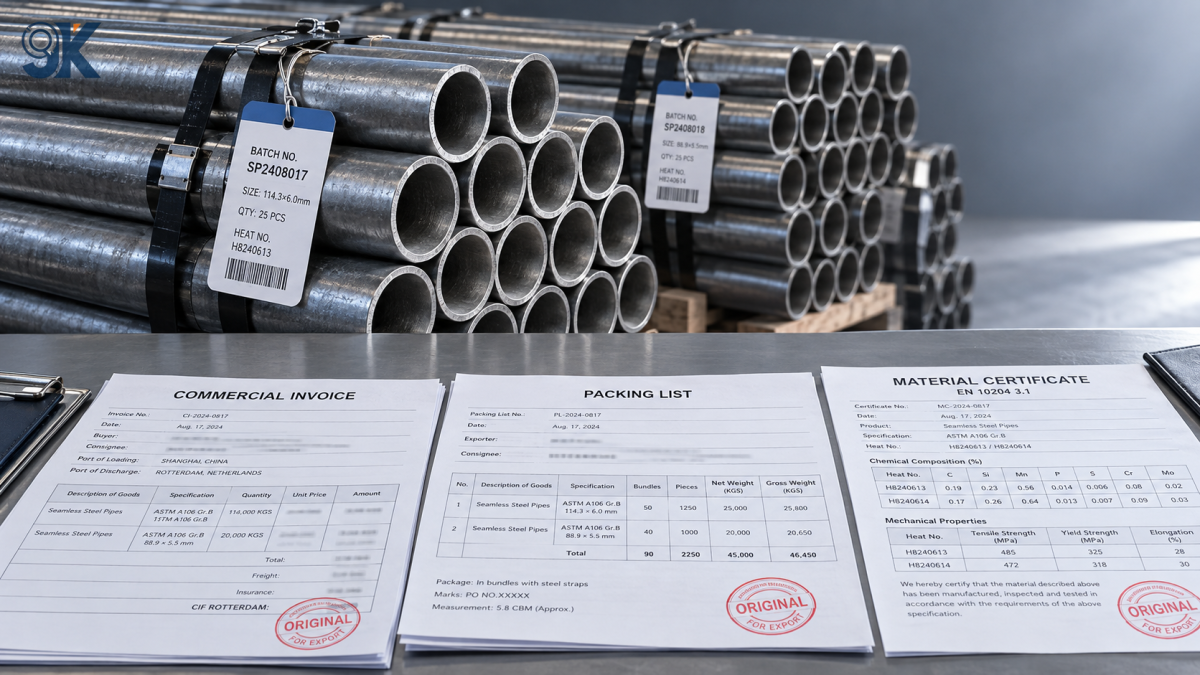
A useful reconciliation follows each invoice line through to its packing-list entry, bundle marks, supporting technical record, and declaration line. This makes mixed-size orders easier to review and helps locate omissions. A single shipment total can look correct while one diameter has been overstated and another omitted.
Mixed-product loads require additional care. If a container includes pipes and Stainless Steel Bar, keep the product lines separately identifiable throughout the invoice, packing list, and classification review. Shared material chemistry does not establish that different product forms belong under the same customs classification.
Check classification and value as commercial decisions with documentary support
An HS code copied from a previous shipment is a starting point for review, not proof that the new shipment is correctly classified. Changes in production method, material, dimensions, or processing may affect the classification. The description “mechanical tube” or “structural pipe” may express the buyer’s intended use without providing all the characteristics needed for a customs decision.
Ask the exporter or broker which product facts support the proposed code. A useful answer connects the classification to the technical description and the applicable tariff provisions. If the answer relies only on what was declared last time, compare the previous and present products before accepting that approach.
The importing buyer may use a tariff number with additional national digits or a different local subdivision. Do not require the full export and import codes to match simply because they refer to the same cargo. Resolve differences in the underlying product description, and have each side assess the classification under its own applicable tariff schedule.
Value checks need similar discipline. Recalculate invoice totals and verify the currency, pricing unit, discounts, and delivery terms. If the contract price includes freight or insurance, establish how those amounts are treated in the declaration under the applicable valuation rules. The invoice total and the declared customs value may have a legitimate relationship without being numerically identical.
Review changes made after the purchase order was issued. Added threading, coating, testing, or packaging charges should be reflected consistently in the commercial records and assessed for declaration purposes. Free replacement goods and samples also need an appropriate valuation basis; the absence of a payment obligation does not by itself establish a zero customs value.
For partial shipments, reconcile the dispatched portion against the order balance. The invoice should describe the goods in that consignment, and the packing list should support the same scope. A full-order invoice attached to a partial shipment can create questions about both quantity and value, even when the buyer and seller understand the commercial arrangement.
Identify conditional documents, then make a clear filing decision
Additional certificates and permits should be assessed against the exact product, destination, trade arrangement, and shipment date. Steel pipe is a broad commercial category, so a document checklist from another order cannot establish the requirements for every shipment. Before filing, the exporter and broker should check the applicable declaration requirements and any controls affecting the goods.
A mill test certificate supports material and inspection information. It does not automatically replace an origin document, establish customs classification, or prove compliance with every destination requirement. Where certificates are contractually required, check that they correspond to the dispatched material and that any specified inspection or endorsement arrangements have been met.
A certificate of origin serves a different purpose. Determine whether the buyer needs non-preferential origin evidence or documentation intended to support a preferential tariff claim. Preferential treatment depends on the relevant arrangement and origin rules; shipment from China alone does not establish eligibility. The origin record should also remain consistent with the invoice, product description, and shipment details.
For licenses, inspection documents, or other official approvals, establish whether they apply to the precise goods and transaction. Verify scope, validity, quantities where relevant, and the identity of the parties covered. Avoid treating a certificate held by the supplier as sufficient without checking whether it applies to this shipment.
Destination requirements deserve a separate check because successful export clearance does not guarantee successful import clearance. The buyer or destination broker should identify any required product conformity records, origin evidence, or other entry documents early enough for the exporter to prepare them. Wood packaging, if used, may also introduce destination-specific requirements that need attention before loading.
Timing matters as much as document availability. Ask when each document must be ready: before export filing, before loading, before payment presentation, or before arrival. Where payment depends on documentary compliance, review the payment instrument alongside the customs documents. A discrepancy can be commercially costly even if it does not prevent export release.
The final filing decision should distinguish unresolved facts from documents scheduled to follow later. Pause submission where product identity, classification, quantity, value, or a mandatory authorization remains unsupported. A later-issued transport document can be managed through an agreed timetable when it is not required at the filing stage.
Before authorizing the broker to submit, obtain a concise confirmation that the final invoice and packing list match the dispatched cargo, the declaration uses the approved data, and any applicable conditional requirements have been addressed. Keep the approved versions and the basis for material decisions together. If loading changes the shipment, reopen the affected checks and have the broker assess any required correction.
For a buyer evaluating shipment readiness, the strongest evidence is a traceable document set with clear ownership of discrepancies. Each declared product should lead back to identifiable goods, each quantity to a defensible measurement, and each value to the commercial agreement. That is the point at which filing becomes a controlled operational step rather than an attempt to resolve open questions at the port.
Latest News
- How do iron ore prices affect steel pipe price trends?
- How do tariffs affect square tube export markets?
- How steel pipe price trends affect inventory valuation
- Steel pipe price forecast for 2026 amid changing raw material costs
- Square Tube Export News: What Buyers Should Watch in Freight and Supply
- What new trade investigations mean for steel pipe exports
Send Us A Message

