
Export Customs Clearance for Steel Pipe: Documents to Check Before Loading
Export Customs Clearance for Steel Pipe: Documents to Check Before Loading
A missing certificate or mismatched invoice can delay a steel pipe shipment before it leaves port, disrupting production schedules and increasing costs. For procurement teams, Export Customs Clearance starts with checking that commercial invoices, packing lists, declaration data, and supporting documents describe the same order and physical cargo.
The challenge is not simply collecting files. Steel pipe orders can combine different grades, dimensions, manufacturing methods, coatings, and processing requirements. A description that works on a purchase order may be too vague for a customs declaration. This guide explains what to verify before loading, which certificates may apply, and how to coordinate with your supplier and broker without creating unnecessary paperwork.
Agree on the cargo description before the documents multiply
Documentation problems often begin when sales, production, warehouse, and logistics teams use different descriptions for the same material. “Steel tube” on an invoice, “mechanical pipe” on a packing list, and a different grade on the inspection certificate leave the broker to resolve questions close to the shipping deadline.
Create one approved item schedule from the purchase order and final production details. For each line, record the steel grade, applicable standard, seamless or welded construction, outside diameter, wall thickness, length, surface condition, and end treatment. Include quantities and agreed weight units. Square or rectangular hollow sections need their relevant cross-sectional dimensions rather than an outside diameter.
Not every document needs every technical detail. The descriptions must, however, remain compatible and allow each item to be identified. If production changes a length, quantity, or packaging arrangement, update the shipment records rather than leaving someone to explain the difference at the terminal.
The core documents: what procurement should actually check
Commercial invoice: value, parties, and terms
Check the seller and buyer’s legal names, invoice reference, currency, item descriptions, quantities, unit prices, and total value. Where the consignee differs from the buyer, confirm that the arrangement is reflected correctly across the documents that require those details. The commercial invoice should represent the actual transaction, not an earlier quotation with outdated quantities.
For steel sold by weight, establish whether pricing uses actual or theoretical weight. Reconcile that basis with the contract and explain legitimate differences between invoiced quantities and measured shipping weights. Also confirm the agreed Incoterms rule, version, and named place or port. Incoterms allocate specified costs and responsibilities; they do not replace a clear agreement on document preparation.
Packing list: connect the paperwork to the bundles
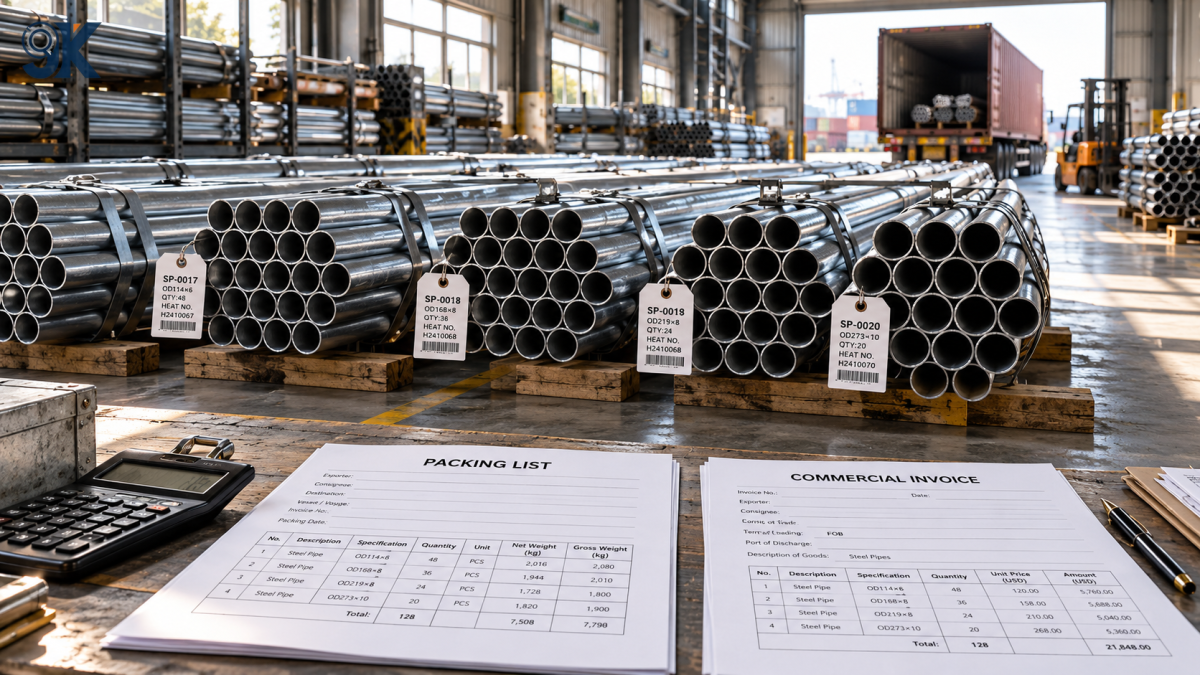
A useful packing list lets a warehouse operator identify cargo without guessing. Check bundle numbers, package counts, pieces per bundle where relevant, dimensions, and net and gross weights. Packaging weight should be distinguished from product weight. Confirm that the stated weight basis is understood, particularly where theoretical weights appear in commercial records.
Mixed specifications require clear separation. Two bundles with the same outside diameter but different wall thicknesses should not become indistinguishable entries. Where inspection records depend on heat or batch numbers, preserve the connection through bundle markings or a traceability schedule.
Before dispatch, compare the final packing list with warehouse tally records and readable photographs of bundle tags. Photographs support identification but do not replace weighing records, certificates, or physical inspection.
Declaration data: review the broker’s draft, not just the invoice
The exporter or appointed customs broker prepares the declaration using commercial and technical information. Procurement should ensure that the supplier has provided enough detail to support classification, quantities, values, and any applicable regulatory requirements. A technically correct invoice does not guarantee that its information was entered correctly into the declaration.
Steel pipe classification can depend on material composition, manufacturing method, cross-sectional shape, dimensions, and other characteristics. Do not copy an HS code from a previous order merely because both shipments contain steel pipe. National tariff extensions and import treatment also need destination-side review. The Chinese export broker and importing broker should each verify the requirements within their jurisdiction.
Certificates: distinguish customs requirements from purchase requirements
Not every steel pipe shipment needs the same supporting documents. Requirements depend on the product, destination, current regulations, contract, and payment terms. An unnecessary certificate adds administration; a missing mandatory document can stop the shipment or prevent the buyer from accepting it.
- Mill test certificate or inspection document: Check the required document type against the order. Verify the manufacturer, grade, dimensions, heat references, test results, and connection to the shipped material. A quality certificate is not automatically a customs clearance requirement.
- Certificate of origin: Confirm whether one is needed for destination clearance, customer acceptance, or a preferential tariff claim. Preferential treatment depends on the applicable agreement and origin rules, not simply on where the goods are shipped from.
- Inspection or conformity documents: Some destinations or applications may require particular assessments. Verify scope, issuing body, timing, and shipment references before assuming that a supplier’s general certificate covers the order.
- Licences or other regulatory documents: Ask the broker to check current controls for the exact product and shipment date. Requirements should not be inferred from an old shipment file.
Mixed-product shipments need additional care. If an order includes pipe alongside DX52D+Z Galvanized Steel Plate, keep the plate on a separate item line with its own specification, quantity, weight, and supporting records. Sharing a container does not make different steel products interchangeable for classification or certification.
Also establish when each document can be issued. Some certificates require final shipment details. Review drafts and confirm issuance arrangements before loading rather than demanding final originals before the necessary information exists.
“Before loading” needs two separate checkpoints
Loading a container at the warehouse and loading cargo aboard a vessel are different milestones. Before container stuffing, check cargo identity, packaging, inspection status, and the approved document data. Before vessel loading, confirm the relevant declaration, customs release, terminal acceptance, and carrier requirements with the responsible parties. The precise sequence depends on the port and shipping arrangement.
For full-container loads, container and seal numbers become available as equipment is assigned and sealed. Update the relevant records at that point. Where required, verified gross mass must be submitted within the carrier’s deadline; it is a shipping safety requirement, not a substitute for the packing list or customs weight data.
LCL shipments require coordination with the consolidator, including receiving deadlines and package identification. For bulk or breakbulk cargo, bundle tallies, shipping marks, weights, and handling arrangements deserve particular attention. Long pipe lengths may affect transport choices before customs paperwork even begins.
Review shipping instructions and the draft bill of lading for consignee details, package counts, cargo description, ports, and release arrangements. A final on-board bill of lading is normally issued after vessel loading. It should not be treated as a document that must already exist before stuffing.
Compare clearance arrangements by exposure, not the lowest fee
A low declaration service fee says little about the total cost of a shipment. Ask which charges are included and who bears amendment fees, inspections, additional handling, storage, or rebooking costs. Distinguish terminal storage from container detention and demurrage; the applicable charging arrangements and free-time conditions need confirmation with the relevant providers.
The more useful comparison is between workable delivery plans. A lower freight quote may leave less time to correct documents or require additional inland handling. A small trial order still needs accurate classification and certificates, even though its logistics structure differs from a recurring full-container shipment. Avoid solving a modest freight saving by accepting an unclear documentation process.
Shandong Jiukai Metal Materials Co., Ltd. combines custom steel pipe production, deep processing, warehousing, logistics, and export customs clearance, with independent import and export rights. That integrated scope can support coordination between the physical cargo and its records. Buyers should still agree on a named document coordinator, approval deadlines, and responsibility for changes.
With shipping options through Tianjin, Qingdao, and Rizhao, Jiukai Metal can coordinate FCL, LCL, and bulk arrangements for different order sizes. Port selection should follow cargo dimensions, inland transport, service availability, and cut-off requirements—not the assumption that every port offers the same practical route.
Set a release gate that people can use
Before authorizing dispatch, circulate one controlled shipment file containing the approved invoice, final packing details, applicable certificate drafts or originals, technical item schedule, and broker feedback. Assign an owner and deadline to unresolved points. Avoid multiple “final” versions moving separately between purchasing, finance, the warehouse, and the forwarder.
The release decision should answer three questions: does the cargo match the order, do the documents match the cargo, and have both export and destination requirements been checked by the responsible parties? If any answer depends on an unverified assumption, resolve it before the next irreversible handling step. That is usually more manageable than correcting the file while the shipment waits at port.
Latest News
- How do iron ore prices affect steel pipe price trends?
- How do tariffs affect square tube export markets?
- How steel pipe price trends affect inventory valuation
- Steel pipe price forecast for 2026 amid changing raw material costs
- Square Tube Export News: What Buyers Should Watch in Freight and Supply
- What new trade investigations mean for steel pipe exports
Send Us A Message

