
Pre-insulated steel pipe can simplify chilled-water installation when factory-controlled insulation, dependable field joints, and suitable corrosion protection address the project’s actual operating and exposure conditions.
For technical evaluators comparing Steel Pipe Solutions, the decisive question is whether the complete assembly will control condensation and remain maintainable throughout its intended service life.
Long distribution routes, buried networks, and projects with restricted installation windows often justify evaluation. Short, congested routes with frequent alterations may favor insulation applied after installation.
Approval should therefore depend on verified thermal performance, vapor-barrier continuity, pressure capability, and joint details. Insulation thickness alone cannot establish suitability for chilled-water service.
Where does pre-insulated steel pipe offer the clearest advantage?
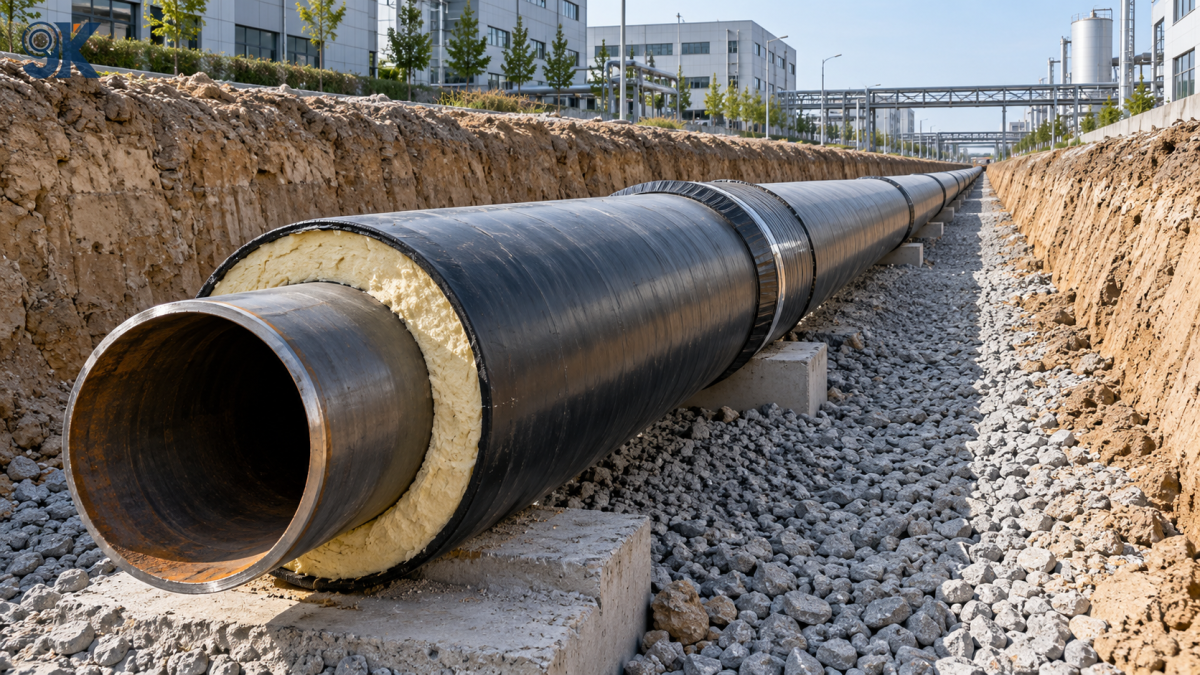
Pre-insulated assemblies typically combine a steel carrier pipe, thermal insulation, and an external protective jacket. Their performance depends on how those layers work together.
Factory application can improve dimensional consistency and reduce insulation work on site. However, transport damage, unfinished terminations, and poorly sealed joints can undermine those advantages.
Campus cooling networks, industrial chilled-water distribution, and connections between separate buildings are strong candidates, particularly where routes contain long straight sections and relatively few branches.
Buried installations can benefit from an integrated protective system, provided its jacket, joints, and structural design address groundwater, soil loads, traffic loads, and installation practices.
Aboveground outdoor routes require different checks, including ultraviolet resistance, weather sealing, support design, and jacket durability. A system suitable underground may need modifications for exposed service.
Inside crowded plant rooms, numerous valves, instruments, and equipment connections can increase field finishing work. Compare actual joint counts before assuming substantial installation savings.
Establish suitability using a route drawing and installation schedule. Identify straight lengths, fittings, access restrictions, penetrations, and inspection points before comparing quotations or selecting insulation.
Will the insulation prevent condensation under actual design conditions?
Condensation develops when a surface falls below the dew point of surrounding air. Evaluators should compare predicted jacket temperatures against the project’s worst credible ambient conditions.
Specify minimum chilled-water temperature, maximum ambient temperature, and coincident relative humidity. Average weather data or indoor comfort assumptions may underestimate exposure in humid service areas.
For example, water supplied at 6°C through a hot, humid utility corridor needs a different assessment from the same pipe inside a conditioned mechanical room.
Require calculations using the selected insulation’s declared thermal conductivity at the relevant mean temperature. Include pipe diameter, insulation thickness, jacket properties, and applicable surface heat-transfer assumptions.
Ask the designer to identify the calculation method, such as ISO 12241 where applicable, and document the margin between predicted surface temperature and design dew point.
Check supports, fittings, valve boxes, and terminations separately. A straight pipe calculation does not demonstrate that these local details will remain free from condensation.
Cooling-energy performance also matters, especially on long networks. Assess total heat gain alongside condensation control, because meeting one criterion does not automatically satisfy the other.
Can the vapor barrier remain continuous throughout the system?
In chilled-water service, ambient water vapor tends to move toward the colder pipe. Moisture entering the insulation can increase heat gain and encourage concealed corrosion.
Closed-cell insulation can resist moisture movement, but its presence does not prove that the installed assembly provides an adequate vapor barrier across every connection.
Request declared water-vapor transmission or resistance data for the insulation, jacket, and joint system, supported by relevant test methods and clearly stated test conditions.
Evaluate the jacket and seals as a complete enclosure. Field joints, end caps, service penetrations, and transitions to conventional insulation require compatible, documented sealing details.
Expansion and contraction can stress those seals. Confirm that the joint arrangement accommodates expected movement without opening a path for humid air or groundwater.
For buried routes, assess groundwater exposure and possible flooding during construction. An intact-looking jacket does not demonstrate that every completed field joint is watertight.
Where consequence of failure justifies monitoring, consider a compatible moisture-detection system. Define sensor coverage, commissioning checks, alarm response, and access for locating and repairing defects.
How will the system protect steel against concealed corrosion?
Carbon steel is widely used for chilled-water carrier pipes, but moisture beneath insulation can create external corrosion risks that remain hidden until significant damage occurs.
Specify external carrier-pipe protection appropriate to the operating temperature, insulation material, and potential moisture exposure. Require documented surface preparation, coating compatibility, application requirements, and inspection criteria.
Pay particular attention to field welds and coating repairs. Factory protection provides incomplete coverage if welding damage and exposed connection areas receive inadequate treatment.
Internal corrosion requires a separate strategy involving water treatment, oxygen control, commissioning cleanliness, and system operation. External insulation cannot compensate for unsuitable circulating-water chemistry.
For outdoor coastal or industrial environments, assess jacket fasteners, exposed metalwork, and penetrations for corrosion resistance. Material selection should reflect actual contamination and maintenance conditions.
Ancillary fabricated components may use corrosion-resistant stock such as 316 Stainless Steel Square Bar where engineering review confirms suitability for the component’s loads and exposure.
Keep that selection separate from carrier-pipe approval. Dissimilar-metal contact, attachment details, and thermal bridging still require assessment, even when an accessory uses stainless steel.
Are field joints and supports as reliable as the factory assembly?
Field joints deserve disproportionate attention because they connect factory-produced sections under variable site conditions. Request a complete installation procedure before accepting the proposed system.
The procedure should cover carrier-pipe joining, required examination, pressure testing, coating repair, insulation reinstatement, jacket closure, and sealing verification in a clearly defined sequence.
Carrier-pipe pressure testing and jacket-sealing checks address different failure modes. Specify both where required, and ensure inspection access remains available until the relevant checks finish.
Insulation reinstatement must avoid voids and preserve the specified thermal performance. Confirm permitted installation temperatures, moisture limits, cure times, and installer training for the selected materials.
Supports need sufficient load capacity without crushing insulation or creating cold bridges. Check concentrated loads, sliding arrangements, anchors, guides, and vapor sealing around support interfaces.
Thermal movement also needs calculation, including changes between installation and operation. Bonded and unbonded assemblies can transfer forces differently, affecting bends, anchors, and building entries.
For buried systems, review bedding, backfill, compaction, cover depth, and crossings. Evaluate groundwater buoyancy where relevant, particularly before filling or when the carrier pipe is empty.
Does the carrier pipe meet hydraulic and mechanical requirements?
Begin with the governing piping code and project specification. Verify material grade, dimensions, wall thickness, manufacturing route, and allowable pressure at the specified design temperature.
Design pressure should account for elevation, pump shutoff conditions, and credible pressure transients. A nominal operating-pressure figure alone may leave important loads outside the assessment.
Check the full temperature envelope, including shutdown, cleaning, and any approved operating modes. Do not assume a chilled-water insulation system is suitable for steam cleaning.
Hydraulic sizing should use actual internal diameter, design flow, fittings, and system pressure-loss limits. Excessive velocity or undersizing can increase pumping demand and operational noise.
Check dimensional compatibility at valves, flanges, equipment nozzles, and existing pipework. Outside-diameter conventions and connection standards can differ between supply markets, creating avoidable site modifications.
For material acceptance, request traceability and inspection documentation appropriate to the contract. Define welding qualifications, examination requirements, and acceptance criteria through the governing specification.
Agree the test sequence before manufacture and installation. Some connections may require temporary exposure, making inspection planning essential to avoid unnecessary removal of completed insulation.
What should a useful supplier quotation include?
A comparable quotation needs a common technical basis. Give each bidder the route schedule, operating envelope, exposure conditions, connection details, and required documentation before requesting prices.
Ask suppliers to identify exclusions explicitly, especially field-joint materials, valve insulation, special supports, inspection services, and replacement kits. These omissions can materially change the installed cost.
Confirm manufacturing tolerances and section lengths against transport restrictions and lifting arrangements. Longer sections reduce joints but may complicate delivery, unloading, and movement through confined sites.
Shandong Jiukai Metal Materials Co., Ltd. provides steel pipe services encompassing custom production, deep processing, warehousing, logistics, and export customs clearance for international industrial customers.
Its drawing evaluation and specification-selection support can help organize enquiries. For pre-insulated assemblies, confirm the proposed manufacturer, verified capabilities, technical scope, and contractual responsibilities explicitly.
For overseas procurement, coordinate packing and shipping through suitable ports, including Tianjin, Qingdao, or Rizhao. Protect jackets, seal exposed ends, and provide documented receiving-inspection instructions.
Do installation savings justify the total project cost?
Compare installed cost over a defined evaluation period. Include pipe assemblies, fittings, freight, handling, field labor, inspection, energy use, maintenance access, and expected repair provisions.
Factory insulation may reduce site labor and weather exposure, particularly along repetitive routes. Savings depend on joint frequency, local labor costs, and installer familiarity.
Conversely, complex layouts can require numerous special fittings and closures. Model representative route sections rather than applying a general percentage saving to the entire network.
Include schedule consequences where they affect project value. Earlier commissioning can matter, but only if fabrication lead times, shipping arrangements, and installation resources support that outcome.
Require a practical repair method before approval. Determine how damaged insulation or a leaking carrier connection can be accessed, dried, repaired, resealed, and inspected.
What should determine final approval?
Pre-insulated Steel Pipe Solutions suit chilled-water lines when the complete assembly satisfies thermal, moisture, structural, hydraulic, and maintenance requirements under documented project conditions.
Approve the system only after reviewing condensation calculations, continuous vapor-sealing details, corrosion protection, field-joint procedures, support design, and evidence supporting the proposed materials and performance.
If critical details remain unresolved, request a representative joint demonstration or project-specific clarification before procurement. Validate the interfaces that will be hardest to inspect after installation.
The strongest selection is an assembly whose performance can be demonstrated, installed consistently, and repaired practically. Those criteria turn factory insulation into a defensible engineering choice.

