
News center
Steel Plate Lead Time from China: What to Confirm Before Ordering
Steel plate lead time from China is only useful when the quotation defines where the clock starts and what “delivery” means. Material ready at a warehouse, cargo loaded on a vessel, and plate available at your plant are different milestones. A short production promise can still leave a substantial gap before the material reaches your cutting line.
Before ordering, establish whether the exact plate is available, what processing and testing remain, and how it will move from the supplier to your receiving site. Then compare quotations against the same delivery milestone. Without those details, the lowest price or shortest quoted lead time may create the highest scheduling cost.
Define the delivery milestone before comparing quotations
A quotation stating “delivery after deposit” leaves two questions unanswered: what else must be approved before work begins, and what event counts as delivery? Production may depend on final drawings, technical acceptance, or a confirmed rolling slot. The quoted period may end when goods are ready for collection, even though your schedule assumes vessel departure.
Ask the supplier to identify the following milestones separately:
Use the applicable Incoterm with a named place or port, but also write the scheduling milestone explicitly. Under a CIF quotation, for example, the seller arranges freight to the named destination port; that does not make the quoted shipment date an arrival commitment. A vessel booking likewise does not establish that the cargo has sailed.
Confirm whether the timeline uses calendar days or working days and which outstanding approvals can move the start date. These details make competing offers comparable.
“In stock” must mean the exact plate you can accept
Stock availability can shorten the schedule, but only when it matches the purchase specification. Plate of the same nominal thickness may differ in grade, delivery condition, dimensions, tolerances, or certification. Material held at an upstream warehouse may also require a separate release and transport arrangement.
Request a stock list showing available quantities, plate dimensions, heat numbers, storage location, and corresponding material certificates. Establish whether the offered pieces can be reserved for your order and when that reservation becomes effective. Stock that remains available to other buyers is a provisional option.
Check usable yield as well as availability. A larger stock plate may be suitable for cutting several components, but its price advantage can disappear through offcuts, extra cutting, or transport constraints. Conversely, a slightly different stock size may avoid a production wait if your nesting layout accommodates it.
Any substitution needs technical approval before the order is released. A similar grade designation from another standard is not enough to establish suitability. Compare the requirements relevant to the application, including mechanical properties, chemistry, delivery condition, and required testing.
For mill production, confirm the slot and the specification together
When suitable stock is unavailable, the schedule depends on the mill’s production plan. An indicative lead time can change once the complete order reaches production planning, particularly for less common grades, dimensions, or delivery conditions.
Ask whether the quotation reflects a confirmed production slot or an estimate awaiting mill acceptance. Also establish whether the order quantity fits the proposed production route. A small requirement for an unusual specification may need to join a larger production batch, making its timing less predictable than a standard stock purchase.
The specification should be complete enough to avoid clarification after acceptance. It should cover:
- Grade, applicable standard, and required delivery condition.
- Thickness, width, length, quantity, and dimensional tolerances.
- Surface condition and any restrictions on repairs.
- Testing, certification, marking, and traceability requirements.
- Cutting drawings, edge preparation, or other processing instructions.
Requirements such as heat treatment, impact testing, or ultrasonic examination can affect both production routing and release. Specify them at quotation stage when the application requires them. Adding them after rolling may introduce extra work or make the proposed material unsuitable.
Schedule flexibility is best explored through specific alternatives. Ask the supplier to quote an approved stock option alongside the original mill-production requirement, with the technical differences clearly stated. This makes the cost of maintaining the exact specification visible without weakening acceptance criteria.
Include processing and inspection in the promised completion date
Plate availability does not mean processed components are ready to ship. Cutting, beveling, drilling, machining, or surface preparation can introduce separate workshop queues. Thick plate and tight dimensional requirements may also require a different processing route from straightforward cutting.
Identify who performs each operation and where. Moving plate between a warehouse, cutting shop, inspection location, and packing facility adds handling and coordination. A supplier managing those activities should provide one schedule covering the complete scope.
Drawings deserve particular attention. Confirm the approved revision, datum references, tolerances, and any allowance for later machining. If cut pieces need heat-number traceability, agree how markings will be transferred and recorded before cutting begins. Reconstructing identification after parts have been mixed can delay release.
Inspection should have a defined place in the schedule. Where third-party attendance is required, establish the notice period, inspection scope, acceptance criteria, and release authority. Clarify which operations require a hold point and which can proceed after document review.
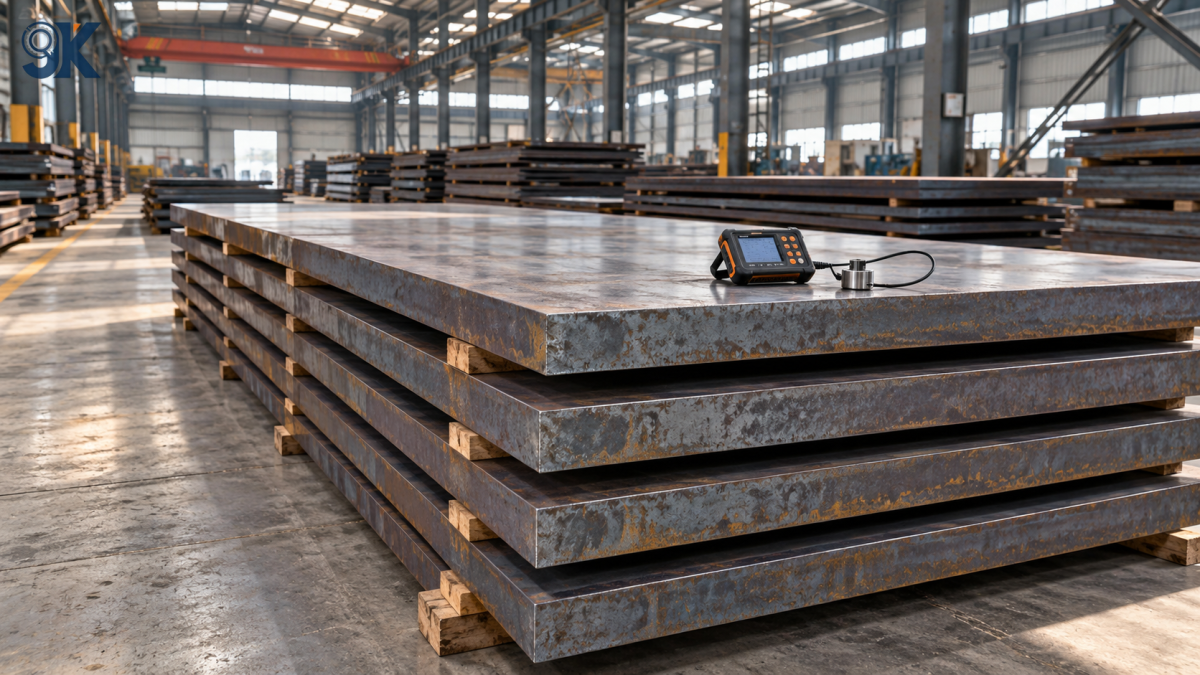
Review material certificates early enough to resolve discrepancies before dispatch. Check that the grade, delivery condition, test results, dimensions, and heat identification correspond to the ordered and physically marked material. Discovering a mismatch after packing can require reopening bundles and repeating checks.
Build the shipping plan around the plate dimensions
The quickest factory completion date is not always the quickest route to your site. Plate dimensions, individual piece weight, total shipment volume, and lifting requirements influence the transport method and available sailings.
Container suitability must account for loading access, weight distribution, securing, and unloading—not just whether the plate appears to fit inside. Oversized or heavy pieces may require another equipment type or a breakbulk arrangement. Cutting plate to suit transport can be practical only when the resulting dimensions remain acceptable for the intended work.
FCL can give a shipment a more direct packing and dispatch arrangement. LCL can suit smaller quantities, but introduces consolidation schedules, additional handling, and deconsolidation at destination. Breakbulk or bulk arrangements may suit larger cargoes, with timing dependent on suitable services and cargo acceptance.
Compare ports using the complete route. For cargo originating in Shandong, Qingdao, Rizhao, or Tianjin may be considered according to inland transport, cargo handling, and available services. The nearest port does not automatically produce the earliest arrival.
Request a shipping plan that identifies the loading port, proposed service, any transshipment, cargo cutoff, and destination handling arrangements. Distinguish an estimated sailing from a confirmed booking, and allow for the interval between cargo readiness and the next usable departure.
Suppliers coordinating warehousing, processing, and export logistics can help connect these stages. Shandong Jiukai Metal Materials Co., Ltd. describes these capabilities within its steel pipe services. For a plate order, establish the actual plate source and confirm the processing and shipment scope in writing.
Compare total purchasing cost, including the cost of waiting
A lower price per tonne can become expensive if it requires an emergency shipment or leaves equipment waiting for material. Compare the cost to receive usable plate, including processing, inspection, packing, inland transport, freight, and applicable destination charges.
Then consider inventory exposure. Ordering earlier creates storage and cash-flow costs, while ordering too close to the production date reduces recovery options. The appropriate buffer depends on how easily the material can be replaced, the reliability of each milestone, and the consequence of a missed arrival.
Stock material often deserves consideration when a small quantity unlocks a larger production sequence. Mill production may be more appropriate when the quantity, specification, or required dimensions justify waiting. Compare the stock premium with the operational cost of delay rather than choosing from the unit price alone.
For mixed orders, establish whether one item can hold back the entire shipment. If plate is being consolidated with 2507 Duplex Stainless Steel Bar, obtain separate readiness dates for each product. Bar availability does not establish plate availability, even when both appear on one purchase order.
A split shipment may protect the production schedule, but brings additional freight, documentation, handling, and receiving costs. Use it when the value of receiving a critical portion early exceeds those extra costs. Identify that critical quantity before negotiating the shipment plan.
Turn the quotation into a schedule you can manage
Before placing the order, obtain a dated schedule linking technical approval, stock allocation or mill production, processing, inspection release, packing, and shipment. Each milestone should have a responsible party and a clear completion condition.
Ask for evidence appropriate to the stage: allocated stock details, confirmation of the production slot, inspection release records, packing information, or booking status. A general update saying “on schedule” gives little warning when an upstream task has slipped.
Document changes as they occur. A revised drawing, added test, or quantity increase should trigger a stated effect on price and timing. Otherwise, the original delivery promise may remain in circulation after its assumptions have changed.
For your next enquiry, send the complete plate specification, quantities, processing drawings, inspection requirements, destination, and required site date together. Ask the supplier to work backward from that date and identify the latest order-release point, outstanding dependencies, and available alternatives. This gives you a purchasing decision based on when usable material can arrive—and a clear basis for acting if the schedule begins to move.
Latest News
- Steel Pipe Price Forecast 2026: Scenarios for Procurement Budgets
- How anti-dumping duties change market access for steel pipe exports
- How could electric arc furnace investment reshape steel industry development?
- How Steel Pipe Warehousing and Logistics Affect Damage Rates and Delivery Costs
- Seamless vs Welded Steel Pipe: Which Option Fits Budget and Lead Time
- ASTM and EN Standards for Carbon Steel Pipe in Pressure Systems
Send Us A Message

