
When does outsourced steel pipe warehousing cost less than in-house storage?
When does outsourced steel pipe warehousing cost less than in-house storage?
Outsourced Steel Pipe Warehousing costs less than in-house storage when storage, handling, and transport fees fall below the internal costs a business can actually avoid. That last distinction matters. Moving stock off-site does not create savings if the warehouse lease, equipment payments, and payroll remain unchanged.
The comparison goes beyond rent. Pipe dimensions, shipment frequency, inventory identification, damage exposure, and delivery commitments all affect the result. Seasonal demand and export staging can leave dedicated space underused, while frequent production-line withdrawals can make an outside warehouse expensive. A useful assessment separates genuine cash savings from accounting allocations, then tests whether the proposed service can support the required delivery pattern.
Start with the costs that will actually disappear
An internal warehouse cost report is a starting point, not a decision model. It may include depreciation, allocated administration, and building expenses that continue after outsourcing. Comparing the full allocated internal cost with a supplier’s quotation can therefore overstate the benefit.
Separate expenses by when they can be removed. Overtime and temporary labor may change quickly. A forklift lease might end at its next renewal. Rent may remain committed for years. Permanent employees may be reassigned rather than removed, creating operational capacity but not an immediate payroll saving.
For the same decision period, use this comparison:
Net outsourcing benefit = avoidable internal storage and handling costs − total external service costs − transition costs − incremental risk costs.
External service costs should include any extra transport, retained internal coordination, and inventory checking. Evaluate transition costs separately from recurring costs so a one-time stock transfer does not obscure the longer-term economics. Conversely, do not hide implementation expenses outside the approval request.
Space released for manufacturing can have value, but it needs a credible use. Count that benefit only where there is an actionable production expansion, subletting arrangement, or avoided building commitment—not simply because an empty area becomes available.
Pipe geometry can matter more than the rate per tonne
Steel pipe does not behave like uniform palletized freight. Long bundles require suitable access routes, support arrangements, lifting equipment, and loading space. Large-diameter, thin-wall pipe may occupy substantial capacity without adding much weight, while smaller heavy-wall pipe creates a different floor-loading and handling requirement.
A low tonne-based rate may therefore be misleading. Ask whether the warehouse charges by weight, occupied area, bundle, or reserved bay, and whether unusual lengths attract a surcharge. Compare quotations against the actual inventory mix rather than the most convenient billing unit.
Storage layout also affects retrieval cost. If a requested bundle sits beneath several others, one dispatch can require multiple moves. Mixed grades, wall thicknesses, lengths, and heat numbers increase the importance of accessible locations and reliable records. Cheap dense storage can become expensive when orders require frequent partial-bundle withdrawals.
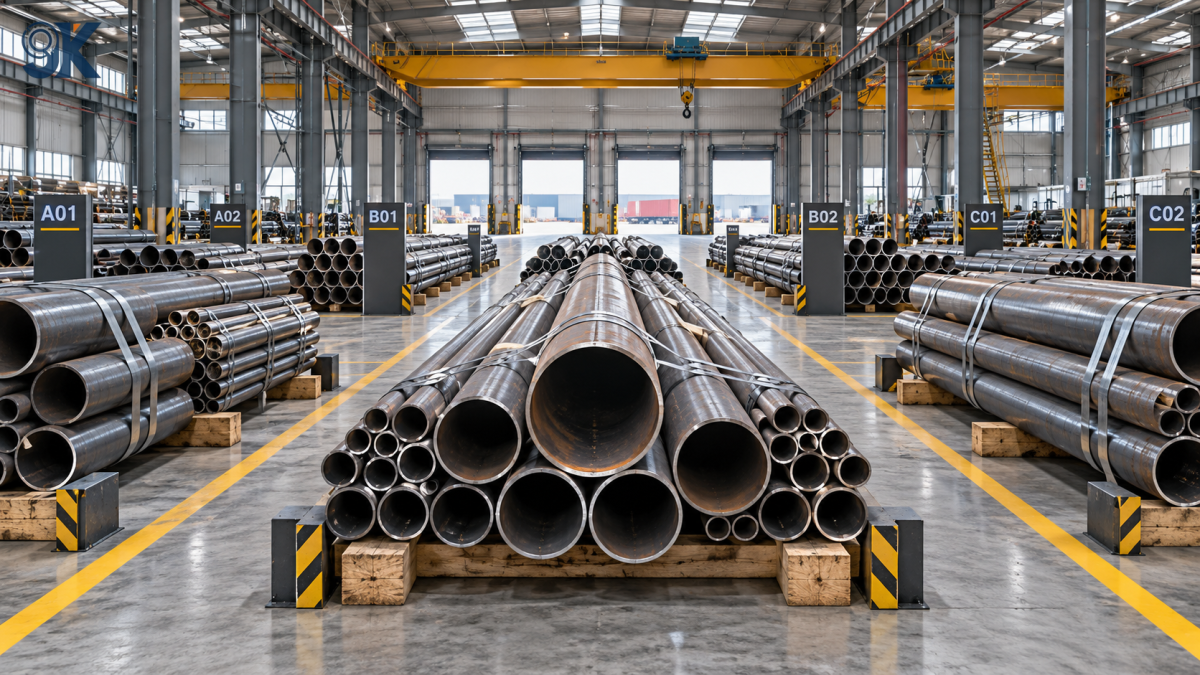
Give bidders a stock profile showing dimensions, bundle weights, average and peak inventory, dwell time, and withdrawal patterns. Include surface protection and indoor or covered-storage requirements. Without these details, competing quotations may describe materially different services.
Where outsourcing is most likely to win
The strongest case usually involves capacity that is costly to maintain but needed only intermittently. A manufacturer holding pipe for occasional projects may otherwise pay for space and lifting capability throughout quiet periods. Shared external capacity can convert part of that fixed commitment into usage-based expenditure, provided minimum charges do not recreate the same problem.
Export staging is another practical candidate. Pipe may need to wait between production completion, inspection, processing, and vessel availability. Holding it near the production source or a suitable export route can avoid moving it through an unnecessary intermediate warehouse. The saving depends on the actual transport plan, not merely proximity to a port.
Outsourcing becomes less attractive when the factory needs small, unpredictable releases throughout the day. Additional truck movements, order cutoffs, and emergency dispatch fees can outweigh lower storage charges. Stable high utilization can also favor an existing internal operation with suitable equipment and efficient labor deployment.
A hybrid arrangement often deserves consideration: keep production-critical stock on-site and outsource slow-moving inventory, project reserves, or export-ready bundles. It avoids treating every tonne as though it has the same service requirement.
Build the break-even model around activity
Average inventory alone cannot explain warehouse cost. Two businesses holding the same tonnage may generate very different workloads if one ships complete bundles monthly and the other releases individual pipes daily.
Model storage occupancy separately from receipts, dispatches, picking, and rehandling. Use a consistent basis for each charge: tonne-days for storage if that is the contractual unit, and actual movements or orders for handling. Confirm whether inbound and outbound handling are charged separately and how partial periods are rounded.
The practical break-even point is the activity level at which the complete external bill equals the internal costs avoidable over the same period. There may not be one universal tonnage threshold because occupancy and throughput change independently.
- Normal operations: use representative stock levels, dispatch sizes, and dwell times.
- Peak demand: test overflow space, overtime handling, and transport availability.
- Slow sales: test longer storage periods, minimum billing, and aged-stock charges.
- Disruption: test delayed collection, urgent withdrawals, and an alternative transport route.
Apply comparable service requirements to both options. A lower-cost external model that assumes slower releases is not equivalent to an internal operation supporting immediate production withdrawals. Any relaxation of service should be an explicit business decision.
Read the rate card alongside the liability terms
The headline storage rate rarely captures the full commercial exposure. Request a worked invoice based on your stock profile, including receiving, unloading, identification, picking, loading, and transport. Clarify whether inspections, photographs, replacement labels, packaging repairs, and inventory reports are included.
Minimum monthly charges and reserved-capacity commitments deserve particular attention. They can eliminate the expected flexibility during quiet periods. Also check notice periods, annual rate adjustments, access restrictions, and the cost of withdrawing all inventory when the agreement ends.
For pipe, condition and identity are financial issues. Bent ends, damaged coatings, corrosion, or lost heat-number traceability can delay use even when the physical stock count is correct. Agree on incoming condition records, segregation rules, identification continuity after bundle splitting, and the process for reporting discrepancies.
Do not assume the provider’s insurance covers the full replacement value or consequential production losses. Establish who insures the goods, applicable limits and exclusions, claim deadlines, and responsibility during loading and transport. Where losses are difficult to estimate, show the exposure separately rather than assigning an unsupported probability.
Mixed-material orders require additional care. If a consignment includes C1720 Copper Plate alongside steel pipe, ask how different product forms will be identified, protected, and charged. A pipe-bundle handling allowance should not automatically be treated as adequate for plate packing or consolidation.
Integrated services can remove handoffs—but verify the route
An integrated provider can be worth evaluating when production, deep processing, storage, and export preparation would otherwise involve several businesses. Fewer transfers may reduce transport legs and handling events. However, a bundled price should still identify what is included so savings are not merely shifted between service lines.
Shandong Jiukai Metal Materials Co., Ltd., based in Shandong’s steel pipe manufacturing region, combines custom production, deep processing, warehousing, logistics, and export customs clearance, with independent import and export rights. Its services include drawing evaluation, specification selection, documentation processing, and logistics tracking for global machinery manufacturers.
For a cost review, the relevant question is whether those activities can be coordinated around the actual order. Can processed pipe remain in storage until release? Can documentation be checked before dispatch? Can trial batches and long-term orders follow different replenishment schedules without unnecessary transfers?
Jiukai Metal supports FCL, LCL, and bulk shipping through options including Tianjin, Qingdao, and Rizhao. These routes should be compared using inland haulage, cargo suitability, sailing availability, terminal handling, and destination requirements. For long or heavy pipe, the lowest ocean freight quotation alone does not establish the lowest delivered cost. Specify who bears port storage, demurrage, detention, and charges caused by delayed documents or collection.
Approve the operating arrangement, not just the quotation
Before committing, reconcile the proposal against recent inventory and dispatch records. Confirm which internal expenses will stop, their termination dates, and any costs retained for oversight. Then verify release lead times, stock-reporting fields, physical count procedures, damage reporting, and escalation responsibilities.
A limited trial using noncritical stock can help check invoice accuracy and retrieval performance before a wider transfer. Keep enough operational flexibility to address discrepancies without interrupting production.
Outsourced steel pipe warehousing is financially justified when avoidable costs exceed the complete external bill across realistic operating conditions. If the saving depends on perfect shipment timing, unproven space reuse, or ignored retrieval charges, the approval case needs revision. The next step is a matched comparison: the same stock profile, the same delivery commitments, and clearly assigned responsibility for every handling stage.
Latest News
- How anti-dumping duties change market access for steel pipe exports
- How could electric arc furnace investment reshape steel industry development?
- How Steel Pipe Warehousing and Logistics Affect Damage Rates and Delivery Costs
- Seamless vs Welded Steel Pipe: Which Option Fits Budget and Lead Time
- ASTM and EN Standards for Carbon Steel Pipe in Pressure Systems
- When a Standard Steel Pipe Works Better Than a Custom Specification
Send Us A Message

