
Maintaining heat traceability in steel pipe warehousing and logistics
Maintaining heat traceability in steel pipe warehousing and logistics
A missing heat number can turn a routine steel pipe shipment into a quality investigation, delaying acceptance and weakening material accountability. For quality control and safety teams, maintaining heat traceability in Steel Pipe Warehousing and Logistics means preserving the link between each pipe, its production heat, and its material test certificate through receiving, storage, processing, and dispatch. The difficult part is not recording that link once. It is keeping it intact when bundles are opened, pipes are cut, stock is relocated, and responsibility passes to another company.
A useful operating rule is simple: nobody should need to guess which certificate belongs to the material in front of them. If the answer depends on where a pipe was probably stored yesterday, traceability is already at risk.
Define the traceability unit before the material arrives
A heat number identifies a steelmaking heat, but it does not necessarily identify every manufacturing or testing condition applicable to a finished pipe. Pipes from the same heat may pass through different production routes, heat-treatment batches, or inspection lots. Where these distinctions affect acceptance, the warehouse record must retain them alongside the heat number.
The required identification level should therefore be settled during order review. Does the customer require individual pipe identification, or is controlled bundle identification acceptable? Will pipes be cut or machined before shipment? Must markings survive coating, outdoor storage, or a long sea voyage? The purchase order, applicable product specification, and customer requirements determine the answer—not whichever marking method happens to be easiest at receiving.
Also check whether heat numbers are unique across your supplier base. They may not be. A reliable database key normally combines the manufacturer’s identity, heat number, and relevant product or lot reference. Treating the heat number alone as a globally unique identifier can connect unrelated stock to the wrong certificate.
Receiving is where document errors become stock errors
The receiving team should compare physical markings, delivery documents, and the material test certificate before releasing stock for picking. Checking only the supplier’s packing list leaves an important question unanswered: does the steel actually carry the identity stated on the paperwork?
The comparison needs to cover the manufacturer, heat number, grade, dimensions, quantity, and any delivery condition or testing references required by the order. Mechanical results may be reported by test lot rather than heat alone, so a matching heat number is not sufficient if the certificate does not cover the supplied product and its relevant condition.
- Legible marking, missing certificate: record the identity and place the stock on documentation hold until the required certificate is obtained and verified.
- Certificate available, marking missing: isolate the affected material; paperwork alone does not establish its identity.
- Marking and certificate disagree: stop release and investigate the discrepancy with the supplier.
- One bundle contains several heats: verify the internal identification and segregation before accepting it as traceable stock.
Receiving photographs are useful evidence, especially before original packaging is removed. Capture readable markings and their relationship to the bundle, not just a wide photograph of a truck. Images support the stock record; they do not replace a controlled identification system.
Keep identity attached when bundles stop being bundles
An intact, single-heat bundle is relatively easy to control. Problems start when a few pipes are removed for an urgent order and the remainder moves to another rack. The original bundle tag may leave with the picked material, while the warehouse system still shows the original quantity and location.
Make bundle opening a recorded transaction. Assign an identity to each resulting handling unit, retain the parent reference, and update quantities immediately. If individual pipes will circulate separately, their identification must remain usable independently of the original bundle tag.
Marking methods need to suit the surface and exposure. Tags can tear away during lifting; paint can disappear under blasting or coating; adhesive labels may fail on oily surfaces. Hard stamping is not automatically an acceptable alternative because some specifications or applications restrict it. Choose an approved method and confirm that it remains readable under actual handling conditions.
For outdoor stock, a protected tag combined with an approved secondary identifier can reduce dependence on a single fragile label. Place identification where staff can read it without climbing unstable stacks or entering a suspended-load area.
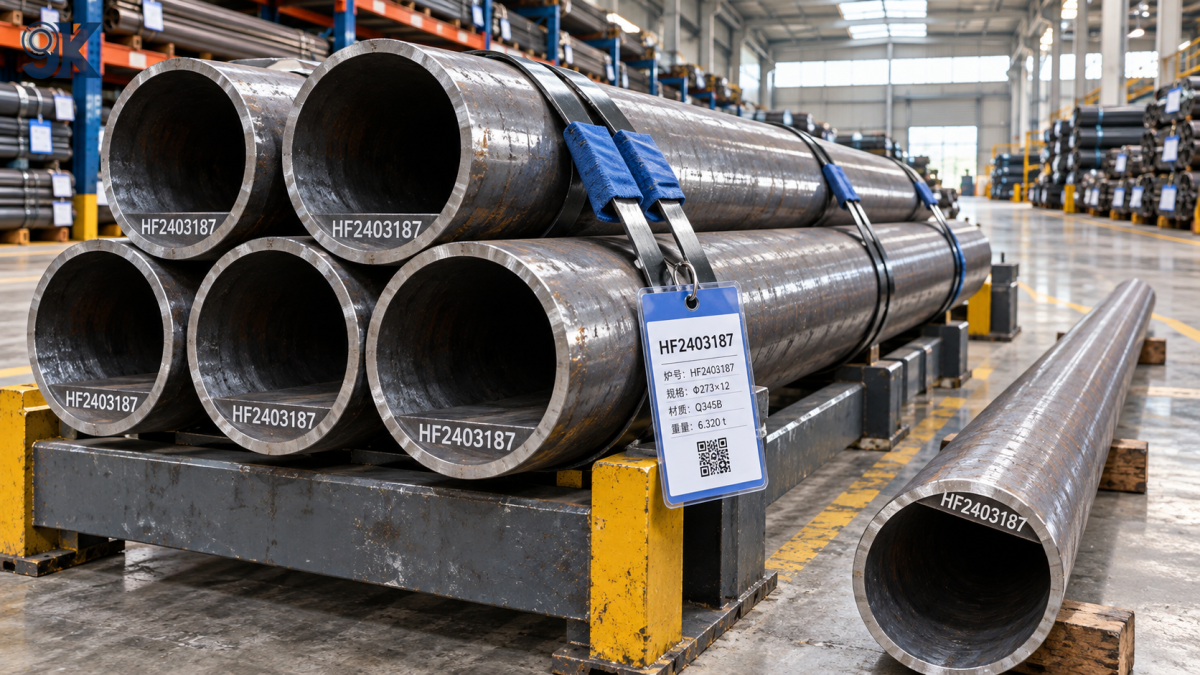
Physical segregation still matters, even with barcode scanning. Separate stock by the distinctions that can cause a wrong-material release: grade, dimensions, delivery condition, heat or lot where required, and inspection status. A rack location helps find material, but location alone is not proof of identity.
Mixed-product storage deserves particular care. If pipe shares a dispatch area with structural sections such as A36 H Beam, use consistent identification controls without treating the products as interchangeable. Each order line still needs its own applicable specification, certificate reference, and release status.
Cutting and processing need a controlled handover
Cutting can destroy traceability in seconds. The marked pipe end goes into the scrap bin, and several unmarked lengths remain beside the saw. Trying to reconstruct their identity after another heat has entered the work area is an avoidable investigation.
Before cutting, verify the source pipe against the work order. Establish how identification will transfer to every required finished length and any reusable remnant. Transfer should take place under a controlled sequence while the parent identity remains verifiable—not later from memory.
The processing record should connect the parent stock reference to the resulting pieces, quantities, lengths, and relevant process records. Reconcile usable output, remnants, and scrap sufficiently to reveal unexplained material movement. Return remnants to stock with their own usable identity; a handwritten “same as yesterday” note is not a traceability record.
Blasting, coating, threading, and machining introduce similar risks. Agree where identification will remain visible and how subcontractors will preserve it. If processing changes a property or condition covered by the original certificate, retaining the heat number does not by itself prove that the finished item meets every requirement.
When a mark disappears, stop rather than improvise
Put unidentified material on physical and electronic hold. Review receiving photographs, movement records, processing records, and controlled segregation evidence. Any re-identification should follow an authorized procedure with a documented basis and approval.
Positive material identification may help distinguish alloy chemistry, but it generally cannot recover a lost heat number or establish all mechanical properties and processing history. Matching dimensions, appearance, or chemistry is not enough to assign a convenient certificate. Where identity cannot be established, disposition must follow the contract and applicable requirements, including customer agreement where necessary.
Build the shipment record around what is actually loaded
Dispatch should verify the picked material against the released order, not merely print documents from the original sales entry. The packing list needs a clear connection between package identifiers, quantities, heat or lot references, and the corresponding certificates. Several heats can travel in one shipment, provided that the required distinctions remain visible and documented.
FCL, LCL, and bulk shipping expose identification to different handling patterns. LCL cargo may pass through consolidation and deconsolidation points, making independently identifiable packages especially useful. Bulk cargo requires attention to lifting, weather exposure, and tag protection. A sealed FCL container helps preserve a verified load, but the seal number does not replace material identification inside it.
Record loading checks while labels remain accessible. Retain package photographs, the final packing list, certificate mapping, and relevant container or transport references. Set clear handover responsibilities with the forwarder: who reports damaged packaging, who may authorize repacking, and what evidence must survive if a tag is replaced?
These interfaces matter for an integrated supplier such as Shandong Jiukai Metal Materials Co., Ltd., whose scope includes custom production, deep processing, warehousing, logistics, and export customs clearance. With shipping options through Tianjin, Qingdao, and Rizhao, traceability planning should cover the route and handling arrangements selected for each order. A port change must not leave the warehouse, forwarder, and customer working from different packing-list revisions.
Test retrieval, not just record collection
A warehouse can hold thousands of certificate files and still struggle to prove which one belongs to a particular pipe. A useful internal check starts with a physical item and follows its identity back to the verified certificate, receiving record, and any processing history. Then reverse the exercise: select a heat and identify its remaining stock, dispatched quantities, and affected shipment references.
Include partial bundles, returned material, subcontracted work, and relocated stock in these checks. Those are the places where an otherwise orderly system tends to lose continuity. Digital scanning can reduce manual transcription, but only if label creation, correction, and stock release are controlled.
Before the next shipment, choose one split bundle and ask a person who did not handle it to trace every remaining piece. If they need verbal reassurance instead of records, fix that handover before the material leaves the warehouse.
Latest News
- How anti-dumping duties change market access for steel pipe exports
- How could electric arc furnace investment reshape steel industry development?
- How Steel Pipe Warehousing and Logistics Affect Damage Rates and Delivery Costs
- Seamless vs Welded Steel Pipe: Which Option Fits Budget and Lead Time
- ASTM and EN Standards for Carbon Steel Pipe in Pressure Systems
- When a Standard Steel Pipe Works Better Than a Custom Specification
Send Us A Message

