
News center
Steel Pipe Warehousing: Preventing Corrosion and Handling Damage
Steel pipe warehousing should keep moisture from lingering, prevent pipes from rolling or bending, and protect surfaces and ends during every move. A covered building alone does not achieve this. Pipes can arrive wet, condensation can form indoors, and a poorly supported bundle can suffer damage without ever leaving its storage bay.
The right precautions depend on the pipe’s material, dimensions, surface condition, and next operation. Heavy structural pipe may tolerate handling marks that would make precision mechanical tubing unsuitable for machining. Start by identifying what must be protected, then match the storage arrangement and handling method to those requirements.
Inspect incoming pipe before it joins usable stock
Receiving is the best point to separate transport damage from problems that develop in storage. Check the delivery identification against the order, including grade, dimensions, quantity, and any required heat or batch references. Keep those references connected to the material when bundles are opened or divided.
Inspect accessible surfaces, pipe ends, bundle restraints, and packaging. Look for crushed wrapping, standing water, displaced supports, rust concentrated beneath straps, dented ends, and evidence that pipes have rubbed together. If a bundle is wet inside, putting it directly into a rack leaves the cause of corrosion in place.
Record damage and isolate affected material before release. A useful receiving record describes the location and extent of the problem: “dent beside the end of the upper pipe” is more actionable than “damaged bundle.” Photographs should show both the defect and enough identification to connect it to the correct stock.
Do not treat every discolored surface as an automatic rejection. Light surface oxidation, deep pitting, coating failure, and mechanical damage have different consequences. Acceptance depends on the purchase requirements and intended use, especially where wall thickness, sealing surfaces, or machining allowance matter.
Keep water out—and give trapped moisture a way to escape
Corrosion prevention begins with controlling the time that moisture remains on steel. Roof leaks, wind-driven rain, damp floors, wet packing, and condensation can all keep pipe surfaces wet. Concentrate inspections on contact points and enclosed spaces, where drying is slow and deterioration may remain hidden.
Store pipe above the floor on suitable racks or dunnage, clear of drainage paths and splash zones. Keep roof drains and floor drainage functioning. Raising a bundle helps only if the supports themselves are clean, sound, and free from materials that hold moisture against the steel.
Outdoor storage needs a stable, drained base and weather protection arranged to shed rain while allowing air movement. A loose cover that forms pockets can collect water; a tightly wrapped wet bundle can retain it. Covers should be secured against wind without creating low points that drain onto the pipes.
Indoors, cold pipe brought into warm, humid air can collect condensation even when the roof is sound. Where this happens repeatedly, monitor temperature and humidity together and manage the transition between storage areas. Ventilation helps when the incoming air supports drying; admitting humid air around cold steel can make condensation worse.
Choose packaging and preservatives for the next operation
Protective oil, temporary coatings, barrier packaging, and vapor corrosion inhibitor systems can help, but they need to suit the material, storage conditions, and expected duration. Apply protection to a properly prepared surface. Covering dirt, salts, or retained water can leave corrosion active beneath the protection.
Machining, welding, painting, and assembly impose different cleanliness requirements. An oily preservative may be practical for machining stock but create extra cleaning before coating or welding. Specify how the protection will be removed and whether it is compatible with the next process.
Pipe ends also need deliberate treatment. Caps protect against dirt and impact, but unsuitable caps can trap water already inside. Check that bores are dry before closing them, and use end protection that suits the preservation system. Where internal cleanliness matters, protection must cover the bore as well as the outside surface.
Build stacks around support and restraint
A safe stack must support the pipe’s weight, resist rolling, and remain stable while material is removed. Bundle bands hold material together for transport or storage; they should not be assumed to provide a lifting point or sufficient restraint after a bundle is opened.
Choose racks and supports for the actual load and pipe geometry. Weight alone does not determine the arrangement. Long or thin-walled pipe can deflect between widely spaced supports, while concentrated loads can deform material at contact points. Support spacing therefore needs to reflect length, diameter, wall thickness, stiffness, and the acceptable straightness of the finished product.
For layered stacks, align support locations vertically so loads pass through the supports without forcing lower pipes to carry uneven bending loads. Use secure chocks, cradles, or other designed restraints against rolling. Improvised wedges that can shift during retrieval are unreliable.
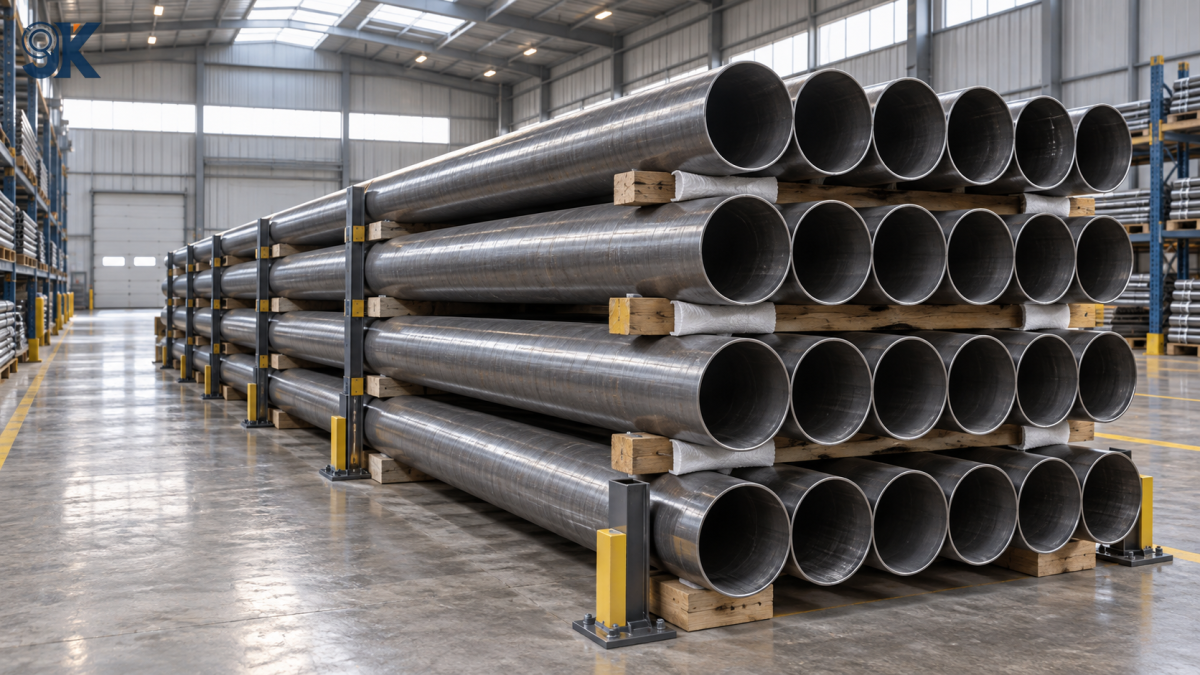
Keep pipe ends within protected storage boundaries rather than projecting into vehicle routes. Leave enough access to inspect the stack and retrieve material without dragging it across neighboring pipes. A crowded bay often creates repeated handling damage because operators must move several bundles to reach one order.
There is no universal safe stacking height. The limit depends on rack capacity, floor capacity, stack geometry, restraint, pipe condition, and handling access. Establish limits for each storage arrangement and display them where loading decisions are made. Reassess the arrangement when the product mix changes.
Separate materials where contact or contamination causes problems
Grouping stock by grade and size supports picking accuracy, but surface requirements also matter. Keep stainless steel and other contamination-sensitive products away from carbon steel grinding dust, dirty supports, and shared handling equipment that can transfer ferrous particles. Embedded iron can later produce rust staining on stainless surfaces.
Coated, galvanized, and finished mechanical tubing need contact surfaces that will not abrade or mark them. Protective pads should be clean and suitable for the load; padding filled with grit can scratch surfaces during movement.
Keep loose scrap and recycling containers outside finished-pipe storage lanes. For example, a designated bay for Copper Wire Scrap helps prevent mixed-metal debris from reaching pipe supports and handling routes. Separation also reduces opportunities for wet contact between dissimilar metals, which can accelerate corrosion under suitable conditions.
Identification deserves the same attention as physical separation. Retain clear labels after partial picking, and use marking methods compatible with the material and surface specification. Do not rely solely on paint colors or a storage location to identify a grade.
Prevent dents and end damage during lifting
Many handling defects begin when a load is picked up, especially if the lifting arrangement concentrates force on a small area. Fork edges, chains, hooks, and tight slings can damage surfaces or distort vulnerable pipe. Select lifting equipment for the load’s weight, length, balance, and required surface finish.
For forklift handling, support the load adequately, center it, and use suitable attachments where needed. Long pipe may require equipment designed to control its overhang and stability. Avoid dragging forks beneath a bundle when they can scrape the bottom pipes or displace the dunnage.
Crane handling requires a planned lifting arrangement. Sling position and angle affect both the force in the lifting gear and the pressure applied to the pipe. Spreader beams can help control sling geometry and reduce squeezing where appropriate, but the complete arrangement must suit the load. Soft slings also need protection from sharp edges.
- Establish the load weight and balance before lifting.
- Use lifting gear and attachments suitable for the load and lifting arrangement.
- Keep personnel clear of suspended loads and areas where pipes could roll.
- Set the bundle onto prepared supports without dropping or dragging it.
- Restrain pipes before cutting bands, and stay clear of the band’s recoil path.
Avoid lifting through pipe ends with hooks unless the equipment and method are specifically suitable. Thin walls, bevels, threads, and sealing faces are particularly vulnerable to localized force. Protect these features during storage as well as lifting: a damaged end can prevent fit-up even when the rest of the pipe is sound.
When rust or damage appears, decide before reworking
If corrosion is found, first stop the exposure that caused it. Cleaning one pipe while leaving the rest in wet packaging does little to control the loss. Inspect adjacent pipes, supports, straps, and internal surfaces where accessible.
Then assess the defect against the product’s requirements. Surface rust may be removable with an approved cleaning method. Pitting requires closer attention because removing rust does not restore lost metal. Coating blisters or white corrosion deposits on galvanized surfaces need a different assessment from red rust on bare carbon steel.
Mechanical damage also needs more than a cosmetic check. Dents, flattening, gouges, and bent ends may affect fit, machining, fatigue behavior, or pressure service. Do not grind out a gouge or straighten a pipe simply to improve its appearance. Rework must preserve the required dimensions, material condition, and service suitability.
Mark questionable stock clearly and prevent accidental picking. Record whether the material is accepted, assigned to controlled rework, reserved for an approved alternative use, or rejected. This keeps unresolved defects from returning to circulation during the next stock movement.
Make inspection and dispatch part of the storage plan
Inspection frequency should follow exposure and product sensitivity. Outdoor stock, bundles near doors, material beneath repaired roof leaks, and long-stored finished tubing deserve closer attention than dry stock moving quickly through a controlled area. Check after heavy rain, packaging damage, or unusual humidity changes as well as during routine rounds.
Rotate stock within the correct specification and traceability requirements. Older inventory should receive attention, but age alone should not override grade, heat identification, or order allocation. When a bundle is partly used, restore its protection, restraints, and labels before returning it to storage.
Before dispatch, inspect the condition that the customer will receive: accessible surfaces and bores, end protection, restraints, labels, and packaging. Pack dry material in dry packaging. For export shipments, consider the full journey, including staging, consolidation, port handling, and possible moisture inside the transport enclosure.
For orders coordinated by Shandong Jiukai Metal Materials Co., Ltd., preservation and packing requirements can be addressed alongside custom production, processing, warehousing, and export logistics. The useful instruction is specific: identify which surfaces need protection, the next manufacturing operation, expected storage conditions, and the packaging needed for the shipping arrangement.
Before placing the next bundle into storage, check three things: whether it is dry, whether its supports and restraints suit the load, and whether it can be retrieved without damaging nearby stock. Resolving those conditions at placement prevents many of the corrosion and handling problems that become expensive at dispatch.
Latest News
- How anti-dumping duties change market access for steel pipe exports
- How Steel Pipe Warehousing and Logistics Affect Damage Rates and Delivery Costs
- Seamless vs Welded Steel Pipe: Which Option Fits Budget and Lead Time
- ASTM and EN Standards for Carbon Steel Pipe in Pressure Systems
- When a Standard Steel Pipe Works Better Than a Custom Specification
- What to Check Before Choosing a Steel Pipe Export Supplier for Your Market
Send Us A Message

