
Steel Pipe Logistics: What Drives Freight Costs for Oversized Loads?
A steel pipe quotation can look competitive until the logistics details arrive: a flat-rack surcharge, a road permit, an additional crane lift, or destination charges that were never included. For procurement teams, the uncomfortable discovery is that the cheapest material offer does not always produce the lowest delivered cost.
Understanding Steel Pipe Logistics means looking beyond a freight rate per tonne. Pipe length, outside diameter, bundle geometry, lifting requirements, route restrictions, and equipment availability all influence the final bill. For exports from Shandong through Tianjin, Qingdao, or Rizhao, the right decision starts with a practical question: how will this exact cargo move from the supplier’s yard to your receiving facility?
“Oversized” Depends on the Entire Transport Chain
A pipe is not oversized simply because it looks large. It becomes an out-of-gauge or abnormal load when its packed dimensions or transport configuration exceed the limits of the equipment, road network, terminal, or vessel handling system being used.
A shipment may fit inside a container yet exceed the permitted road weight on part of its journey. Another may be relatively light but too long for standard enclosed equipment. Large-diameter, thin-wall pipes can occupy substantial space without approaching payload limits.
This distinction matters because weight-driven and dimension-driven shipments generate different costs. Heavy cargo may require additional vehicles, suitable axle distribution, and higher-capacity lifting equipment. Bulky cargo may require special equipment, extra vessel space, or a different shipping mode altogether.
Before requesting freight quotations, confirm the packed length, width, height, gross weight, and number of handling units. Nominal pipe dimensions alone are not enough for a reliable booking.
Where the Freight Budget Actually Goes
International freight is only one part of the movement. A useful comparison separates the quote into cost blocks rather than treating “shipping” as a single number.
Import duties, taxes, and cargo insurance also affect the purchasing budget, although they are not simply freight charges. Keep them visible as separate lines so that logistics quotations and total landed-cost comparisons remain clear.
Pipe Geometry Often Matters More Than the Tonnage
Length can determine the equipment before price negotiations begin
Standard containers offer a useful cost benchmark, but their internal dimensions, door openings, payload ratings, and floor-loading limits must all be checked. A pipe that appears to fit by nominal container length may leave insufficient room for end protection, securing, or practical loading.
Long pipes may need flat racks, suitable open-top arrangements, or breakbulk transport, depending on the dimensions and handling method. Open-top equipment does not automatically solve overlength cargo, and any out-of-gauge configuration needs carrier approval.
Shortening pipe lengths can sometimes reduce transport complexity. However, this is only sensible when the buyer’s drawings, fabrication process, and technical requirements allow it. Freight savings can disappear quickly if shorter lengths create extra welding, inspection, or material waste.
Diameter and wall thickness change cargo efficiency
Large-diameter pipes carry a significant amount of empty space. Smaller-diameter, thick-wall pipes may reach weight limits while leaving usable volume unfilled. Consequently, two orders with equal net tonnage can have very different freight costs per tonne.
Nesting smaller pipes inside larger ones can improve space use in suitable mixed-size orders. It should never be assumed, though: coating protection, extraction access, securement, identification, and handling safety need review. A compact loading arrangement has little value if the receiving team cannot unload it without damage.
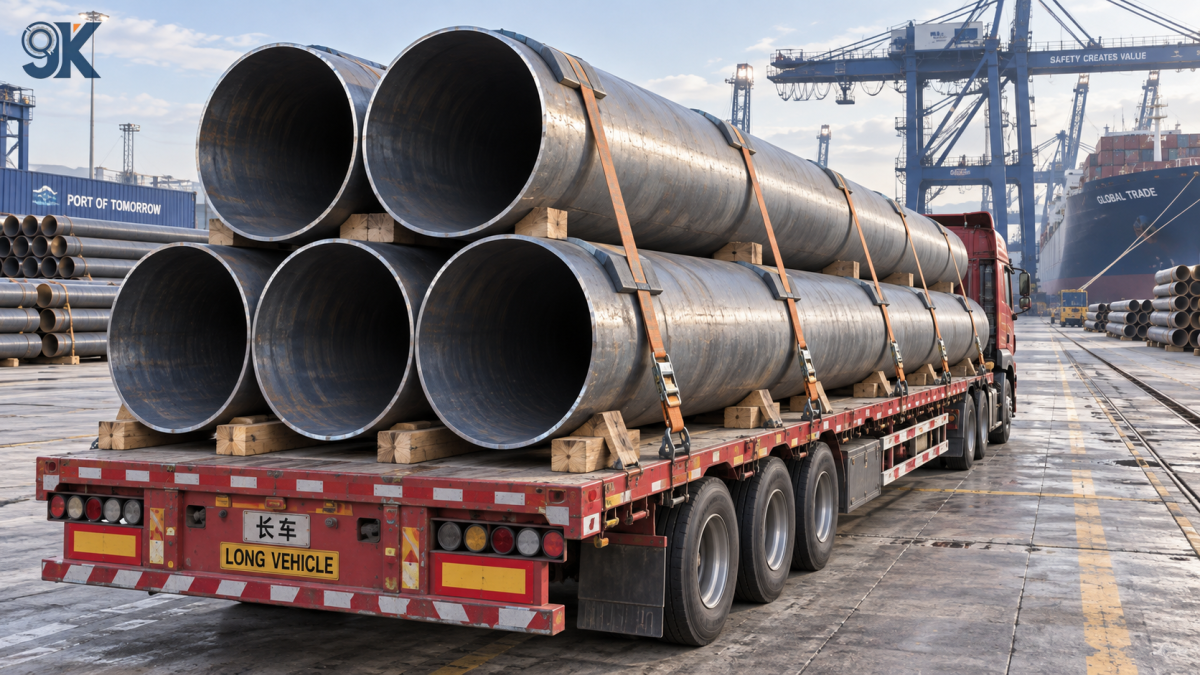
Ask for a loading sketch showing bundle positions, support points, packed dimensions, and weight distribution. It gives the supplier, forwarder, carrier, and receiving team a common reference before equipment is booked.
Choosing Between FCL, LCL, Flat Rack, and Breakbulk
The lowest headline rate is not necessarily the best option. Each shipping method prices space and handling differently, and each creates a different exposure to delays or extra charges.
- Standard FCL: Often worth evaluating first when pipes fit within approved dimensions and weight limits. Dedicated container space also reduces intermediate cargo handling, although loading and securing still require careful planning.
- LCL: Useful for some small trial orders, but long or heavy bundles may face acceptance restrictions, minimum charges, and additional warehouse handling. A small shipment is not automatically economical as LCL.
- Flat-rack or open-top equipment: Can accommodate certain nonstandard configurations. Compare equipment availability, securing requirements, out-of-gauge charges, and inland transport feasibility—not just ocean freight.
- Breakbulk: Worth considering for large, long, heavy, or substantial-volume pipe shipments. Its competitiveness depends on vessel schedules, parcel size, port capability, handling arrangements, and destination discharge conditions.
For breakbulk, clarify whether freight is calculated by weight, measurement, or another agreed basis, and request the precise calculation rule. Also establish which loading, stowage, securing, and discharge costs belong to each party. A rate cannot be compared fairly without those boundaries.
Container quotations need similar scrutiny. Special-equipment availability, carrier acceptance, and vessel space are separate issues; an indicative rate does not guarantee that all three are secured.
The Nearest Port Is Not Always the Lowest-Cost Port
For a Shandong-based supplier, Tianjin, Qingdao, and Rizhao provide different routing possibilities. The best departure port depends on the shipment and destination rather than a fixed preference.
A shorter inland haul may be offset by limited equipment supply or an indirect ocean service. A more distant port may offer a suitable sailing, better cargo-handling access, or a workable breakbulk opportunity. Equally, a cheaper ocean rate can lose its advantage if the route requires additional transfers and handling.
Compare the complete route cost: factory pickup, permits where applicable, port handling, ocean transport, destination charges, and final delivery. Then compare timing. A lower-cost sailing that misses the required production window may create a much larger purchasing problem.
For abnormal road loads, route planning deserves early attention. Bridge capacities, turning space, overhead clearance, local travel windows, and site access can influence both feasibility and price. Requirements differ by jurisdiction, so origin and destination arrangements should be confirmed separately.
Handling and Delay Charges: The Budget Risks Buyers Miss
Steel pipe is robust in service, but it can still suffer coating damage, distorted ends, or deformation during transport. Protection and securing should match the pipe specification and handling conditions, not be treated as optional extras.
Ask how pipes will be supported, restrained against rolling, and lifted without unacceptable contact damage. Thin-wall or large-diameter products may require particular attention to support spacing and lifting arrangements. Where cranes or special attachments are needed, identify who provides them at both ends.
Time-related charges deserve equal attention:
- Storage: Cargo arriving too early, or waiting for paperwork, can accumulate warehouse or terminal costs.
- Demurrage and detention: Check the applicable definitions, free-time allowances, charging periods, and rates with the carrier and terminal; terminology and application can vary.
- Vehicle or crane waiting: A missed loading slot or an unprepared receiving site can generate charges outside the original transport allowance.
- Rebooking: Late production, incorrect dimensions, or missed cutoffs may require revised transport arrangements at different rates.
The receiving plan is therefore part of procurement, not an afterthought. Confirm gate access, unloading capacity, available storage space, and appointment requirements before dispatch.
Build a Comparable Steel Pipe Logistics Quotation
Send every supplier or forwarder the same shipment information. Otherwise, the apparent price difference may simply reflect different assumptions.
- Product details: Outside diameter, wall thickness, length, quantity, surface condition, and any special protection requirements.
- Packing data: Bundle count, dimensions, net and gross weights, and any nesting proposal.
- Movement details: Pickup address, destination port, final delivery address, cargo-ready date, and required arrival window.
- Handling constraints: Loading and unloading equipment, approved lifting points where relevant, and site access limitations.
- Commercial scope: The agreed Incoterms® rule and named place or port, insurance requirements, inclusions, exclusions, and quotation validity.
A named Incoterms® rule helps allocate obligations and risk, but it does not replace a detailed charge schedule. Ask specifically about origin handling, destination handling, customs services, special-equipment fees, free time, and final unloading. “Freight included” is too vague for an oversized shipment.
For mixed steel orders, consolidation may improve equipment utilization. If you are also sourcing A36 Round Steel Bar, request a combined loading assessment rather than assuming it can simply fill spare space. Dense bar bundles can change floor loading, weight distribution, and securing requirements.
Make the Decision on Delivered Cost, Not Freight Alone
A practical comparison uses two views: total shipment cost and cost per accepted delivered tonne. The first exposes the cash commitment; the second helps compare purchasing options. Include packing and handling in the calculation, while keeping recoverable taxes separate where appropriate to your accounting treatment.
Alongside the quoted total, record unresolved items: unconfirmed equipment, provisional destination charges, pending route approval, or uncertain unloading arrangements. These are not necessarily reasons to reject an option, but they are reasons to avoid treating its price as final.
Shandong Jiukai Metal Materials Co., Ltd. combines custom production, deep processing, warehousing, logistics, and export customs clearance. For procurement teams, coordinating these stages allows transport constraints to be reviewed while specifications and packing arrangements can still be adjusted. Its access to shipping options through Tianjin, Qingdao, and Rizhao supports evaluation of FCL, LCL, and bulk shipping for different order sizes.
The most useful next step is not simply to request a cheaper freight rate. Request a transport plan tied to your actual pipe dimensions, delivery location, and receiving conditions—with the equipment, route, handling scope, and exclusions clearly stated. That is how an attractive purchase price becomes a dependable delivered-cost budget.
Latest News
- How anti-dumping duties change market access for steel pipe exports
- How Steel Pipe Warehousing and Logistics Affect Damage Rates and Delivery Costs
- Seamless vs Welded Steel Pipe: Which Option Fits Budget and Lead Time
- ASTM and EN Standards for Carbon Steel Pipe in Pressure Systems
- When a Standard Steel Pipe Works Better Than a Custom Specification
- What to Check Before Choosing a Steel Pipe Export Supplier for Your Market
Send Us A Message

