
How to prevent coating damage during steel pipe logistics operations
Prevent coating damage during steel pipe logistics by keeping abrasive surfaces away from the pipe, distributing contact pressure, and stopping movement between pipes and their supports. Establish these controls before lifting begins, then maintain them through storage, securing, transport, and unloading. A padded trailer still causes damage if grit is trapped under the padding or pipes slide across it during braking.
Start with the coating specification and the actual handling conditions. Galvanized surfaces, fusion-bonded epoxy, polyethylene systems, and painted finishes respond differently to pressure, friction, temperature, and moisture. Record the coating condition before dispatch so that fresh damage can be identified at each transfer point.
Release the coating for handling before arranging the lift
A coating that feels dry is not necessarily ready for slings, stacking, or transport restraints. Painted systems require sufficient cure for the expected contact pressure; the relevant release condition comes from the coating manufacturer's instructions. Loading too early leaves sling impressions, flattened areas, or bonded packaging even when no obvious scratch appears.
Separate the following conditions when deciding whether pipes are ready to move:
- Freshly applied paint: confirm the permitted handling and stacking conditions. Surface dryness alone does not establish resistance to sustained pressure.
- Polymer-coated pipe: consider the expected surface temperature during loading and transport. Heat can soften some systems and increase indentation under narrow supports.
- Galvanized pipe: keep contact surfaces clean and provide drainage and ventilation. Moisture trapped between closely packed surfaces encourages wet storage staining.
Also inspect coating transitions, weld seams, pipe ends, and any specified cutback areas. An intentionally uncoated end is different from accidental coating loss. Packaging must preserve the specified end condition without rubbing the adjacent coating edge or trapping water beneath a loose cover.
Control pressure and movement at every lifting point
Use lifting equipment with suitable capacity, geometry, and clean contact surfaces. Wide synthetic slings are commonly suitable for coated pipes, but their width alone does not guarantee protection. Embedded metal fragments, hardened paint, damaged stitching, or grit turn a soft sling into an abrasive contact point. Inspect and clean the surfaces that will touch the coating before each lift.
Sling position matters as much as sling material. Support the pipe so that it remains balanced without excessive bending or sling migration. A shallow sling angle increases sling tension and can increase squeezing forces. Where pipe length, bundle configuration, or coating sensitivity requires it, use a correctly selected spreader beam to maintain suitable lifting geometry.
Avoid bare chains and wire ropes directly against the coated surface. Any protective sleeve must remain between the lifting gear and the pipe throughout the lift; a sleeve that slips aside provides no protection at the exposed point. Do not assume a textile sling makes a choke arrangement acceptable for every coating or bundle configuration.
Lift clear before travelling. Dragging a pipe off a rack, pulling it from beneath another pipe, or letting it slide through a sling produces long scratches that padding cannot prevent. Lower the load onto prepared supports, release its weight fully, and withdraw the lifting gear without scraping it along the surface.
Forklift handling requires particular attention because forks create concentrated contact and can strike the underside of a pipe before the contact point is visible. Use a suitable attachment or secured protective contact surfaces, approach squarely, and prevent rolling. Never rely on loose padding that can fall away as the forks enter.
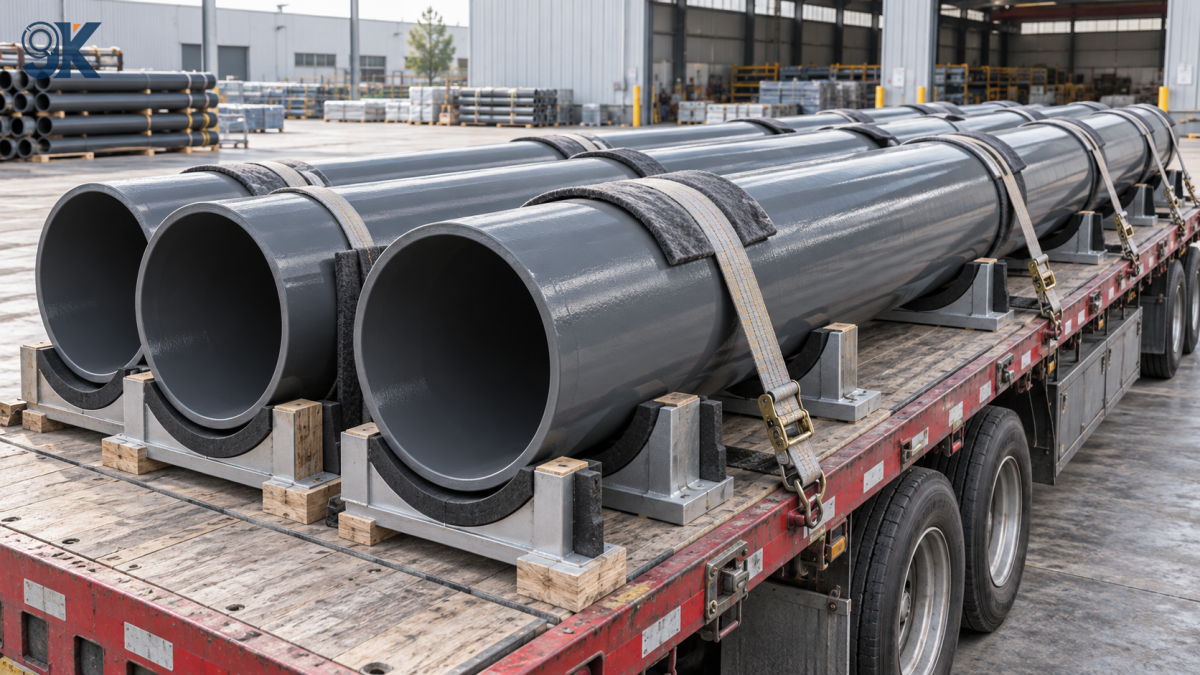
Build the support arrangement around the pipe
Prepare the storage rack, trailer bed, or container floor before bringing the load into position. Remove welding spatter, projecting fasteners, sharp edges, loose scale, and debris. A small hard particle under a heavily loaded pipe can penetrate a coating even when the surrounding support is smooth.
Choose dunnage and padding for their load-bearing behavior as well as their surface softness. Material that compresses excessively allows the pipe to settle onto a hard edge; material that absorbs water keeps moisture against the coating. Use clean, stable supports with compatible contact layers, and avoid treated timber or packaging materials where their chemicals could affect the finish.
Support spacing must suit pipe length, diameter, wall thickness, bundle weight, and the permitted deflection. Thin-wall pipe requires particular care because local deformation can strain the coating even without an external scratch. Use the loading plan or engineering assessment to establish the arrangement rather than copying support positions from a different shipment.
Where stacks use dunnage between layers, align the supports vertically so that the load transfers through a stable path. Misaligned supports introduce bending and uneven contact pressure. Secure chocks or cradles against displacement, and keep sharp fastening points outside the pipe contact area.
Direct contact between coated pipes deserves separate attention. Road vibration produces repeated rubbing at narrow contact lines, especially where a bundle has room to settle. Use suitable separators where required, making sure they remain in position during handling. Recheck the arrangement when changing pipe diameter or bundle shape; separators that worked for one load can leave another insufficiently supported.
Secure the load without crushing the finish
Load restraint must prevent movement under the transport conditions while respecting the coating's contact-pressure limits. Over-tightening a narrow restraint can mark or cut the finish. Insufficient restraint allows rolling, sliding, and repeated abrasion. Resolve both requirements through the support and restraint arrangement rather than trying to correct poor positioning with extra tension.
Place suitable protective saddles or pads wherever restraints bear on coated surfaces. They should spread pressure, resist displacement, and remain compatible with the coating. A thin cloth wrapped around a hard corner offers little protection against concentrated loading.
Packaging bands and transport lashings have different functions. A band that keeps a bundle together does not automatically provide adequate restraint for the vehicle or container. Keep band buckles, clips, and cut ends away from coated surfaces, and use a restraint plan appropriate to the load and transport mode.
After initial securing, examine contact areas for squeezed-out padding, displaced separators, pipe rotation, or coating impressions. Where the transport procedure permits and requires it, reassess restraint tension after initial settling. Tightening a restraint without investigating a shifted bundle can conceal a support failure.
Adapt packaging to the route and neighboring cargo
Full-container, shared-container, and open-deck movements expose coatings to different damage mechanisms. A full container offers greater control over neighboring cargo, but restricted access makes internal contact points difficult to inspect after loading. Shared loads introduce changing cargo interfaces and additional handling. Open transport increases exposure to rain, road contamination, and cover movement.
In mixed loads containing products such as DX51D+Z/DC51D+Z (CR) Galvanized Corrugated Plate, isolate sheet edges, bundle straps, and projecting corners from coated pipes. Secure each cargo group independently so that movement in one package cannot drive an edge into the adjacent pipe coating.
Wrapping should address the actual exposure. Abrasion-resistant covers help at rubbing points, while weather protection requires an arrangement that sheds water without holding it against the steel. Impermeable wrapping around damp pipes traps moisture; loose tarpaulins repeatedly strike or rub the finish during travel. Load pipes in a suitable dry condition and secure covers clear of abrasive contact.
For galvanized surfaces, distinguish mechanical coating loss from white corrosion products caused by retained moisture. These conditions require different responses. Ventilated packing and drainage address moisture retention, while improved separation and restraint address rubbing. Adding tighter plastic wrapping to a wet bundle can worsen the storage condition.
Keep storage duration in view. Packaging adequate for a short covered transfer might not suit extended outdoor storage or a voyage with condensation cycles. State the intended storage conditions in the handling instructions so that temporary packaging is not treated as long-term protection.
Use damage patterns to find the failed contact point
Inspection becomes more useful when the mark is connected to a physical cause. Photograph suspect areas before moving padding or releasing restraints, where access is safe. Include the pipe identification, the contact arrangement, and a close view of the defect so that location and mechanism remain traceable.
Appearance alone cannot establish acceptance. A superficial scuff, exposed steel, coating disbondment, and a dent beneath intact coating have different implications. Use the project requirements and coating repair procedure to determine the necessary assessment. Electrical holiday testing applies only to suitable nonconductive coating systems and must use the specified equipment and settings.
Prepare unloading before restraints are released
A protected shipment can still be damaged during its final lift. Confirm that the receiving area has suitable supports, sufficient clearance, and compatible lifting equipment before unloading begins. Provide the lifting arrangement and pipe weights with the shipment information so that equipment selection does not depend on guesswork at arrival.
Inspect the load for shifted pipes, slack restraints, damaged chocks, and water accumulation before releasing anything. Restraints can be holding an unstable pipe in place. Establish how the load will remain supported and restrained during unloading, and release components in the planned sequence. Keep clear of potential rolling paths and suspended loads.
Once the pipes are safely supported, compare their condition with the dispatch record. Include accessible underside contact areas in the inspection; viewing only the upper surface misses damage from dunnage and forks. Record any newly exposed defect before stacking makes it inaccessible.
If coating damage is found, identify and segregate the affected pipe, preserve traceability, and apply the approved assessment and repair process. Cleaning and surface preparation, compatible repair material, permitted repair extent, and curing conditions all affect whether a local repair is acceptable. Do not cover exposed steel with an arbitrary paint simply to restore its appearance. Release the repaired area for further handling only after the specified acceptance conditions are met.
Latest News
- How anti-dumping duties change market access for steel pipe exports
- How Steel Pipe Warehousing and Logistics Affect Damage Rates and Delivery Costs
- Seamless vs Welded Steel Pipe: Which Option Fits Budget and Lead Time
- ASTM and EN Standards for Carbon Steel Pipe in Pressure Systems
- When a Standard Steel Pipe Works Better Than a Custom Specification
- What to Check Before Choosing a Steel Pipe Export Supplier for Your Market
Send Us A Message

