
FOB vs. CIF: How to Compare Steel Pipe Export Quotes Beyond Unit Price
FOB vs. CIF: How to Compare Steel Pipe Export Quotes Beyond Unit Price
A lower unit price does not always mean a better steel pipe deal. When comparing FOB and CIF offers, procurement teams need to look beyond the headline figure to understand freight charges, insurance coverage, destination fees, and where shipping risk transfers. A useful Steel Pipe Export comparison puts both offers on the same cost basis, then checks whether the proposed shipment actually fits the material and the delivery schedule.
This matters for both trial batches and recurring orders. A small shipment can attract disproportionate handling charges, while a full-container order can lose its apparent price advantage through poor loading assumptions or unexpected destination costs. The better quote is the one whose costs and responsibilities you can verify—not simply the one with the lowest number beside “USD/MT.”
FOB and CIF separate cost from risk
Under Incoterms® 2020, FOB and CIF are rules for sea and inland waterway transport. Both place the delivery and risk-transfer point onboard the vessel at the port of shipment. The important difference is who arranges and pays for the main carriage and insurance.
With FOB, named port of shipment, the seller clears the goods for export and delivers them onboard the buyer-nominated vessel. The buyer arranges the ocean freight and decides how to insure the shipment. With CIF, named port of destination, the seller also contracts and pays for carriage and the required cargo insurance to the named destination port.
CIF does not mean the seller carries transit risk until arrival. Risk still transfers onboard at origin. If pipes arrive wet, bent, or short, responsibility depends on the cause, the sales contract, transport documents, and insurance—not just the fact that the invoice says CIF. Neither term, by itself, determines ownership transfer or payment timing.
Write the full term into the quotation and purchase order, such as “FOB Qingdao, Incoterms® 2020” or “CIF [named destination port], Incoterms® 2020.” For containerized cargo handed to a terminal before vessel loading, discuss whether FCA better matches the actual handover. Using FOB out of habit can leave an awkward gap between operational control and contractual responsibility.
Normalize the pipe specification before the freight
A freight comparison is wasted effort if the underlying material offers are different. For machinery manufacturing, a nominally similar pipe may not be interchangeable once wall-thickness tolerances, straightness, surface condition, or machining allowances are considered.
Put the agreed grade, manufacturing route, applicable standard, outside diameter, wall thickness, and length on one comparison sheet. Include end preparation, coating or oiling, testing, inspection documents, and any cutting or other processing. If a drawing governs acceptance, identify its revision. Do not leave critical requirements inside an email thread that never reaches the production order.
Then check the invoicing basis. Is the quotation per metric tonne of actual net weight, theoretical weight, or gross packed weight? How are quantity tolerances settled? A theoretical-weight price and an actual-weight price should not be ranked without reconciling their calculation methods. Likewise, cheaper random lengths can become more expensive than cut lengths after machining scrap and local handling are included.
Build one landed-cost sheet, not two price columns
Compare both offers through to the same endpoint, ideally the receiving warehouse. A CIF port price is not a delivered-to-factory price. Conversely, a FOB price is not incomplete or uncompetitive merely because ocean freight appears separately.
Under CIF, some destination unloading costs may already sit within the seller’s carriage contract. Others remain payable by the buyer. Request an explicit breakdown rather than assuming either that everything is included or that every local charge is additional. This prevents both omissions and double counting.
Keep recoverable import taxes separate from nonrecoverable costs, while still allowing for their cash-flow effect. Duties and trade remedies need checking against the actual classification, origin, product description, and destination rules. A generic “steel pipe duty” assumption is not a reliable budget.
The loading plan can change the winning quote
Steel pipe freight depends on more than tonnage. Length, bundle dimensions, diameter, nesting possibilities, and lifting requirements all affect the shipment. Thick-wall pipe may reach weight limits before filling the available space; large-diameter thin-wall pipe may consume space much faster than weight capacity.
Ask for a packing list estimate and loading proposal before treating a freight figure as firm. Check container payload and inland road restrictions, not just nominal equipment capacity. Long lengths may require different equipment or bulk handling, and the receiving site must be able to unload them safely.
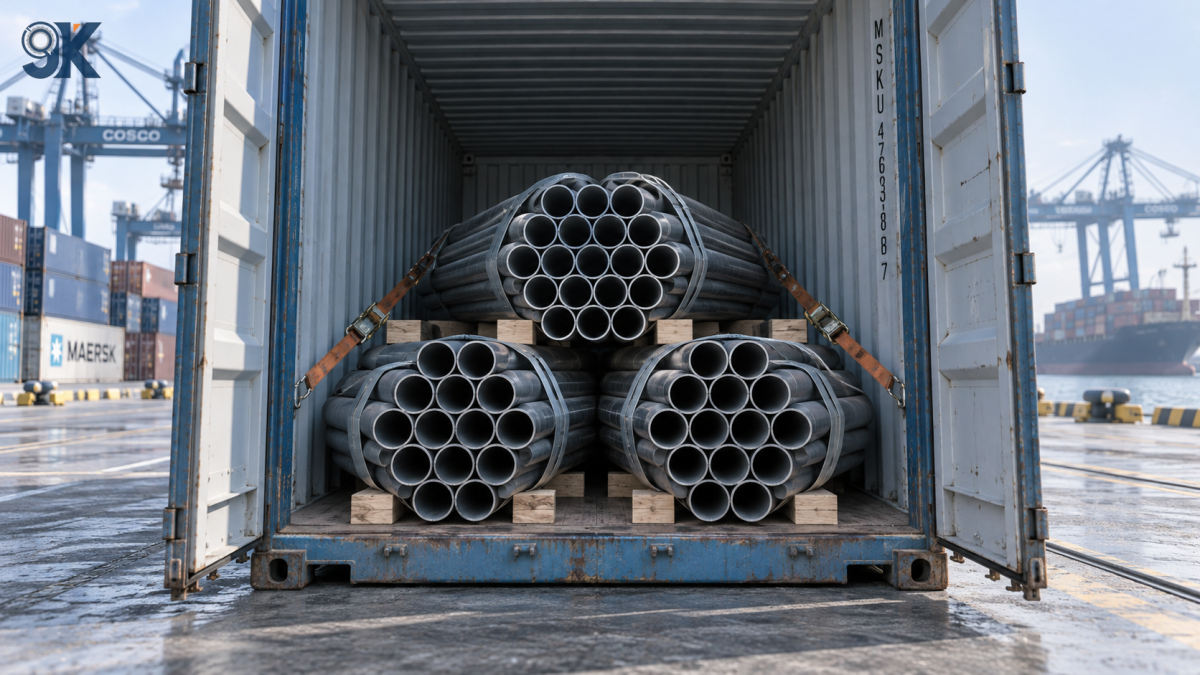
For a small trial order, LCL can look attractive because the buyer avoids paying for a whole container. However, consolidation, destination warehouse handling, and additional cargo movements can offset that saving. Confirm how freight is assessed, whether the consolidator accepts the bundle dimensions and weight, and what protection is provided during handling.
Mixed-material purchasing adds another complication. If an order also includes 1070 Aluminum Coil, do not assume pipe and coil can share a loading arrangement without review. Their support, separation, restraint, and surface-protection requirements differ. Any consolidation saving should be evaluated after a workable packing plan exists.
Read the insurance scope against likely pipe damage
Under CIF in Incoterms® 2020, the default insurance requirement is minimum cover corresponding to Institute Cargo Clauses (C) or similar clauses, unless otherwise agreed. The required insured amount is generally at least 110% of the contract price. That percentage describes the insured value; it does not mean every type of damage is covered.
For steel pipes, ask specifically about wet damage, rust, handling damage, and exclusions relating to insufficient packing or pre-existing condition. Even broader cover remains subject to policy wording and exclusions. Surface condition also matters commercially: light oxidation that is tolerable before further processing may be unacceptable on a finished component.
Request the proposed insurance wording before shipment, not merely a promise that insurance is included. Confirm that the buyer can claim, where a survey can be arranged, and what notification deadlines apply. Packing photographs, loading records, bundle identification, and a documented receiving inspection can help establish what happened if damage is discovered.
Choose logistics control deliberately
FOB often suits buyers with established forwarders, dependable destination agents, and enough shipment volume to manage freight purchasing effectively. It gives the buyer more direct control over carrier selection, routing, and booking changes. That control has value only if someone is available to manage it.
CIF can be practical when the supplier has stronger origin-side coordination or the buyer wants fewer booking tasks. Still, ask for the proposed carrier, route, destination agent, and estimated transit time. A lower freight cost may involve a less convenient schedule or transshipment. Neither term alone guarantees an arrival date.
For Shandong sourcing, compare the whole route through Qingdao, Tianjin, or Rizhao rather than selecting a port solely by ocean freight. Inland haulage, suitable sailings, equipment availability, and shipment type can change the result. Shandong Jiukai Metal Materials Co., Ltd. combines production, processing, warehousing, logistics, and export customs-clearance services, with FCL, LCL, and bulk shipping options. In a quote evaluation, those capabilities should translate into a specific loading plan, document schedule, and named contact—not just a broad service description.
Documentation deserves particular attention. Agree when draft bills of lading, packing lists, commercial invoices, and required inspection or origin documents will be reviewed. Clarify whether payment and document-release arrangements could delay cargo collection. Competitive freight does little good if the goods arrive before the buyer can obtain release.
Before approving the purchase order
Ask each bidder to return the same short clarification sheet: exact material scope, weight basis, named Incoterm and port, packing method, shipment mode, freight validity, destination exclusions, insurance scope, and production readiness. Separate “ready for shipment” from vessel departure and estimated arrival; these are different milestones.
Then test the unresolved items. Would a booking delay require a freight revision? Is adequate free time confirmed for customs clearance and inland collection? Who pays if extra storage results from late seller documents? Put material answers into the contract rather than relying on informal assurances.
Choose FOB when your freight arrangement gives a clearer, better-controlled total cost. Choose CIF when the supplier’s carriage and insurance package is competitive and transparent. If a quotation still leaves the loading method, destination charges, or claims process unclear, it is not yet ready for approval—however attractive its unit price looks.
Latest News
- How anti-dumping duties change market access for steel pipe exports
- How Steel Pipe Warehousing and Logistics Affect Damage Rates and Delivery Costs
- Seamless vs Welded Steel Pipe: Which Option Fits Budget and Lead Time
- ASTM and EN Standards for Carbon Steel Pipe in Pressure Systems
- When a Standard Steel Pipe Works Better Than a Custom Specification
- What to Check Before Choosing a Steel Pipe Export Supplier for Your Market
Send Us A Message

