
Export Customs Clearance for Steel Pipe: Documents to Check Before Shipping
A steel pipe order can be ready for dispatch and still miss its shipping window because the invoice describes one specification, the packing list shows another, and the customs declaration uses a third. For procurement teams, Export Customs Clearance begins with document consistency—not with the truck arriving at the port.
Before steel pipes leave China, buyers should verify the commercial invoice, packing list, declaration data, and any shipment-specific certificates or permits. Quality documents also deserve attention: they may not be mandatory for every customs filing, but missing or mismatched certificates can interrupt payment, destination clearance, or acceptance at the factory.
The practical question is not simply “Does the supplier have the documents?” It is “Do the documents accurately describe the same goods, and are they suitable for this shipment?”
Separate export requirements from purchase and destination requirements
A document requested by your purchasing department is not automatically a Chinese export customs requirement. Equally, successful export clearance does not prove that the pipes satisfy the importing country’s technical regulations.
Organize the document review around three purposes:
- China export filing: declaration information and supporting commercial documents, plus licenses, inspection evidence, or other regulatory documents where applicable.
- Transport and payment: shipping instructions, transport documents, insurance where required, and documents specified by the sales contract or letter of credit.
- Destination entry and product acceptance: origin evidence, applicable conformity documentation, material certificates, and any importer-specific approvals.
Some documents serve more than one purpose. Agree with the supplier, freight forwarder, and destination broker which documents must be ready before declaration, before loading, or after departure. A final bill of lading, for example, is normally issued later; its draft data should still be checked in advance.
The core document check for steel pipe shipments
Commercial invoice: make the description technically usable
“Steel pipe” alone rarely gives a broker enough information to assess classification confidently. The supporting description should identify the relevant characteristics: seamless or welded manufacture, material category, section shape, dimensions, and intended application where classification requires it.
Confirm the ordered standard and grade against the purchase order. If several sizes or grades are supplied, separate invoice lines usually make reconciliation easier than a single combined description. Detailed schedules can support the invoice, provided the references between documents are clear.
Check the named place or port alongside the Incoterms rule and edition. Where the invoice price includes freight or insurance, the declaration team should have the breakdown needed for the applicable reporting basis. Do not assume that the commercial total can be copied into every declaration field unchanged.
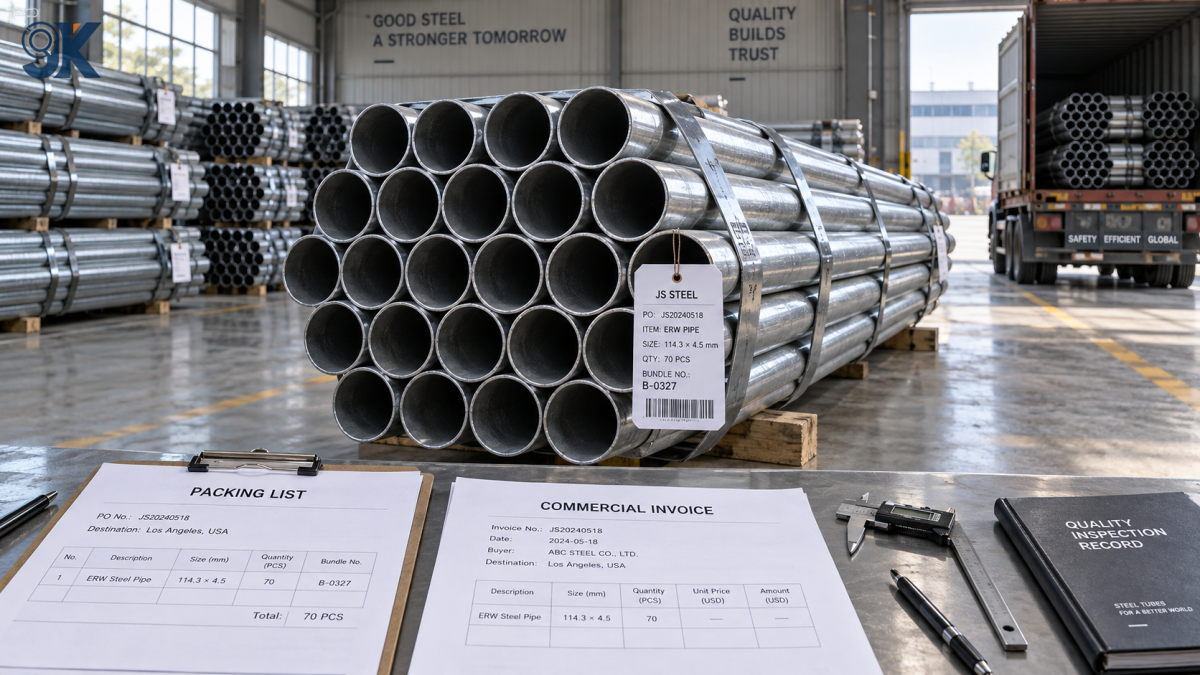
Packing list: reconcile pieces, bundles, and weight
Steel pipes are commonly sold by weight, manufactured by length, and handled by bundle. That creates several opportunities for apparently minor differences.
Ask whether invoice quantities use actual weighed mass or an agreed theoretical basis. Actual net weight, theoretical weight, and gross shipping weight are not interchangeable. Gross weight includes packaging; net weight should reflect the goods themselves. Any different measurement bases must be identified rather than silently mixed.
For mixed-size orders, a useful packing list records bundle marks, specification, length, piece count, and weight. It should distinguish fixed-length from random-length supplies and show accessories separately where applicable. Buyers then have a practical record for receiving inspections, not merely a document for the port.
Classification is a technical decision, not a copy-and-paste task
Incorrect tariff classification can cause declaration amendments, examination, or delays. Steel tubes and pipes may fall under different headings depending on construction, material, cross-section, and other characteristics. Headings such as 7304, 7305, and 7306 cover different categories, but these references are only a starting point—not a classification instruction.
Ask the exporter or appointed broker to confirm the current Chinese commodity code and required declaration elements for the exact goods. The destination broker should separately confirm the importing country’s classification. National code extensions and reporting requirements may differ even where the initial Harmonized System digits align.
Provide technical evidence rather than relying on a trade name: manufacturing method, material specification, outside diameter, wall thickness, section shape, and relevant application details. Deep processing also matters. Threading, fittings, or fabrication may require further classification review depending on the condition of the exported article.
The distinction becomes especially important when an order includes different product forms. A separately purchased item such as S235JR Carbon Steel Strip should not be merged into a pipe line merely because both are steel products. Strip and finished pipe require their own classification review, descriptions, and supporting quality records.
Before each shipment, confirm whether the applicable code and product trigger export licensing, inspection, export duties, or other controls. These requirements can change; an earlier shipment is not sufficient evidence of current treatment.
Material certificates: verify the evidence behind the grade
A material certificate is not a universal export customs permit. Nevertheless, it is often essential to the purchasing contract and may support technical assessment or destination compliance.
Start with the specified product standard, including its edition where contractually relevant. ASTM, EN, API, and GB references are not interchangeable labels. A broadly similar chemical composition does not establish full equivalence in manufacturing requirements, mechanical properties, testing, or permitted tolerances.
What an EN 10204 requirement actually means
If the purchase order requires an EN 10204 inspection document, confirm the exact type. A Type 3.1 inspection certificate includes specific inspection results and validation by the manufacturer’s authorized inspection representative independent of the manufacturing department. Type 3.2 involves additional validation under the standard’s requirements; it is not simply a more detailed 3.1 certificate.
Neither type should be assumed unless agreed and available for the supplied material. A generic certificate of conformity or distributor statement is not automatically an acceptable substitute.
For each material certificate, check:
- The manufacturer and certificate identity.
- The product standard, grade, dimensions, and delivery condition.
- Heat or cast numbers and any relevant lot identifiers.
- Required chemical, mechanical, and other test results.
- Validation appropriate to the specified document type.
Then connect the certificate to the cargo. For example, if a packing list identifies bundles B01–B08, the supporting traceability records should show which heat numbers those bundles contain. Loose certificates with no link to bundle markings offer limited reassurance when the goods arrive.
Where pipes have been cut, machined, coated, or otherwise processed, confirm how original material identification has been preserved. The documents should also distinguish original mill testing from inspections performed after processing.
Origin, conformity, and permits: check the route before booking
A certificate of origin may be requested for customs treatment, contractual purposes, or trade-policy checks. If preferential tariff treatment is intended, the goods must satisfy the relevant agreement’s origin rules, and the origin evidence must meet its requirements. Shipment from China alone does not establish eligibility.
Ask the destination broker whether invoice wording, shipment routing, exporter information, or certificate timing could affect acceptance. Do this before issuing the final document set.
Technical conformity needs the same early attention. Steel pipe is not subject to one universal international certification requirement. Requirements depend on the destination, product scope, and use—for example, structural, pressure, or general mechanical applications. CE marking should not be requested or represented as a blanket requirement for every pipe shipment to Europe.
Where the destination applies trade-remedy measures, confirm whether the product falls within their legal scope. A tariff code alone may not resolve that question. Origin and manufacturer information may also matter, and Chinese export clearance does not settle the importer’s duty exposure.
A workable pre-shipment release sequence
Procurement teams do not need to prepare the customs declaration themselves. They do need a clear approval process that catches errors before amendments become expensive.
- Set the requirements when placing the order. Agree on document types, language, originals or electronic copies, inspection requirements, and any letter-of-credit wording.
- Review a draft pack before cargo dispatch. Compare the invoice, packing list, declaration data, and available certificates against the purchase order.
- Reconcile the physical shipment. Verify bundle marks, final quantities, actual weights, packaging dimensions, and container or bulk-loading arrangements.
- Close outstanding regulatory questions. Obtain confirmation from the relevant brokers on classification, permits, origin evidence, and destination requirements.
- Control the final versions. Approve one coordinated document set and circulate amendments to every party using the affected information.
Timing depends on the port, carrier, and shipment mode. FCL movements require attention to container details and applicable verified gross mass deadlines; LCL cargo must meet the consolidator’s receiving requirements; bulk shipments need suitable cargo lists and loading coordination. Confirm the actual cutoffs rather than relying on a standard lead time.
Keep one shipment record from production to departure
For buyers sourcing through Shandong Jiukai Metal Materials Co., Ltd., the company’s integrated production, deep processing, warehousing, logistics, and export customs clearance services provide a basis for coordinating these checks. Its independent import and export rights and shipping options through Tianjin, Qingdao, and Rizhao support different order sizes and transport arrangements.
The useful purchasing approach is to request a shipment-specific document matrix: who prepares each document, who reviews it, when it becomes final, and which reference connects it to the goods. That is particularly valuable when processing changes lengths, bundle composition, or shipping weights after the original order confirmation.
Before authorizing dispatch, ask one final question: Can the broker, carrier, and receiving team identify the same goods from this document set without guessing? If the answer is yes—and the applicable regulatory checks are complete—the shipment is better prepared for export clearance and for acceptance at its destination.
Latest News
- How anti-dumping duties change market access for steel pipe exports
- How Steel Pipe Warehousing and Logistics Affect Damage Rates and Delivery Costs
- Seamless vs Welded Steel Pipe: Which Option Fits Budget and Lead Time
- ASTM and EN Standards for Carbon Steel Pipe in Pressure Systems
- When a Standard Steel Pipe Works Better Than a Custom Specification
- What to Check Before Choosing a Steel Pipe Export Supplier for Your Market
Send Us A Message

