ASTM A53 vs. A106 Carbon Steel Pipe: Which Fits High-Temperature Service?
ASTM A53 vs. A106 Carbon Steel Pipe: Which Fits High-Temperature Service?
Selecting Carbon Steel Pipe for high-temperature service requires more than matching dimensions and grades. ASTM A53 and ASTM A106 may appear interchangeable, but their manufacturing requirements, testing provisions, and intended applications can affect specification decisions. The question is not simply which standard handles more heat, but which meets the applicable design code, operating conditions, and documentation requirements.
For elevated-temperature process piping, ASTM A106 is generally the more direct specification because it specifically covers seamless carbon steel pipe for high-temperature service. ASTM A53 is not automatically unsuitable, however. Its acceptability depends on the grade, manufacturing type, governing code, and calculated design conditions. Neither designation provides a universal maximum operating temperature.
The difference starts with specification scope
ASTM A53/A53M covers black and hot-dipped zinc-coated steel pipe, both welded and seamless. Its scope includes mechanical and pressure applications, as well as ordinary uses involving steam, water, gas, and air lines. That broad coverage makes A53 common in plant utilities and general industrial piping, but “A53 pipe” alone is an incomplete engineering description.
ASTM A106/A106M covers seamless carbon steel pipe for high-temperature service. It is commonly specified for steam and hot process lines where the piping design calls for this material. Its scope is a better starting point for those duties—not a substitute for checking allowable stress, wall thickness, or fluid compatibility.
Use the project-specified editions when reviewing these requirements. A purchase order that omits the edition, grade, or manufacturing route leaves room for a technically different product to be offered.
Why matching Grade B does not establish equivalence
A frequent substitution argument is that A53 Grade B and A106 Grade B have the same minimum tensile and yield strengths. Their specified minimum values are indeed commonly listed as 60,000 psi tensile strength and 35,000 psi yield strength. Those room-temperature properties do not establish identical manufacturing controls, chemistry, or elevated-temperature design performance.
For example, A106 includes a minimum silicon requirement, while the chemistry provisions of A53 differ. Heat-treatment requirements also depend on the specification and manufacturing route. Cold-drawn A106 pipe requires heat treatment after the final cold-drawing pass; hot-finished material follows different provisions. A generic description such as “seamless, Grade B” does not capture those distinctions.
Seamless construction removes the longitudinal weld seam from consideration, which can simplify material selection for some demanding services. It does not eliminate other risks: wall eccentricity, surface imperfections, incorrect heat treatment, or lost traceability can still make seamless pipe unacceptable. Conversely, properly specified welded pipe is not inherently unsuitable for every elevated-temperature application.
The practical rule is straightforward: compare the complete material designation and code listing, not just the grade letter or room-temperature strength.
Temperature suitability comes from the piping design
There is no responsible single-number answer to “How hot can A106 run?” A material specification defines the supplied product. The governing design code establishes how that material may be used under pressure at temperature. Depending on the installation, the relevant framework may be ASME B31.1, ASME B31.3, or another project-approved code.
Start with the design metal temperature and design pressure, not merely the normal fluid temperature. Startup, shutdown, steam-out, tracing, and credible upset conditions may change the design basis. External heating can also make pipe metal temperature different from the bulk fluid temperature.
The calculation then needs the allowable stress for the exact material at the design temperature, together with the applicable coefficients, manufacturing tolerance, corrosion allowance, and any required weld-related factors. Two pipes with the same nominal diameter and schedule should not be treated as interchangeable until these inputs have been checked.
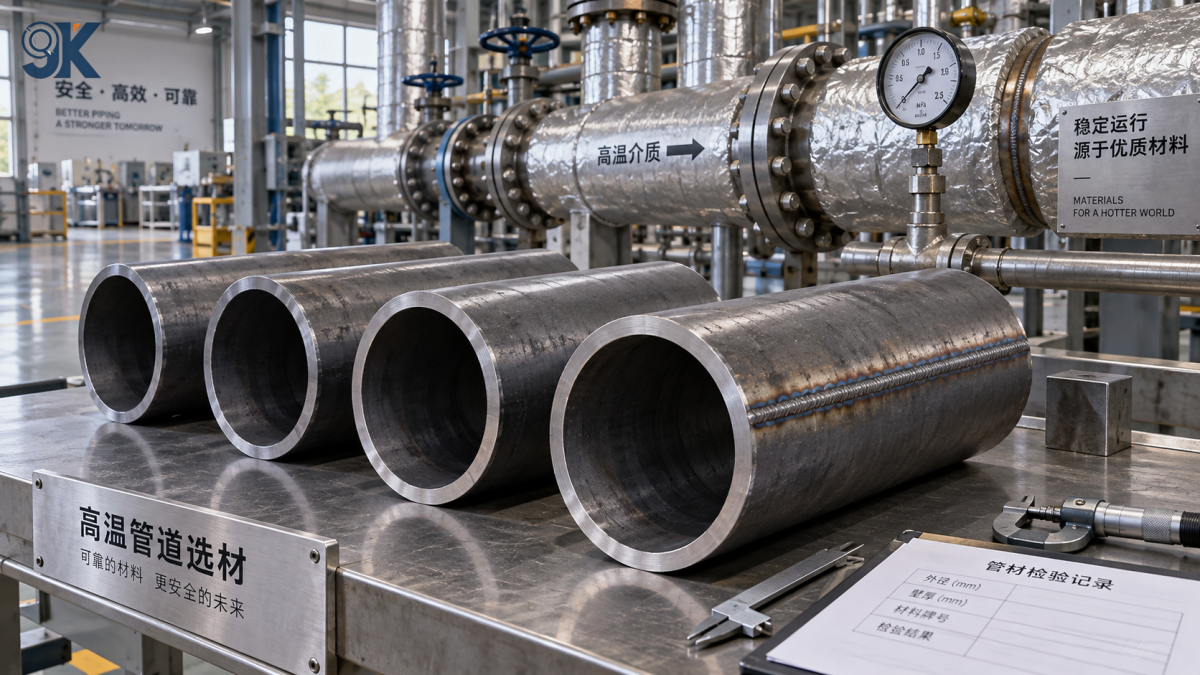
For sustained high-temperature operation, time-dependent damage becomes relevant. Graphitization, creep, oxidation, or process-specific corrosion may limit carbon steel suitability before a buyer expects it. Hydrogen-containing service requires a separate materials assessment; specifying A106 alone does not establish resistance to high-temperature hydrogen attack.
If the design approaches the practical limits of carbon steel, increasing wall thickness is not necessarily the answer. The appropriate response may be an alloy steel or another material system, selected through the applicable code and damage-mechanism review.
Where each specification makes sense
For a hot process line whose piping material class explicitly requires A106 Grade B, an A53 Grade B offer is a proposed substitution—not an equivalent supply by default. Even A53 seamless pipe needs engineering review against the specified requirements. Any acceptance should be documented through the project’s deviation process.
For a utility line operating under less demanding conditions, A53 may be entirely appropriate when the governing code and piping class permit the supplied type and grade. Specifying A106 everywhere can add cost or restrict availability without resolving an actual design need. The better decision follows the service conditions rather than a blanket preference for seamless pipe.
Dual-certified material can offer procurement flexibility, but the certificate must demonstrate compliance with both specifications. A distributor’s description of “A53/A106 equivalent” is not dual certification. Review the original material test report, marking, manufacturing route, and applicable test results before accepting that claim.
Coating also deserves a separate decision. The availability of galvanized A53 does not mean zinc coating is suitable for the proposed hot service, welding procedure, or process fluid. Pressure-boundary material selection and coating selection should be evaluated independently.
Testing and traceability: check what the certificate actually proves
A hydrostatic test or nondestructive examination is valuable, but neither establishes a pipe’s high-temperature pressure rating. These examinations address specified acceptance criteria under defined test conditions. They do not replace design calculations or demonstrate long-term resistance to creep and corrosion.
The required test route depends on the standard, product characteristics, and purchase-order provisions. Avoid assuming that every pipe has received both hydrostatic testing and full-body ultrasonic examination. If a project requires particular examination methods, supplementary requirements, or witnessed inspection, state them before production.
A useful receiving review connects the physical pipe to its documentation:
- Confirm the specification, edition, grade, dimensions, and manufacturing route against the purchase order.
- Match heat numbers and markings to the material test report, including after cutting or processing.
- Review chemistry, mechanical results, heat-treatment information where applicable, and recorded examination results.
- Check required inspection-document format and any project-specific certification provisions.
- Record deviations before releasing material for fabrication.
Traceability becomes especially vulnerable when stock lengths are cut into short spools. Marking transfer and controlled records should be part of the processing plan, not an improvised task after delivery.
Procurement details that prevent avoidable substitutions
A usable enquiry should include the applicable piping class, specification and grade, outside diameter, wall thickness or schedule, length requirements, end preparation, quantity, and documentation requirements. Provide the design conditions and any fabrication constraints that affect selection. If alternatives are acceptable, define the approval process rather than leaving substitution to the supplier.
Shandong Jiukai Metal Materials Co., Ltd. combines custom production coordination, deep processing, warehousing, and export logistics from Shandong Province. For an engineering-led order, these capabilities are most useful when drawing evaluation, cutting, end preparation, and document review are aligned before material is processed. That reduces the risk of receiving correctly sized pipe with incomplete acceptance records.
Shipment planning matters as well. Jiukai supports small trial quantities and larger ongoing orders through FCL, LCL, and bulk shipping, using options through Tianjin, Qingdao, and Rizhao. The appropriate route depends on cargo dimensions, quantity, handling exposure, and destination requirements. Packing and bundle identification should preserve both physical condition and traceability throughout transit.
Mixed-material orders require clear separation. If an order also includes 201 Stainless Steel Wire, keep its specification, intended use, and inspection records separate from those of the pressure pipe. A stainless designation does not establish suitability as a substitute for a high-temperature pressure component.
Choose the compliant material, not the stronger-sounding label
ASTM A106 is usually the more direct choice when the duty is explicitly high-temperature service and seamless carbon steel is required. ASTM A53 remains a valid option where its specific type and grade satisfy the governing code and project specification. Neither conclusion should bypass the pressure-temperature calculation or service-specific materials review.
Before approving an offer, resolve three points: whether the exact material is permitted, whether its required wall thickness is adequate at design conditions, and whether the supplied pipe can be traced to evidence of compliance. If any answer is unclear, the selection is not ready for release—even when the dimensions, price, and delivery date look right.
Latest News
- How Steel Pipe Warehousing and Logistics Affect Damage Rates and Delivery Costs
- Seamless vs Welded Steel Pipe: Which Option Fits Budget and Lead Time
- ASTM and EN Standards for Carbon Steel Pipe in Pressure Systems
- When a Standard Steel Pipe Works Better Than a Custom Specification
- What to Check Before Choosing a Steel Pipe Export Supplier for Your Market
- Carbon Steel Pipe Grades Explained for Pressure, Temperature, and Corrosion
Send Us A Message

